Follow Us:
Follow Us:

In the early months of 2024, Ukrainian forces released drone footage showing a precision strike that destroyed what was believed to be one of Russia’s newest tanks. The vehicle, surrounded by scorched earth and tangled wreckage, was identified as a T-90M Proryv-3—a platform Russian state media had once called “invincible.” For critics, it seemed to confirm suspicions that even Russia’s best armor could not survive in the drone-saturated, sensor-rich battlefields of modern war.
But then came a string of very different reports.
By mid-2024, defense analysts and open-source intelligence groups began noting a quiet but noticeable shift on the battlefield. More T-90M main battle tanks were being seen in active roles, guarding key supply lines, leading armored assaults, and, in some cases, surviving encounters that had previously left older Soviet-era tanks in ruins.
Some Ukrainian units reportedly flagged the Proryv-3 tank as a top priority target, not just for its firepower, but for its battlefield resilience and sensor suite. It was not indestructible, but it was clearly more difficult to kill.
This unexpected survivability has prompted a reevaluation. While the T-90M tank might not be revolutionary in appearance, it seems to represent a deeper shift in Russia’s armored doctrine. With improved armor composition, a digital fire control system, and new thermal sights, the T-90M Proryv-3 tank may be less about showcasing future technology and more about pushing proven designs to their absolute limit.
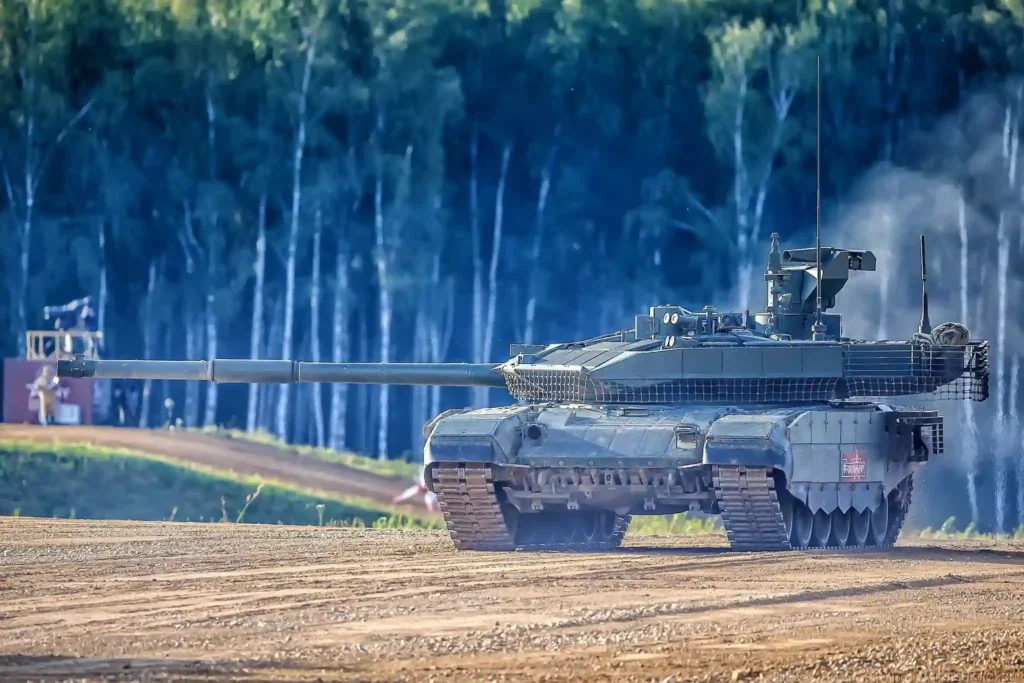
What’s especially notable is that this tank is not sitting in a parade or locked away in a prototype facility. It is being fielded in large numbers, under real combat pressure, in one of the most drone-dominated and artillery-intensive wars of the 21st century.
In that context, its relevance is difficult to ignore. Could it be that, in the end, Russia’s most dangerous tank isn’t the futuristic T-14, but the battle-hardened, production-ready Proryv-3? That’s the twist. And it’s one worth unpacking.
The original T-90 tank emerged in the early 1990s, during a turbulent period marked by the collapse of the Soviet Union. It wasn’t entirely new, but rather a refined blend of existing systems, incorporating features from the T-72 and experimental elements from the more expensive T-80.
The goal at the time seemed to be clear: to produce a capable, affordable main battle tank that could meet Russian operational needs without the high costs or logistical headaches of its more advanced cousins. By that measure, the T-90 was arguably a success. It became Russia’s most exported tank and served as the foundation for what would eventually evolve into the T-90M.
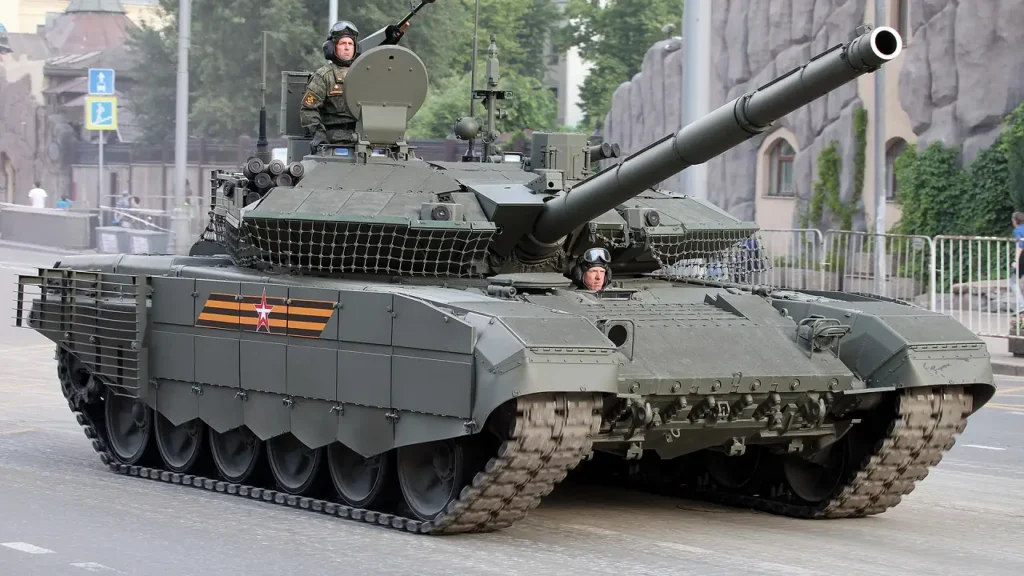
As time passed, however, the battlefield changed. Conflicts in Chechnya, Syria, and eastern Ukraine exposed serious vulnerabilities in older T-90 variants, especially against modern anti-tank guided missiles, UAVs, and Western-style combined arms tactics. These hard-earned lessons appear to have influenced the development of the T-90M Proryv-3, a deeply upgraded version that may represent a shift in how Russian armor thinks about survivability, situational awareness, and multi-domain combat.
The Proryv-3 upgrade, whose name roughly translates to “Breakthrough,” was reportedly designed with several key goals in mind.
First and foremost, improving crew survivability. This seems to have led to the inclusion of new modular reactive armor, improved internal fire suppression systems, and possibly even enhanced passive protection against tandem-charge warheads.
The second major goal was sensor and fire control modernization. The T-90M includes a panoramic sight for the commander, a modern thermal imaging system, and digital ballistic computing.
Another important aim appears to have been network integration. While not as openly discussed, the T-90M is believed to support encrypted communications and data-sharing systems, potentially giving Russian tank units better coordination in combined arms operations. This shift toward network-centric warfare might not yet rival NATO standards, but it marks a significant step up from legacy platforms.
Ultimately, the T-90M upgrades seem to reflect a balance between ambition and pragmatism. Rather than developing an entirely new tank from scratch, Russia chose to heavily modernize an existing platform that was already familiar to its crews and maintenance systems.
The result is the T-90M Proryv-3, a tank that, while not revolutionary on paper, could be far more lethal and adaptable than its predecessors, especially when deployed in large numbers under real combat conditions.
When we talk about the T-90M Proryv-3, it’s tempting to rattle off specs like a sales sheet—main gun, armor type, engine output. What really makes this tank worth paying attention to, especially in the context of today’s wars, is how these features potentially come together in real operational conditions.
The T-90M is equipped with the 125mm 2A46M-5 smoothbore gun, which on the surface sounds familiar (it’s part of the same gun family seen in earlier Russian tanks). But this version is capable of launching anti-tank guided missiles straight from the barrel. That could, at least theoretically, allow the tank to strike targets several kilometers away, beyond the reach of conventional shells.
On paper, this creates a kind of hybrid capability: traditional tank versus tank firepower combined with standoff attack potential. In practice, however, it’s still unclear how often these missile capabilities are actually used in combat, especially under the fog of war.
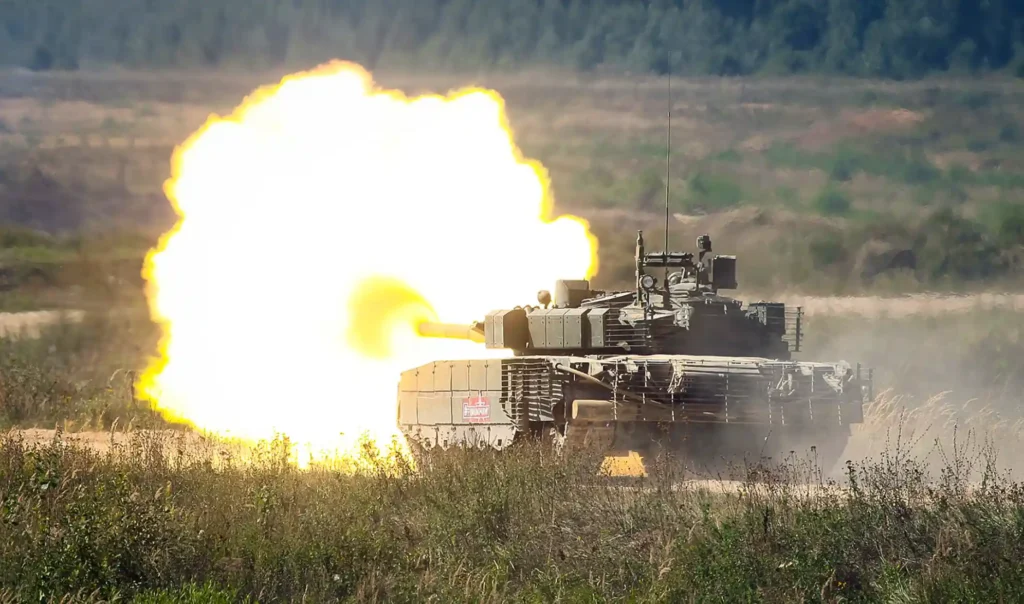
Supporting that primary weapon is a coaxial 7.62mm machine gun and a 12.7mm heavy machine gun mounted remotely. While not groundbreaking, the remote weapon station does hint at a growing Russian interest in protecting the commander during close engagements.
The T-90M features Relikt explosive reactive armor, which is a marked improvement over the older Kontakt-5. Relikt is reportedly better at defeating both kinetic energy rounds and tandem-charge warheads, offering a higher degree of survivability in modern high-threat environments.
Some sources suggest that elements of the Shtora-1 soft-kill system may also be integrated, offering potential defense against incoming guided munitions, although its effectiveness has often been questioned, particularly in conflicts like Syria and Ukraine. That said, the redesigned turret, believed to improve crew survivability by better containing ammo storage, is perhaps the more meaningful upgrade, at least in terms of real-world outcomes.
Mobility is another area where the T-90M tries to strike a balance. Its V-92S2F diesel engine produces around 1,130 horsepower, enough to push the 48-ton tank to speeds of about 60 km/h on paved roads.
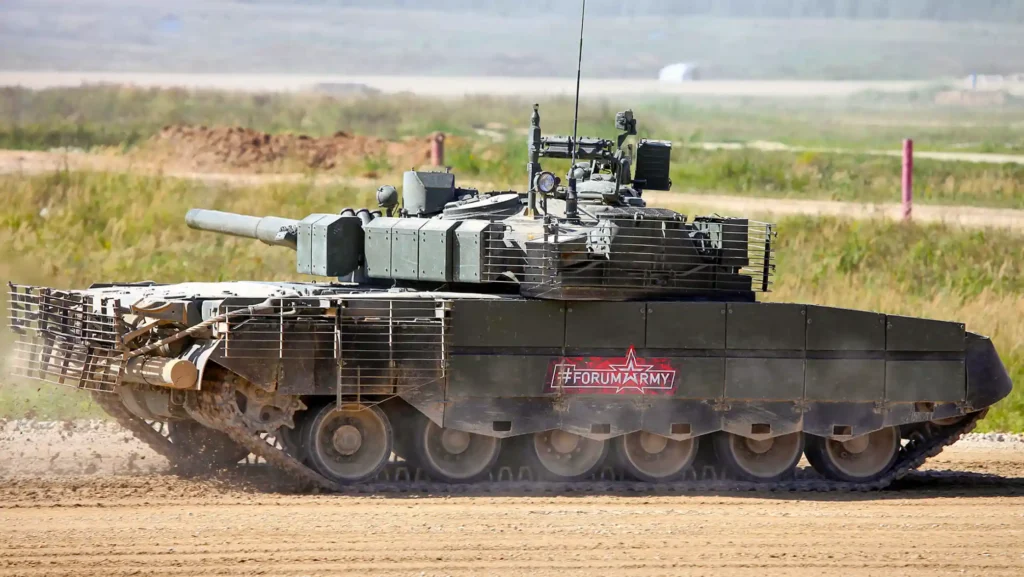
Compared to Western tanks like the M1A2 Abrams, which is significantly heavier, the T-90M’s lighter frame could offer advantages in crossing soft ground or navigating narrow infrastructure, such as bridges in rural or urbanized zones. However, that lower weight might also suggest thinner passive armor, which could leave the tank vulnerable to top-attack weapons or even advanced drone strikes, as has been seen in Ukraine.
The T-90M is said to come with a modernized fire control system—thermal imaging, laser rangefinding, and a ballistic computer are part of the package. The commander also benefits from a panoramic sight, while the gunner is equipped with advanced thermal optics.
These features, while increasingly common on Western tanks, represent a substantial leap forward for Russian designs. If functioning properly, they could allow the T-90M to detect, identify, and engage targets faster than older Russian tanks. But again, much depends on real-time conditions: dust, jamming, crew training, and maintenance all play a role in whether those systems actually deliver as promised.
The T-90M’s estimated combat weight of about 48 tons puts it in an interesting category. It’s heavy enough to carry decent armor and equipment but light enough to be transported more easily and to operate in terrain where heavier tanks might struggle.
| Category | Specification |
| Main Armament | 125mm 2A46M-5 smoothbore gun (capable of firing guided missiles) |
| Secondary Armament | 7.62mm coaxial MG, 12.7mm remote-controlled MG |
| Armor Protection | Relikt ERA, possibly Shtora-1 soft-kill system, turret redesign |
| Engine | V-92S2F diesel engine, ~1,130 hp |
| Max Speed | Approx. 60 km/h (road) |
| Fire Control System | Upgraded digital system with thermal imaging, laser rangefinder, ballistic computer |
| Targeting Optics | Panoramic sight for commander, thermal optics for gunner |
| Combat Weight | Estimated ~48 tons (T-90M Proryv-3 weight) |
What sets the T-90M Proryv-3 tank apart from earlier Russian models is the layered package of upgrades that collectively push it closer to what Western analysts might call a third-generation-plus main battle tank. While it’s difficult to claim superiority outright, especially without fully transparent testing data, several enhancements in protection, battlefield electronics, and crew safety suggest that the Proryv-3 tank is no longer just a modest upgrade of the old T-90. It could be something more refined and combat-aware.
In terms of protection, the advanced defensive systems on the T-90M are arguably one of the most substantial leaps forward. Its Relikt ERA (Explosive Reactive Armor) is said to offer better resistance against both kinetic penetrators and tandem-charge HEAT warheads than the earlier Kontakt-5.
That might not seem like a big deal on paper, but in the Ukrainian conflict, where tanks are frequently ambushed by Western-supplied Javelins and other top-attack systems, every added layer of defense could make a life-or-death difference. While it’s unclear if the Russian T-90M tank consistently includes an integrated active protection system like Afghanistan or Arena-M, some prototypes and exports have been shown with modular mounts that suggest this may be a possibility down the line.
Beyond armor, battlefield awareness appears to have received a long-overdue modernization. One of the more understated yet potentially game-changing features is the addition of a panoramic sight for the commander, allowing 360-degree surveillance and faster target acquisition.
Combined with upgraded thermal imaging and digital fire control, the T-90M upgrades seem to address a long-standing Russian armor gap in situational awareness, particularly in night operations or urban settings. It may not rival NATO’s full digital integration or data fusion, but it’s arguably a meaningful improvement over older analog systems used in previous generations.
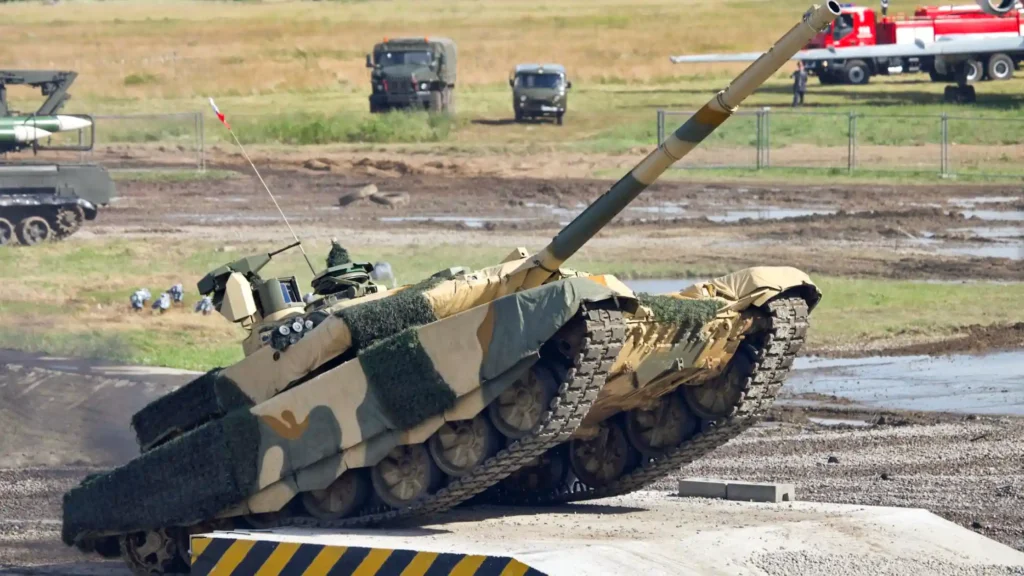
And then there’s crew survivability, an issue that has become highly visible in the ongoing war. Russian tanks have historically placed ammunition around the turret ring (a design vulnerability that’s been repeatedly exposed by catastrophic turret-blowouts in Ukraine). The T-90M Proryv-3 reportedly addresses this with a redesigned turret and improved internal layout, possibly including blow-out panels or more secure ammo stowage.
Reports suggest that the T-90M main battle tank has been actively deployed in Ukraine, particularly since the intensified phases of the conflict in 2022 and beyond. The Kremlin appears to have gradually integrated the tank into elite armored units, including those previously equipped with older T-72 and T-80 series tanks.
Some sources hint that formations like the 1st Guards Tank Army, a historically prestigious unit, have received early batches of the T-90M Proryv-3, which could imply a certain level of confidence in its advanced capabilities. Still, this doesn’t necessarily mean the tank has been fielded at scale. The production numbers, though likely increasing, seem to be relatively limited compared to Russia’s massive inventory of legacy tanks.
On the ground, the T-90M’s combat performance has been a mix of promise and vulnerability. In some accounts, the tank has withstood hits that might have crippled older models, thanks in part to its Relikt ERA and improved turret design. There have even been reports of tanks continuing to fight after taking multiple hits, suggesting a meaningful improvement in crew survivability.
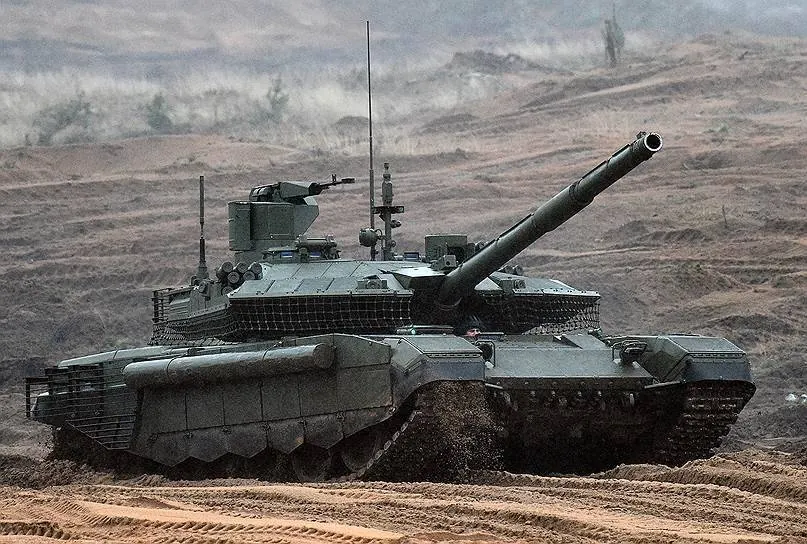
Battlefield footage also shows instances where T-90M tanks were knocked out by modern Western-supplied anti-tank weapons or loitering munitions. In a few high-profile cases, some T-90Ms were even captured intact by Ukrainian forces, which has raised questions about tactical deployment and crew training.
From a usability perspective, it’s difficult to draw definitive conclusions about user feedback from Russian crews. However, limited interviews and leaked commentary from within Russian military circles hint that the T-90M upgrades, particularly in optics, fire control, and thermal imaging, are seen as a welcome step forward. The integration of a panoramic commander sight and digital battle management system may have improved situational awareness.
Outside of Russia, the T-90M Proryv-3 tank has not yet seen widespread export. While the original T-90 family has been exported to countries like India and Algeria, and more recently ordered by nations like Egypt and possibly Vietnam, the upgraded Proryv-3 variant seems to be reserved, at least for now, for Russian use. That said, there are rumors that friendly states or clients might receive it in the future, especially if the Kremlin views the T-90M as a showcase of Russian technological strength.
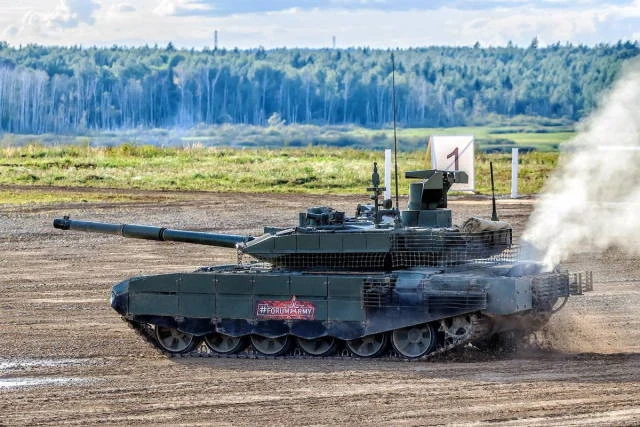
The price tag, while not officially confirmed, has been estimated to be significantly lower than Western counterparts like the Leopard 2A7 or M1A2 Abrams, which could make it attractive to budget-conscious militaries if geopolitics allow.
So, how effective is it?
On paper, it represents a significant leap over previous Russian main battle tanks, particularly the older T-72 variants and baseline T-90 models that have often struggled against modern threats. With its improved fire control system, panoramic optics, and Relikt explosive reactive armor, the T-90M seems designed to offer a more survivable and capable platform, better suited to the realities of 21st-century armored warfare. Its guided missile capability and digitally enhanced targeting systems might give it an edge in longer-range engagements, especially in mixed-terrain environments where first-shot accuracy and visibility are decisive.
However, its real-world deployment in Ukraine has shown that technological upgrades alone may not be enough. Despite its enhancements, the Russian T-90M tank has been documented as both damaged and captured, often by relatively low-cost weapons such as top-attack missiles or drone-guided munitions. This highlights a key limitation that even a modernized tank can remain vulnerable without proper combined arms support, coordinated tactics, and effective logistics.
Furthermore, Russia’s limited ability to mass-produce the Proryv-3 at scale likely means that, although it is the most advanced tank in their inventory, its impact on the wider war effort might remain relatively constrained.
In the end, the T-90M Proryv-3 is perhaps best viewed as a transitional design. It reflects an effort to modernize within the limits of existing industrial capacity and doctrinal preferences. While it is arguably the most capable Russian main battle tank in service today, its performance seems to depend as much on the conditions of its use as on the strength of its features. In the right context and in the hands of well-trained crews, it appears to be a formidable battlefield asset.