Follow Us:
Follow Us:

When you think of a modern tank, what probably comes to mind is a massive steel beast, rumbling across rough terrain, ready for battle. But in today’s world of high-tech warfare, raw firepower isn’t enough — protection is just as critical. That’s where Explosive Reactive Armor (ERA) comes in.
ERA might sound like something out of a sci-fi movie, but it’s very real and plays a crucial role in how tanks survive on the battlefield. It’s a clever bit of engineering designed not to just absorb an enemy’s attack, but to actively fight back against it — in a split second. So, what exactly is explosive reactive armor, and how does it protect some of the most powerful vehicles on Earth?
Explosive Reactive Armor (ERA) is a type of modern tank defense designed to counteract one of the deadliest threats to armored vehicles: shaped-charge warheads and high-velocity penetrators. These include weapons like rocket-propelled grenades (RPGs) and anti-tank guided missiles (ATGMs), which can punch through thick steel like a hot knife through butter. ERA works by using controlled explosions to disrupt these incoming threats before they can breach the tank’s main armor.

Think of reactive armor plates as defensive “bricks” mounted on the outside of the tank. Each brick contains a layer of explosive material sandwiched between two metal plates. When a projectile hits, the explosive layer detonates outward — not to destroy the tank itself, but to push against the incoming force, disrupting its energy and trajectory. That’s the basic concept behind how explosive reactive armor works.
The history of explosive reactive armor goes back to the 1970s, though the concept had been toyed with earlier. The idea was officially brought to life almost simultaneously by two countries: Israel and the Soviet Union.
Israel was among the first to experiment with early versions of reactive armor, especially after experiencing significant losses to anti-tank weapons during the Yom Kippur War in 1973. Around the same time, the Soviets developed their own versions of ERA tank armor, leading to the iconic Kontakt-1 ERA, which was fielded on tanks like the T-64 and later the T-72 and T-80.
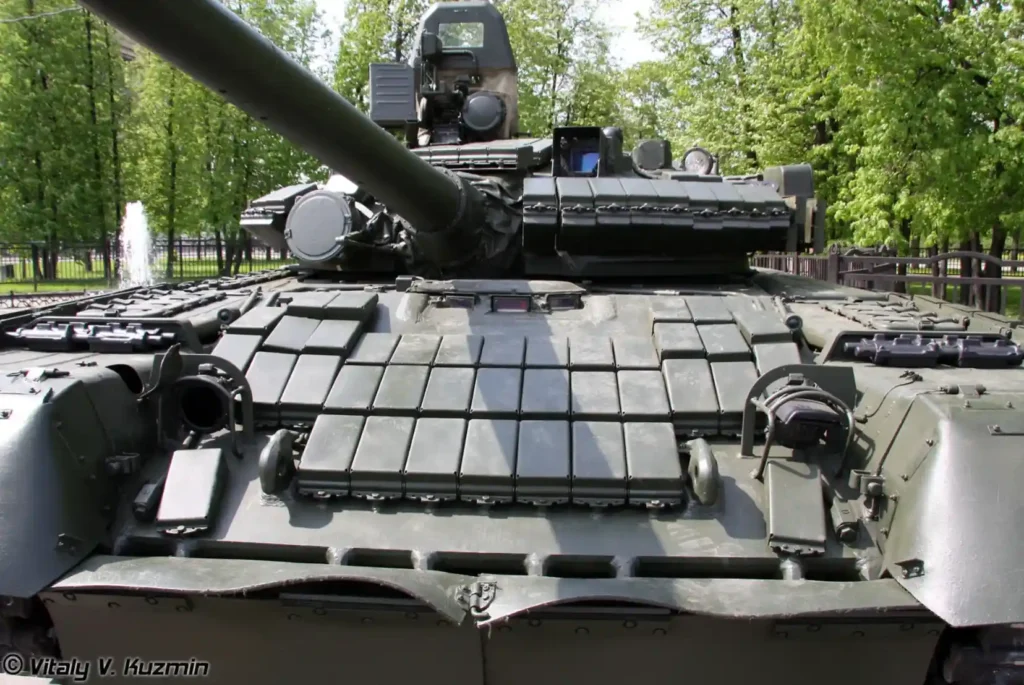
By the 1980s, the technology had matured. Both Israel and the USSR deployed it widely, and it quickly became standard on many armored fighting vehicles. Other nations followed, recognizing that traditional passive armor wasn’t enough against increasingly powerful anti-tank weapons.
Today, modern tank protection systems almost always include some form of ERA — or, in some cases, its safer cousin, NERA (Non-Explosive Reactive Armor). Countries like the U.S., France, China, and Germany have all integrated or tested ERA systems on their main battle tanks.
At its core, ERA tank armor is all about timing and redirection. Each reactive armor plate consists of a sandwich-like setup: two outer metal plates with a layer of explosive material in between. These plates are mounted on the outside of a tank — usually in key vulnerable spots like the turret or hull sides.
When a shaped charge — like a HEAT (High-Explosive Anti-Tank) round — hits the armor, it creates a focused jet of molten metal designed to burn through solid steel. The moment that jet makes contact with the ERA plate, the explosive layer detonates.
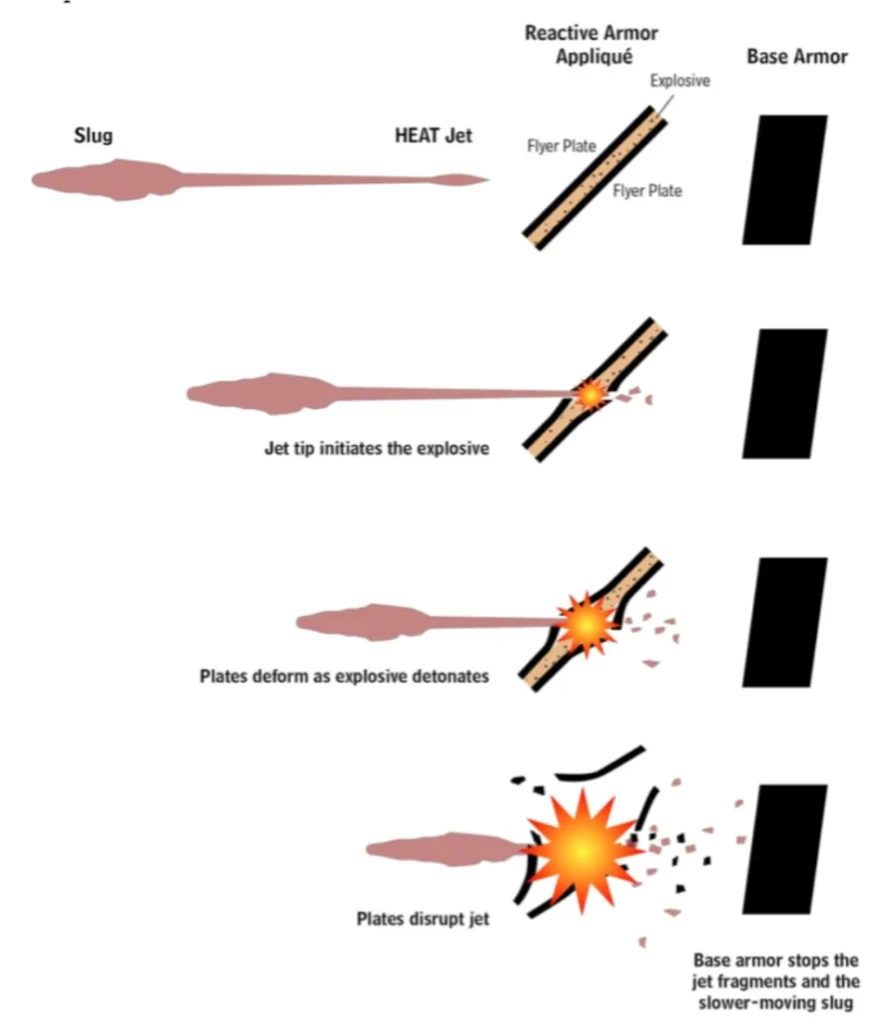
What makes it so effective is that the explosion pushes outward, not inward. It pushes the two steel plates in opposite directions — one outward, one inward — right into the path of the incoming jet. This moving barrier disrupts and diffuses the energy of the HEAT round, breaking up the molten jet before it can reach the tank’s main armor underneath. It’s like trying to stab through a door, only to have that door suddenly shove back at you with tremendous force.
This split-second reaction is incredibly effective against shaped charges. That’s why ERA was such a game-changer on the battlefield — it provided an active layer of protection instead of just passively absorbing damage. It turned the tables on weapons that were designed to defeat tanks outright.
In many real-world conflicts — from the Middle East to Eastern Europe — ERA protection has proven its worth by keeping tanks in the fight longer, even after direct hits.
But It’s Not a Silver Bullet,
That said, explosive reactive armor isn’t perfect. One of its biggest limitations comes when facing kinetic energy penetrators — like the long, dart-shaped projectiles fired from modern tank cannons (think armor-piercing fin-stabilized discarding sabot, or APFSDS rounds).
These penetrators don’t rely on a focused jet, but rather on sheer speed and mass to punch through armor. Because of that, ERA’s explosive reaction has much less impact. The metal plates may still move and interfere slightly, but they’re not fast or forceful enough to significantly disrupt a solid kinetic rod traveling at several times the speed of sound.
That’s why some tanks now combine ERA with other forms of protection, like composite armor or even non-explosive reactive armor (NERA), to deal with a wider range of threats. In fact, the whole ERA vs composite armor debate often comes down to trade-offs: ERA is better against HEAT, while composite armor offers broader, more consistent protection.
After all, ERA is just one part of a much bigger puzzle when it comes to keeping tanks alive on today’s high-tech battlefield. Let’s break it down by looking at how ERA compares to two major technologies: composite armor and active protection systems (APS).
Composite armor is the standard armor found on most modern main battle tanks — including the U.S. M1 Abrams, the British Challenger 2, and others. It typically consists of layered materials like ceramics, metals, and sometimes even plastics or synthetic fibers. The idea is to absorb and disperse energy from incoming rounds without using any explosives.

So how does ERA vs composite armor compare?
The two aren’t really in competition — in fact, they’re often used together. Many tanks mount reactive armor plates over a base layer of composite armor, giving them a multi-layered defense system. If the ERA defeats the first threat, the composite armor can handle anything that slips through.
While ERA physically reacts to a hit, active protection systems (APS) aim to stop a threat before it even touches the tank. APS includes radar, sensors, and interceptor devices (like mini-missiles or projectiles) that detect incoming rounds and shoot them down mid-air.
So, in the ERA vs APS comparison:

Each has its strengths and weaknesses. APS can potentially stop multiple threats in rapid succession, but it’s more vulnerable to saturation attacks (where multiple missiles are fired at once). ERA, while simpler and more rugged, is “one-shot” — once a tile explodes, that spot becomes vulnerable until replaced.
So, rather than choosing between them, modern tanks increasingly combine ERA, composite armor, and APS to cover as many scenarios as possible. For example, Israel’s Merkava tanks use ERA protection along with APS like Trophy, and Western tanks like the Abrams are being upgraded with similar layered systems.
In other words, it’s not just reactive armor vs composite armor or ERA vs APS — they’re part of a layered defense strategy that keeps tanks survivable in the most dangerous combat environments.
Explosive Reactive Armor (ERA) has evolved significantly since it was first introduced. Initially developed to protect tanks from shaped-charge weapons like RPGs and HEAT rounds, ERA has advanced over the decades to counter a broader range of threats — including kinetic energy penetrators like APFSDS rounds. Several countries, most notably Russia and Israel, have led the way in developing distinct ERA systems.
Introduced by the Soviet Union in the 1980s, Kontakt-5 was one of the first ERA tank armor systems to go beyond just stopping shaped charges. Traditional ERA tiles were highly effective against HEAT warheads but offered little protection against long-rod penetrators fired from other tanks.
Kontakt-5 changed that. It featured larger, more robust explosive tiles with a more aggressive plate motion upon detonation. When a kinetic energy penetrator — like an APFSDS round — struck the ERA panel, the explosion forced the metal plates to move sideways rapidly, disrupting the projectile’s path and reducing its penetrative ability. While it didn’t stop kinetic penetrators entirely, it could significantly degrade their effectiveness.
Tanks such as the T-80U, T-72B, and later models of the T-90 were equipped with Kontakt-5, giving Soviet and later Russian armored units a major survivability boost against NATO tank firepower.
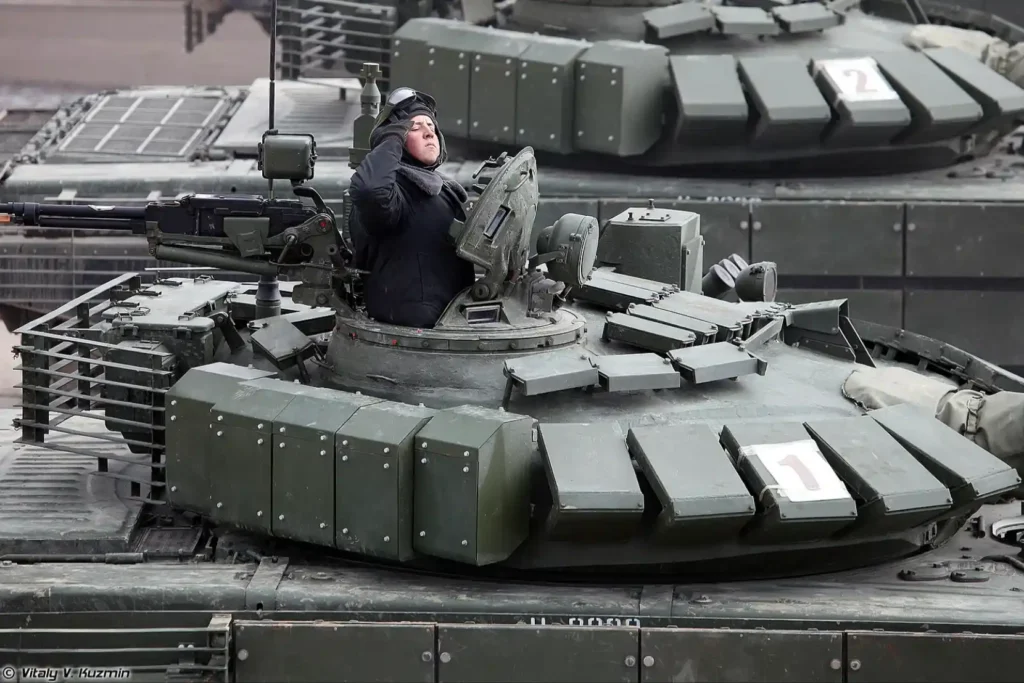
Russia later improved upon Kontakt-5 with Relikt, an advanced ERA system that first appeared in the 2010s. Relikt offers better protection not just against tandem-charge HEAT warheads — which are designed to defeat ERA by using a small first charge to trigger the reactive plate, followed by a larger main charge — but also against newer, more advanced kinetic energy rounds.
Relikt works faster and more efficiently than Kontakt-5. It uses an updated explosive compound and improved plate designs that react quickly enough to interfere with both stages of tandem warheads and with the high-speed impact of kinetic rounds. This system is now fitted on modernized Russian tanks like the T-72B3M, T-80BVM, and certain versions of the T-90M.
Relikt represents Russia’s effort to keep pace with Western advances in anti-tank munitions while continuing to rely on explosive armor as a critical layer of defense.
While the Soviets were refining Kontakt-5, Israel was busy developing the world’s first operational ERA protection system: Blazer. Introduced in the late 1970s, Blazer was fielded during the 1982 Lebanon War, where Israeli tanks faced a high volume of RPG attacks from urban and mountainous terrain.
Blazer consisted of small, modular explosive tiles mounted on the tank’s exterior — particularly around the turret and sides — specifically designed to counter HEAT threats. It was highly effective at defeating RPGs and early-generation anti-tank missiles, and it saved many vehicles and crews in combat.
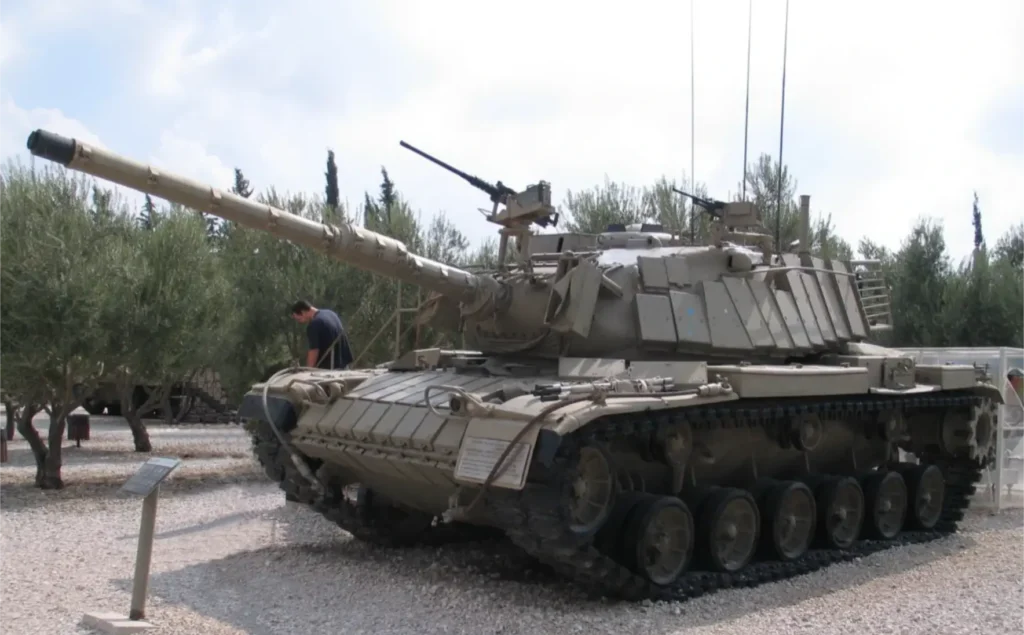
However, Blazer was not effective against kinetic penetrators, nor was it designed to be. It was a first-generation system aimed at solving a specific problem: the massive vulnerability of tanks to man-portable HEAT weapons.
Since then, Israel has developed newer generations of reactive and non-explosive reactive armor (NERA), and integrated these with systems like composite armor and active protection systems (like Trophy) to create a comprehensive, layered defense.
Like any armor technology, ERA comes with both strengths and trade-offs. But is ERA worth it?
One of the biggest reasons ERA became so widely adopted is its high protection-to-weight ratio. In other words, it offers strong defensive capability without adding massive bulk to a vehicle. That’s a big deal, because tanks are already extremely heavy, and traditional composite armor—though effective—adds a lot of weight and cost. ERA, by contrast, provides significant additional protection without overburdening the tank’s mobility or requiring a complete redesign.
ERA is also highly effective against shaped-charge weapons, like RPGs and HEAT (High-Explosive Anti-Tank) rounds, which are common threats on modern battlefields. These warheads focus explosive energy into a narrow jet to burn through armor—but when they hit an ERA tile, the explosion from the tile disrupts the jet and reduces or even neutralizes the damage. This makes ERA a critical layer of defense, especially in urban or asymmetric warfare where shoulder-fired weapons are prevalent.
Another major plus is modularity. ERA tiles can often be mounted onto existing tanks without needing to overhaul the entire armor package. This makes it a cost-effective upgrade for older platforms, allowing them to stay relevant against modern threats.
However, ERA isn’t perfect—and in some cases, it can even introduce new problems. One of the most well-known disadvantages of explosive reactive armor is its risk to nearby infantry. Because ERA works by detonating, it can pose a serious danger to soldiers operating close to the tank. The blast, shrapnel, and flying debris from an exploding tile can injure or kill dismounted troops nearby, making it less suitable in tightly coordinated infantry-tank operations.
Another issue is limited reusability. Once an ERA tile has detonated, that section of the tank is left exposed until it’s repaired or replaced. In fast-paced combat, there may not be time or resources to do this, potentially leaving the vehicle vulnerable to follow-up attacks.
Also, while ERA is excellent against shaped charges, it’s less effective against kinetic energy penetrators—long-rod projectiles like APFSDS rounds fired from other tanks. More advanced ERA types like Kontakt-5 and Relikt have made strides in this area, but even those systems only reduce the effectiveness of kinetic threats; they don’t fully neutralize them.
Finally, it’s worth noting that ERA can be rendered less effective by tandem warheads—missiles that use a small initial charge to trigger the ERA, followed by a main charge designed to hit the now-exposed spot. Newer reactive armor systems are built to deal with this, but older or basic ERA tiles may not stand a chance.
So, is Explosive Reactive Armor still worth it today? The short answer is yes — but with some important context. ERA isn’t a one-size-fits-all solution, and it’s not meant to be. When it first appeared, it was a breakthrough that gave tanks a fighting chance against the growing threat of handheld anti-tank weapons like RPGs and HEAT rounds. And in that role, it still shines.
Even now, in the age of drones, precision missiles, and smart munitions, shaped-charge threats are everywhere — from guerrilla ambushes to advanced anti-tank guided missiles. ERA remains one of the most effective ways to counter those, especially in urban or asymmetric warfare where tanks face attacks from all directions.
That said, modern warfare demands layers. ERA is no longer the only armor game in town — it works best alongside composite armor, active protection systems, and even non-explosive reactive armor (NERA). Think of it as one part of a broader defense system: not perfect on its own, but incredibly valuable when used right.
So yes, ERA is still relevant. It’s been adapted, improved, and reimagined to keep up with new threats — and as long as shaped-charge weapons remain a danger on the battlefield, ERA will continue to earn its place on the front lines.