Follow Us:
Follow Us:

What does the biggest submarine in the world actually look like? Picture an underwater vessel stretching nearly 175 meters (574 feet) long, longer than one and a half football fields, and displacing almost 48,000 tons beneath the waves. These aren’t just oversized warships.
They’re floating cities designed to remain hidden underwater for months while carrying some of the most powerful weapons ever deployed at sea.
Building the largest submarines ever built wasn’t simply about making them bigger. Every extra meter of hull created room for more ballistic missiles, larger nuclear reactors, greater food supplies, and better living conditions for crews expected to spend months without seeing daylight.
During the Cold War, submarine size became a strategic advantage, allowing naval powers to patrol farther, stay submerged longer, and maintain a credible nuclear deterrent across the globe.
In this post, we’ll rank the top 5 biggest submarines in the world ever built using submerged displacement, the international standard for measuring a submarine’s true size while underwater.
Along the way, you’ll discover how these underwater giants compare in length, weight, propulsion systems, missile capacity, and operational roles. Some remain active today, quietly patrolling the world’s oceans, while others have earned legendary status as engineering marvels that pushed the limits of naval design.
You’ll also see why modern submarines aren’t necessarily getting larger. Advances in stealth technology, sonar, and missile systems mean today’s most capable submarines often rely on sophistication rather than sheer size.
Even so, the giants on this list remain unmatched in scale and continue to represent some of the most ambitious military engineering projects ever undertaken beneath the sea.
Before comparing the world’s largest submarines, it’s important to understand one thing: size isn’t measured by length alone.
A submarine can be longer than another vessel yet still rank lower if it displaces less water. That’s why naval analysts almost always use submerged displacement as the primary benchmark when determining the biggest submarine ever built.
Submerged displacement refers to the total weight of a submarine when it’s fully submerged, including its crew, fuel, weapons, ballast water, and onboard supplies.
In simple terms, the heavier the submarine is underwater, the more water it pushes aside. This measurement provides the most accurate representation of a submarine’s true operational size because it reflects the vessel in its combat-ready state.
Length, beam (width), and draft are still important. A longer hull can accommodate additional missile tubes, while a wider beam creates space for larger reactors, sonar equipment, and crew quarters.
But these dimensions don’t always tell the whole story. Two submarines of similar length may differ by thousands of tons depending on their internal layout and mission.
It’s also worth remembering that bigger doesn’t automatically mean better. Modern submarine warfare rewards stealth above almost everything else.
A smaller, quieter submarine with advanced sonar and low acoustic signatures can be more difficult to detect than a much larger vessel. That’s one reason many recent submarine designs focus on improved sensors, quieter propulsion systems, and more efficient hull shapes rather than simply increasing size.
For this ranking, the submarines are ordered by submerged displacement, with supporting comparisons that include length, beam, propulsion, crew size, and strategic role.
This approach offers the clearest picture of how these underwater giants compare in both physical scale and real-world capability.
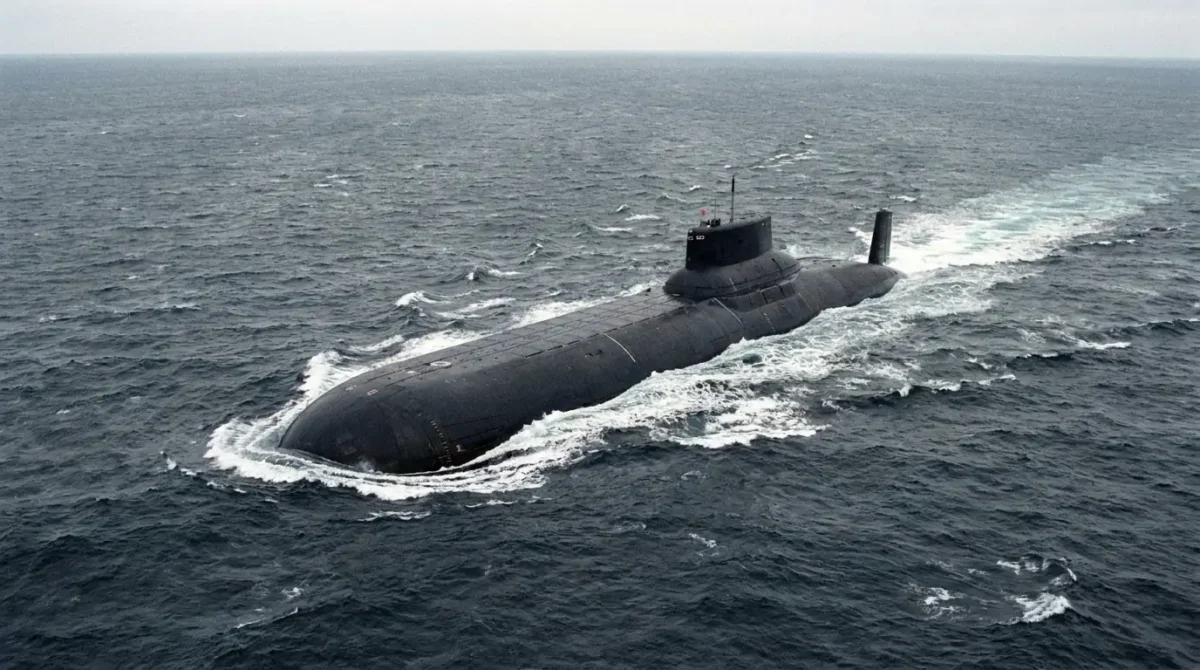
No submarine has ever surpassed the Typhoon-class in sheer size. Developed by the Soviet Union at the height of the Cold War, this colossal ballistic missile submarine (SSBN) was designed to ensure a survivable nuclear deterrent against the United States. When the first boat entered service in 1981, it instantly became the biggest submarine ever built, a title it still holds today.

At 175 meters (574 feet) long and displacing approximately 48,000 tons when submerged, the Typhoon-class dwarfs nearly every other submarine in history. Its massive beam of 23 meters (75 feet) came from an unconventional twin-pressure-hull design, essentially placing two main hulls side by side inside a single outer hull.
This unique layout increased buoyancy, improved survivability, and created enough internal space for crew amenities rarely found aboard military submarines, including a gym, sauna, and even a small swimming pool.
Powered by two OK-650 nuclear reactors, the Typhoon could remain submerged for months, limited primarily by food supplies rather than fuel. Its primary weapon was the RSM-52 (SS-N-20 Sturgeon) submarine-launched ballistic missile, with each submarine carrying up to 20 missiles, each capable of delivering multiple nuclear warheads across intercontinental distances.
| Specification | Typhoon-Class |
| Country | Soviet Union/Russia |
| Length | 175 m (574 ft) |
| Beam | 23 m (75 ft) |
| Submerged Displacement | ~48,000 tons |
| Propulsion | 2 × Nuclear Reactors |
| Crew | About 160 |
| Primary Role | Ballistic Missile Submarine (SSBN) |
Although six Typhoon-class submarines were built, most have since been retired.
Today, the class remains a symbol of Cold War engineering, an era when naval power was measured not only by stealth and firepower, but also by the ability to build machines on a truly extraordinary scale. Even four decades later, no operational submarine has managed to eclipse its record-breaking dimensions.
While the Typhoon-class was built to dominate through sheer size, the Borei-class reflects a different philosophy. Introduced by Russia in the early 21st century, it combines a powerful nuclear deterrent with quieter operation, improved automation, and lower operating costs.
Although it’s only about half the displacement of the Typhoon, the Borei is now the backbone of Russia’s sea-based nuclear force and ranks among the largest submarines ever built.
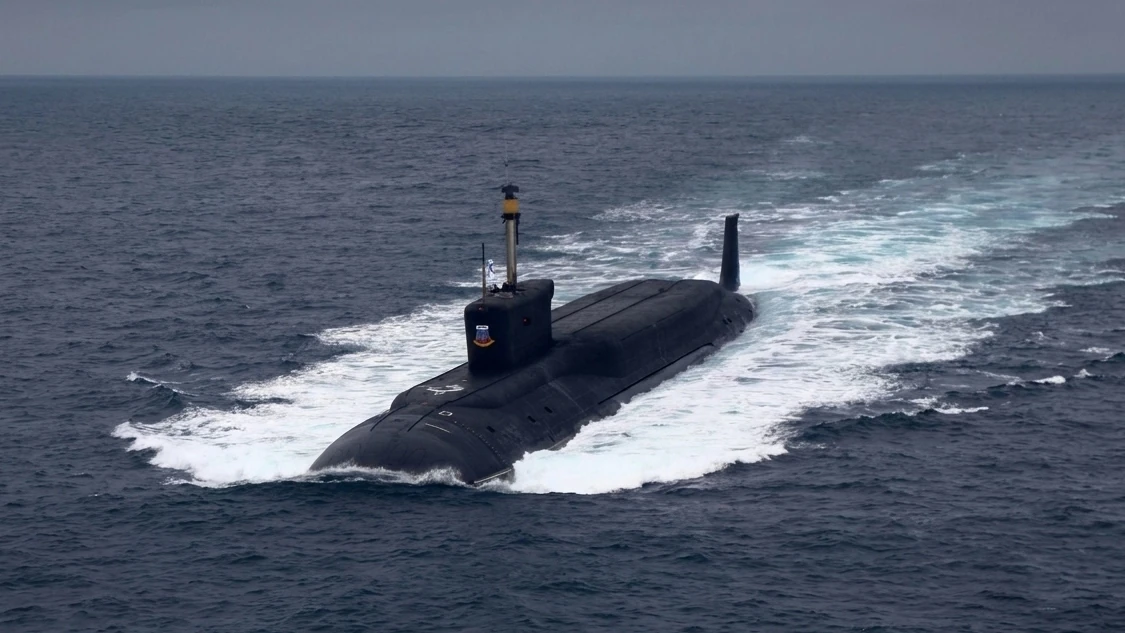
Measuring 170 meters (558 feet) in length with a submerged displacement of around 24,000 tons, the Borei-class is slightly shorter than the U.S. Ohio-class but considerably heavier underwater. Its streamlined hull and advanced acoustic technologies make it far quieter than many Soviet-era submarines, reducing the likelihood of detection during long strategic patrols.
The submarine is powered by a single OK-650V pressurized-water nuclear reactor, allowing virtually unlimited range and endurance. Its primary armament consists of 16 RSM-56 Bulava submarine-launched ballistic missiles (SLBMs), each capable of carrying multiple independently targetable nuclear warheads (MIRVs).
Combined with modern sonar, electronic warfare systems, and reduced crew requirements, the Borei-class represents a significant leap forward in Russian submarine design.
| Specification | Borei-Class |
| Country | Russia |
| Length | 170 m (558 ft) |
| Beam | 13.5 m (44 ft) |
| Submerged Displacement | ~24,000 tons |
| Propulsion | 1 × Nuclear Reactor |
| Crew | About 107 |
| Primary Role | Ballistic Missile Submarine (SSBN) |
Unlike the Typhoon-class, which is largely a relic of the Cold War, the Borei-class is very much an active platform. New Project 955A (Borei-A) variants continue to enter service, featuring improved stealth, upgraded sensors, and quieter propulsion.
Rather than chasing records for size, Russia has focused on building the biggest submarine that balances survivability, firepower, and modern technology, qualities that make the Borei one of the world’s most capable strategic submarines today.
For more than four decades, the Ohio-class has been the cornerstone of the United States’ nuclear deterrent at sea.
Although it was introduced in the early 1980s, it remains one of the most capable and recognizable submarine classes ever built. Combining impressive size with exceptional endurance and reliability, the Ohio-class ranks among the biggest submarines still serving today.
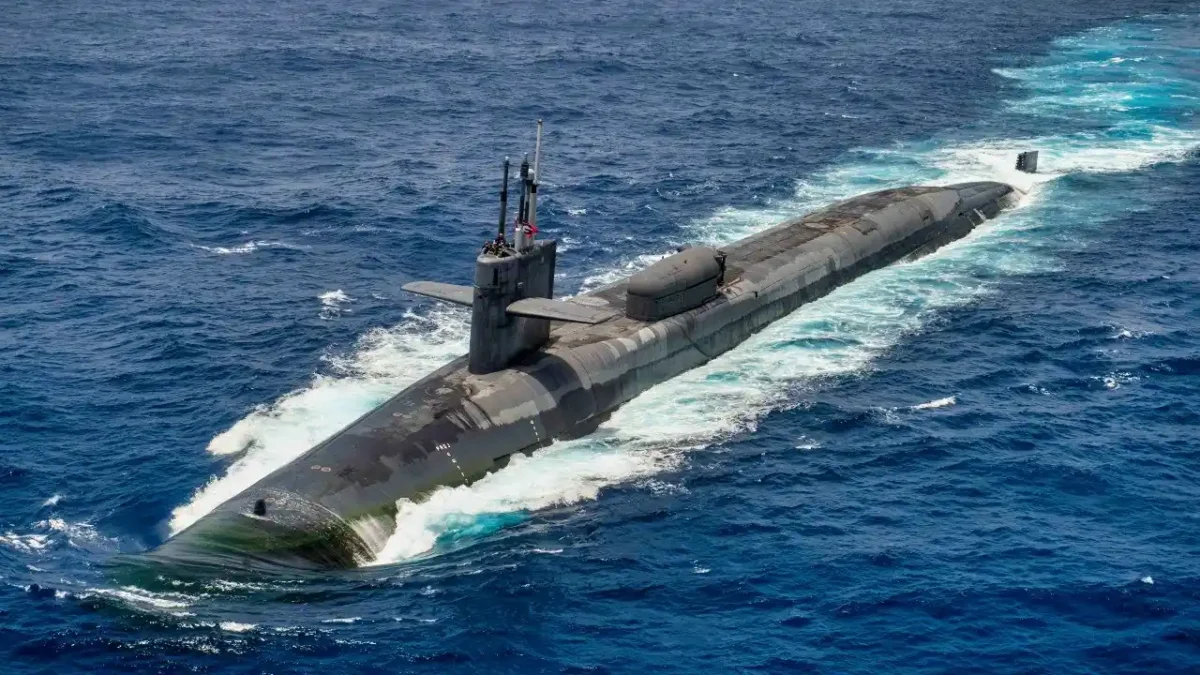
The submarine measures 170.7 meters (560 feet) long and has a submerged displacement of approximately 18,750 tons. Powered by a single S8G pressurized-water nuclear reactor, it can remain submerged for months without refueling, allowing it to patrol vast areas of the Atlantic and Pacific Oceans in near silence.
The original Ohio-class SSBNs were built to carry 24 Trident II D5 submarine-launched ballistic missiles (SLBMs), giving them one of the world’s most formidable second-strike nuclear capabilities.
Four submarines were later converted into guided missile submarines (SSGNs), replacing ballistic missiles with up to 154 Tomahawk land-attack cruise missiles while also supporting special operations forces. This transformation turned the Ohio-class into one of the most versatile submarine platforms ever developed.
| Specification | Ohio-Class |
| Country | United States |
| Length | 170.7 m (560 ft) |
| Beam | 12.8 m (42 ft) |
| Submerged Displacement | ~18,750 tons |
| Propulsion | 1 × S8G Nuclear Reactor |
| Crew | About 155 |
| Primary Role | SSBN / SSGN |
One reason the Ohio-class has remained operational for so long is its adaptability. Continuous upgrades to sonar, navigation systems, and weapons have kept the fleet relevant despite rapid advances in submarine technology.
As the U.S. Navy gradually transitions to the Columbia-class, the Ohio-class continues to patrol the world’s oceans, proving that a well-designed submarine can remain strategically valuable for decades. Its blend of size, stealth, and firepower has made it one of the most successful submarine classes in modern naval history.
Unlike the submarines ranked above it, the Oscar II-class wasn’t built to launch nuclear missiles at distant targets. Instead, its mission was far more specialized and equally intimidating.
Designed during the Cold War, this massive cruise missile submarine was created to hunt and destroy U.S. aircraft carrier strike groups, making it one of the most heavily armed attack submarines ever constructed.
At 154 meters (505 feet) long with a submerged displacement of around 18,300–19,400 tons (some estimates are slightly higher), the Oscar II-class is among the largest submarines ever built.
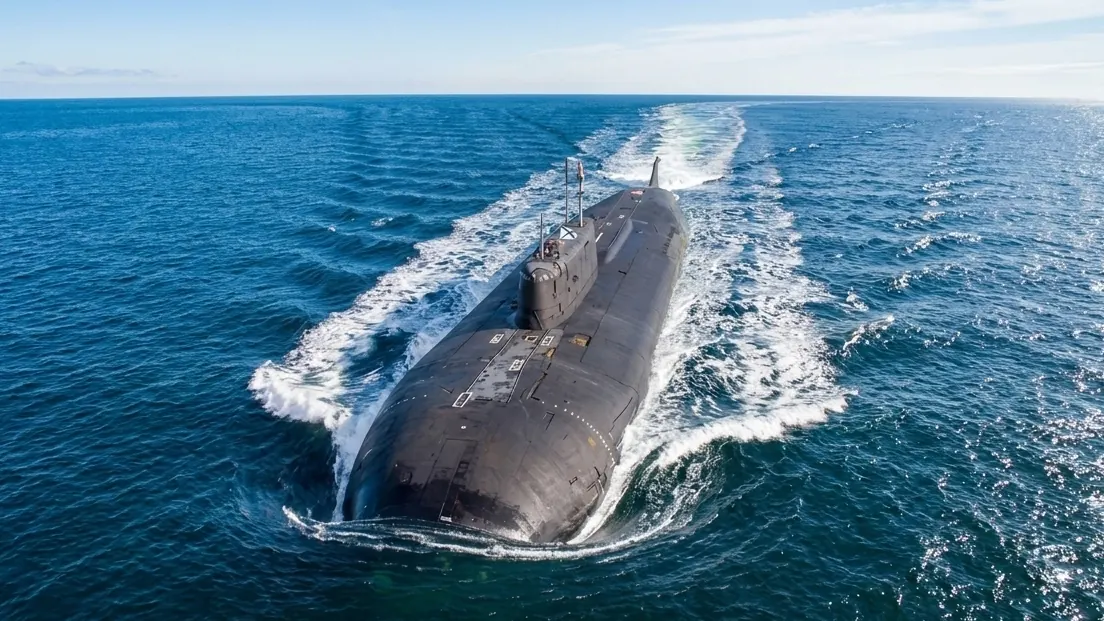
Its double-hull construction provides excellent survivability while housing an enormous arsenal of anti-ship weapons. Power comes from two OK-650 nuclear reactors, enabling long-range deployments and sustained underwater operations.
The submarine’s signature weapon is its battery of 24 P-700 Granit (SS-N-19 Shipwreck) supersonic anti-ship cruise missiles. Designed to overwhelm naval defenses through coordinated attacks, these missiles gave the Oscar II-class the firepower to threaten even the most heavily defended carrier groups.
Several boats are now being modernized to carry newer P-800 Oniks and 3M-54 Kalibr cruise missiles, significantly expanding their strike capabilities against both naval and land targets.
| Specification | Oscar II-Class |
| Country | Soviet Union/Russia |
| Length | 154 m (505 ft) |
| Beam | 18.2 m (60 ft) |
| Submerged Displacement | ~18,300–19,400 tons* |
| Propulsion | 2 × Nuclear Reactors |
| Crew | About 107–130 |
| Primary Role | Guided Missile Submarine (SSGN) |
The Oscar II-class is also remembered for the tragic loss of K-141 Kursk in 2000, an accident that drew worldwide attention and highlighted the risks faced by submarine crews even outside combat.
Despite that tragedy, several Oscar II submarines remain in Russian service today. Their combination of size, endurance, and heavy missile armament ensures they continue to play an important role in Russia’s naval strategy.
The Vanguard-class may be the smallest submarine on this list, but don’t let its ranking fool you. It remains the largest submarine ever operated by the United Kingdom and serves as the sole platform for the country’s continuous at-sea nuclear deterrent.
Since the early 1990s, at least one Vanguard-class submarine has been on patrol at virtually all times, ensuring the UK maintains a credible second-strike capability.
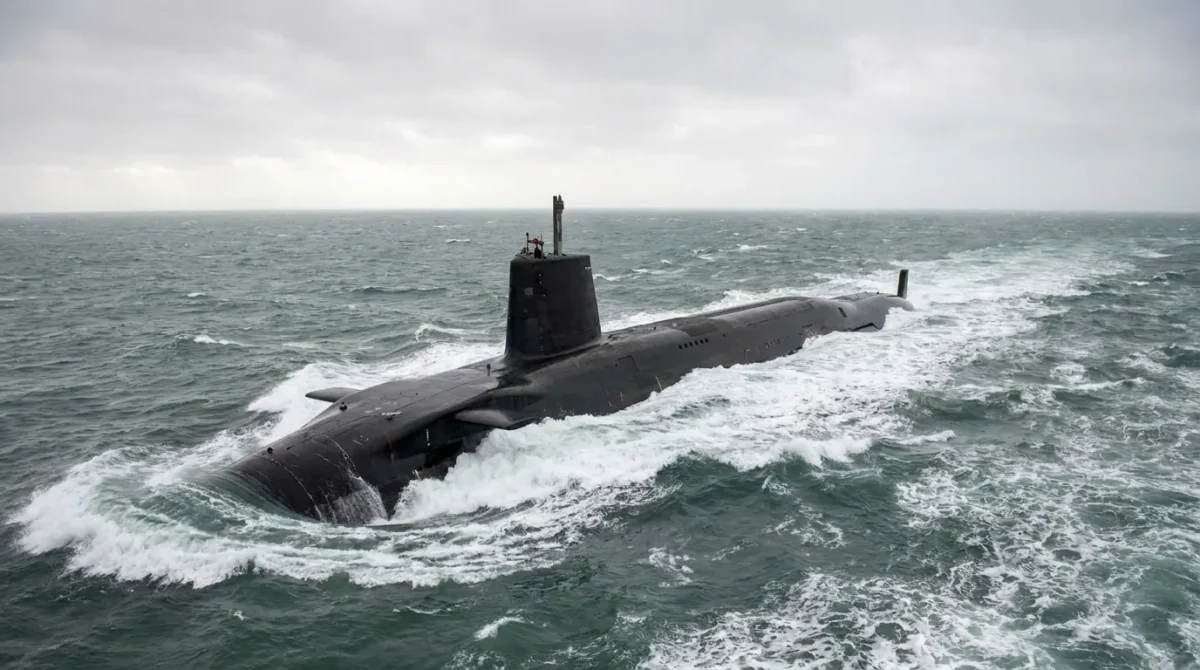
Each submarine measures 149.9 meters (492 feet) in length and has a submerged displacement of approximately 15,900 tons.
Powered by a Rolls-Royce PWR2 nuclear reactor, the Vanguard-class can remain underwater for months, with patrol duration limited mainly by crew endurance and food supplies rather than fuel. Quiet operation and long-range endurance are central to its mission, allowing the submarine to operate undetected across vast ocean areas.
The Vanguard-class carries up to 16 Trident II D5 submarine-launched ballistic missiles (SLBMs), the same missile system used by the U.S. Navy’s Ohio-class.
Although the number of deployed missiles and warheads varies according to UK defense policy, the class remains one of the most capable strategic nuclear platforms in Europe.
| Specification | Vanguard-Class |
| Country | United Kingdom |
| Length | 149.9 m (492 ft) |
| Beam | 12.8 m (42 ft) |
| Submerged Displacement | ~15,900 tons |
| Propulsion | 1 × Rolls-Royce PWR2 Nuclear Reactor |
| Crew | About 135 |
| Primary Role | Ballistic Missile Submarine (SSBN) |
After more than three decades of service, the Vanguard-class is gradually approaching retirement. It will eventually be replaced by the Dreadnought-class, which is currently under construction and expected to provide the UK’s nuclear deterrent well into the second half of the 21st century.
While it may not rival the biggest submarines built by Russia or the United States in terms of displacement, the Vanguard-class has earned a reputation for reliability, stealth, and strategic importance, qualities that matter far more than raw size in modern submarine operations.
Looking at individual submarine classes is useful, but placing them side by side makes the differences much easier to appreciate.
The table below compares the biggest submarines in the world using key specifications, including length, submerged displacement, propulsion, crew size, and primary mission.
| Rank | Submarine Class | Country | Length | Submerged Displacement | Crew | Primary Role |
| 1 | Typhoon-class (Project 941) | Soviet Union/Russia | 175 m (574 ft) | ~48,000 tons | ~160 | SSBN |
| 2 | Borei-class (Project 955/955A) | Russia | 170 m (558 ft) | ~24,000 tons | ~107 | SSBN |
| 3 | Ohio-class | United States | 170.7 m (560 ft) | ~18,750 tons | ~155 | SSBN / SSGN |
| 4 | Oscar II-class (Project 949A) | Soviet Union/Russia | 154 m (505 ft) | ~18,300–19,400 tons | ~107–130 | SSGN |
| 5 | Vanguard-class | United Kingdom | 149.9 m (492 ft) | ~15,900 tons | ~135 | SSBN |
Several interesting trends emerge from this comparison.
The Typhoon-class remains in a league of its own, with a submerged displacement nearly twice that of the Borei-class, despite only being about five meters longer. That difference highlights how beam, internal volume, and hull configuration can dramatically affect a submarine’s overall size.
The table also reveals how submarine design priorities have evolved. Cold War vessels such as the Typhoon and Oscar II emphasized maximum payload and survivability, resulting in exceptionally large hulls.
In contrast, newer designs like the Borei-class achieve similar strategic objectives with more compact layouts, quieter propulsion systems, and improved automation.
Ultimately, the largest submarine isn’t always the most advanced. Modern navies increasingly value stealth, sensor performance, and operational flexibility over sheer displacement.
Even so, every submarine on this list remains a remarkable engineering achievement, demonstrating just how far underwater naval technology has progressed over the past half-century.