Follow Us:
Follow Us:

There’s something almost mythical about speed in military aviation. Long before stealth coatings and artificial intelligence became the buzzwords of modern air combat, engineers chased one goal with relentless determination: make the next fighter fly faster than anything that came before it.
For decades, breaking another Mach barrier wasn’t just an engineering milestone, it was a statement of national power.
The fastest US fighter jet wasn’t designed simply to impress spectators at airshows. These aircraft were built to intercept enemy bombers before they reached American skies, outrun hostile missiles, and seize control of the air in the opening moments of a conflict.
During the Cold War, every fraction of a Mach mattered. A fighter capable of flying just a little faster could mean the difference between catching an incoming threat or watching it disappear over the horizon.
Interestingly, raw speed is no longer the ultimate measure of a fighter’s effectiveness.
Today’s aircraft often fly slower than some of their Cold War predecessors, yet they dominate the battlefield through stealth, advanced sensors, and networked warfare.
That shift makes the history of America’s fastest fighters even more fascinating, they represent a period when aerodynamic innovation, engine technology, and pilot endurance were pushed to extraordinary limits.
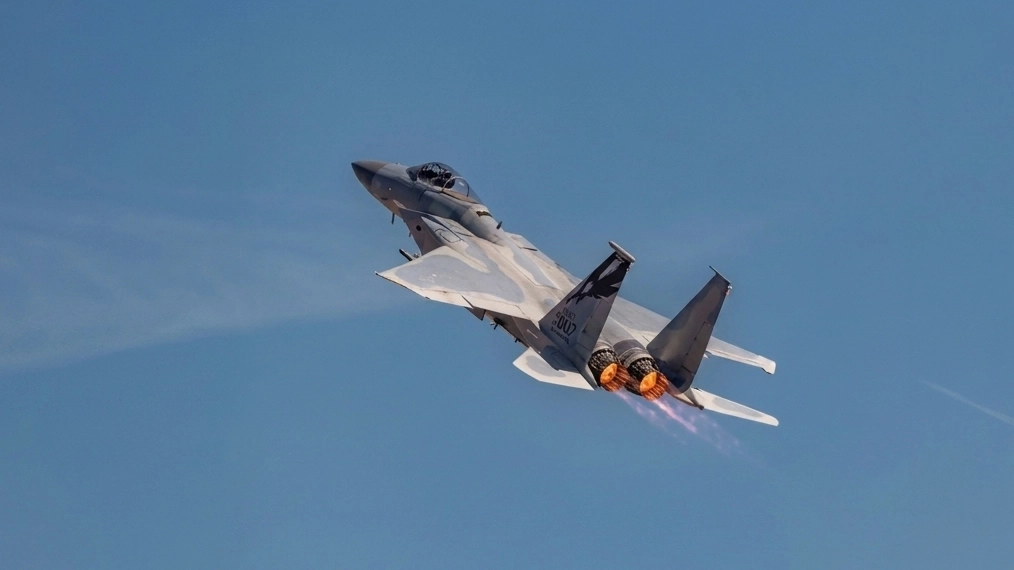
In this post, we’ll rank the top five fastest American fighter aircraft ever built based on their officially published maximum speeds.
Along the way, you’ll discover why each aircraft was designed, the engineering breakthroughs that made such remarkable performance possible, and why some of these legendary jets remain benchmarks in aerospace history decades after their first flight.
If you’ve ever searched for the fastest US fighter jet, you’ve probably noticed something odd. One article puts the SR-71 Blackbird at the top. Another includes the XB-70 Valkyrie.
Some even rank experimental X-planes alongside operational fighters. While those aircraft are undeniably fast, comparing them to fighter jets is a bit like comparing a Formula 1 car to a high-speed train, they’re built for completely different jobs.
To keep this ranking accurate and useful, we followed a clear set of criteria rather than simply listing the highest speed numbers.
First, every aircraft on this list was designed primarily as a fighter, interceptor, or air-superiority aircraft. Multirole fighters and fleet-defense fighters qualify because air combat remained one of their core missions. Aircraft built exclusively for reconnaissance, strategic bombing, or experimental research do not.
Second, we used each aircraft’s officially published maximum speed under ideal operating conditions. These figures typically represent performance at high altitude with afterburners engaged, where jet engines produce maximum thrust.
It’s worth remembering that real-world combat missions rarely involve flying at top speed for long periods. Fuel consumption rises dramatically, engine temperatures increase, and sustained supersonic flight places enormous stress on the airframe.
By using these standards, the ranking reflects the fastest American fighter aircraft that actually served in military roles, not aircraft that achieved extraordinary speeds in entirely different missions.
The result is a fair comparison that highlights genuine engineering achievements while giving each jet the historical context it deserves.
If there is one aircraft that perfectly embodies the phrase “speed with purpose,” it’s the F-15 Eagle. More than five decades after its first flight, it remains one of the fastest US fighter jets ever built, and, remarkably, it continues to serve on the front lines.
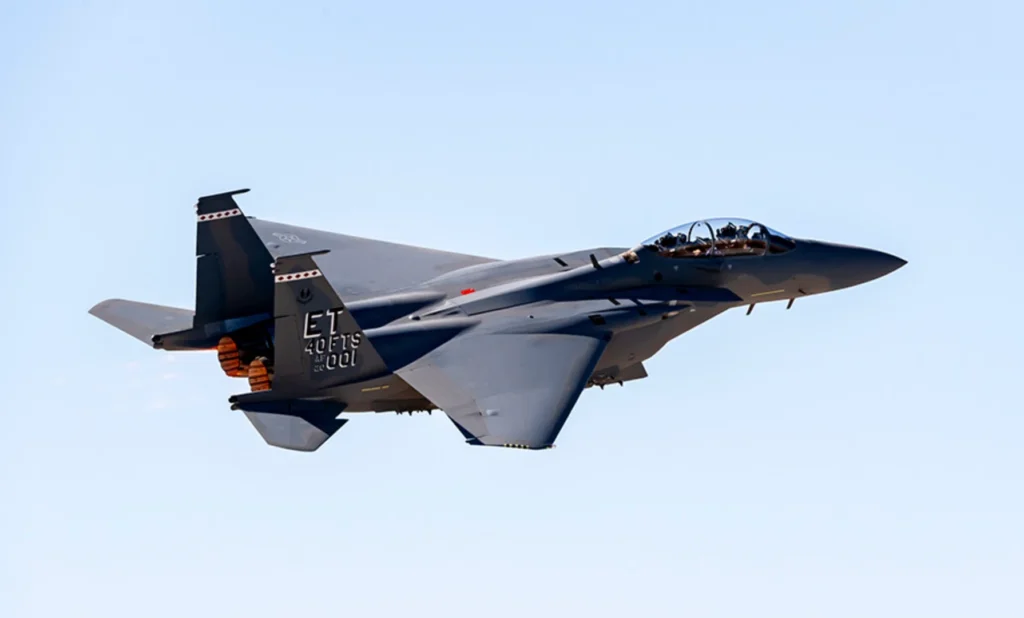
The Eagle wasn’t designed to break speed records simply for prestige. It emerged in the aftermath of the Vietnam War, when U.S. military planners realized that future air combat demanded a fighter capable of climbing faster, accelerating harder, and outmaneuvering any opponent in the sky. The result was an aircraft engineered around one simple objective: achieve and maintain air superiority.
Introduced in 1976 by McDonnell Douglas (now part of Boeing), the F-15 combines two powerful afterburning turbofan engines with a lightweight airframe, allowing it to reach an official top speed of Mach 2.5 (approximately 1,875 mph or 3,018 km/h) at high altitude.
More importantly, it reaches that speed quickly, giving pilots a critical advantage during interceptions and high-altitude engagements.
| Specification | F-15 Eagle |
| Maximum Speed | Mach 2.5 |
| Engines | 2 × Pratt & Whitney F100 Afterburning Turbofans |
| Service Entry | 1976 |
| Primary Role | Air Superiority Fighter |
| Crew | 1 (F-15C), 2 (some variants) |
| Service Ceiling | More than 65,000 ft (19,800 m) |
One of the Eagle’s most remarkable characteristics is its thrust-to-weight ratio. In certain configurations, the aircraft produces more thrust than it weighs, meaning it can accelerate while climbing vertically.
To spectators, it almost looks like the jet is defying gravity, pointing its nose skyward and continuing to gain altitude under pure engine power.
But speed is only part of the Eagle’s legacy.
The F-15 is also one of the most successful fighter aircraft ever built, credited with more than 100 aerial victories without a confirmed air-to-air combat loss.
That extraordinary record, achieved by operators including the U.S. Air Force and allied nations, reflects not only the aircraft’s performance but also its reliability, radar capability, and adaptability over decades of service.
The story doesn’t end there. Modern variants like the Boeing F-15EX Eagle II feature upgraded avionics, digital flight controls, advanced electronic warfare systems, and significantly greater weapons capacity.
Despite the arrival of fifth-generation fighters, the Eagle continues to evolve, proving that a fundamentally sound design can remain relevant well into the 21st century.
Nearly 50 years after entering service, the Eagle still lives up to its name, commanding the skies with a blend of power, precision, and performance that few fighters in history have matched. It isn’t just America’s speed king; it’s one of the greatest fighter jets ever built.
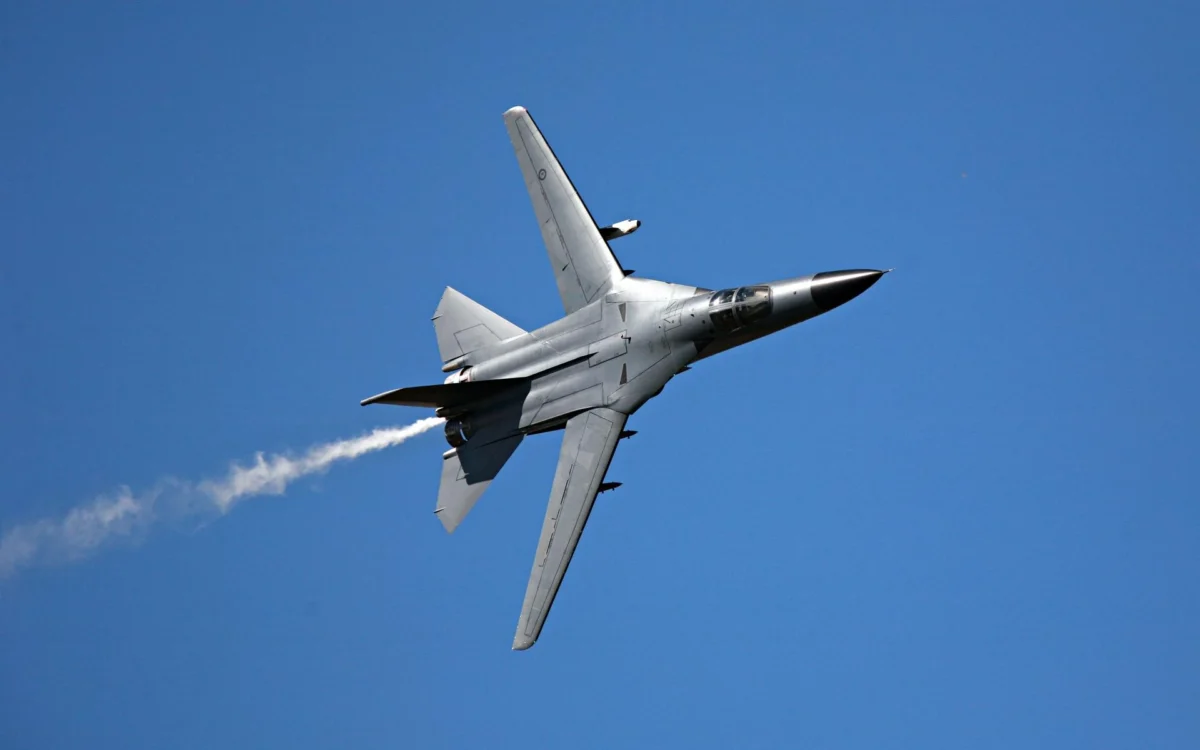
The F-111 Aardvark is probably the most debated aircraft on this list.
Ask five aviation enthusiasts whether it belongs among the fastest US fighter jets, and you may get five different answers. That’s because the F-111 wasn’t a pure air-superiority fighter like the F-15 or F-22. Instead, it was conceived as a multirole aircraft capable of striking targets deep behind enemy lines while still defending itself if necessary.
Even so, there’s one fact that isn’t up for debate: it was incredibly fast.
Powered by two Pratt & Whitney TF30 afterburning turbofan engines, the F-111 could reach an impressive top speed of Mach 2.5 (about 1,650 mph or 2,655 km/h) at altitude. That put it in the same speed class as dedicated interceptors, despite carrying a much heavier payload and significantly more fuel.
Its standout innovation was the variable-sweep wing system. Pilots could adjust the wing angle in flight to match the mission.
Fully extended, the wings generated extra lift for short takeoffs and low-speed cruising. Swept sharply backward, they dramatically reduced drag, allowing the aircraft to dash at speeds exceeding twice the speed of sound.
| Specification | F-111 Aardvark |
| Maximum Speed | Mach 2.5 |
| Engines | 2 × Pratt & Whitney TF30 Turbofans |
| Service Entry | 1967 |
| Primary Role | Tactical Strike / Fighter-Bomber |
| Crew | 2 |
| Distinctive Feature | Variable-Sweep Wings |
The Aardvark was also years ahead of its time in other ways. It introduced terrain-following radar, enabling crews to fly automatically at very low altitudes, even at night or in poor weather.
Instead of climbing high where enemy radar could easily detect it, the aircraft hugged the landscape, weaving through valleys at remarkable speed. For air-defense systems of the 1960s and 1970s, that combination of velocity and low-level flight was extremely difficult to counter.
Combat experience eventually proved the concept. During operations in Vietnam and later in the Gulf War, the F-111 demonstrated exceptional long-range strike capability with relatively low loss rates. It could carry a heavier bomb load than many fighters while reaching targets without relying heavily on aerial refueling.
Although its fighter credentials remain a topic of discussion, the F-111’s engineering achievements are undeniable. It blurred the line between fighter and bomber, pioneered technologies that influenced later combat aircraft, and showed that speed alone wasn’t enough; it had to be paired with range, payload, and survivability.
Those qualities make the Aardvark one of the most remarkable high-speed military aircraft ever developed by the United States.
Few fighter jets have achieved the same legendary status as the F-14 Tomcat. Even people with little interest in military aviation can recognize its sweeping variable-geometry wings or remember its starring role in the movie Top Gun. But behind the Hollywood fame was an aircraft built for one very serious mission: protecting U.S. aircraft carriers from long-range threats.
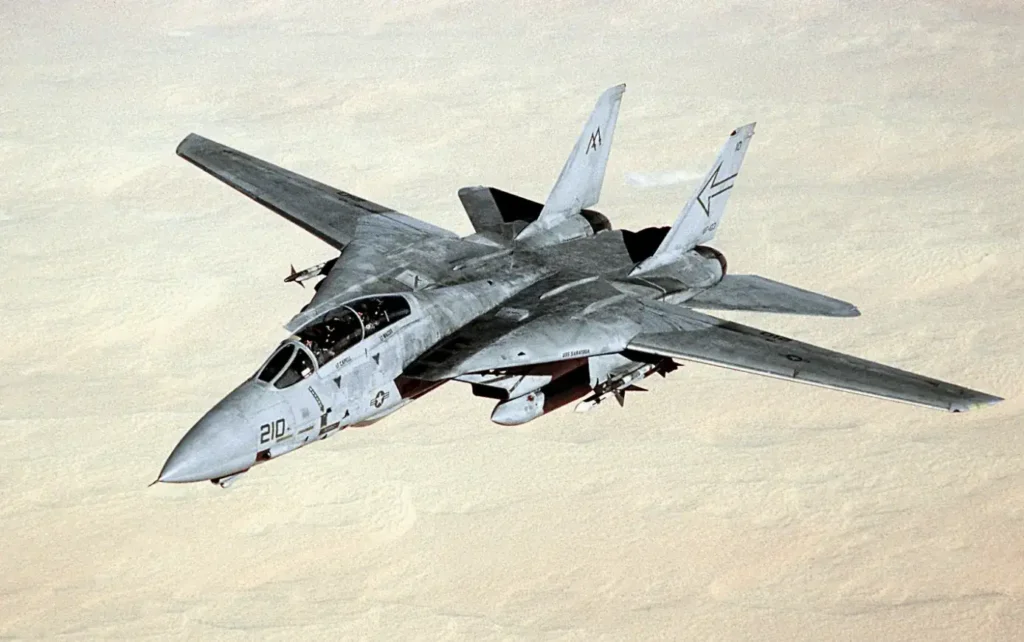
Introduced in 1974 by Grumman Aerospace, the F-14 was designed during the height of the Cold War, when the U.S. Navy expected waves of Soviet bombers armed with anti-ship missiles. To stop those bombers before they could launch their weapons, the Tomcat needed to fly fast, very fast.
With a maximum speed of Mach 2.34 (around 1,544 mph or 2,485 km/h), the F-14 became one of the fastest carrier-based fighters ever built. Its secret was a combination of two powerful afterburning turbofan engines and its iconic variable-sweep wings.
At lower speeds, the wings extended outward to generate extra lift for carrier takeoffs and landings. As speed increased, they automatically swept backward, reducing drag and allowing the aircraft to slice efficiently through the air.
| Specification | F-14 Tomcat |
| Maximum Speed | Mach 2.34 |
| Engines | 2 × Pratt & Whitney TF30 (later General Electric F110) |
| Service Entry | 1974 |
| Primary Role | Fleet Defense / Air Superiority |
| Crew | 2 |
| Distinctive Feature | Variable-Sweep Wings |
Speed alone wasn’t the Tomcat’s greatest advantage. It was also the first U.S. fighter capable of tracking multiple airborne targets simultaneously while carrying the long-range AIM-54 Phoenix missile.
In theory, a single F-14 could engage several enemy bombers from more than 100 miles away, an extraordinary capability for its time.
The aircraft later proved its versatility in real-world combat, transitioning from fleet defense to air superiority, strike missions, and reconnaissance.
During operations over the Balkans, Iraq, and Afghanistan, the Tomcat demonstrated that it could adapt to missions its designers had never originally envisioned.
The U.S. Navy retired the F-14 in 2006, replacing it with the more versatile Boeing F/A-18E/F Super Hornet.
Even so, the Tomcat remains one of the most admired aircraft in aviation history. Its combination of blistering speed, long-range firepower, and unmistakable silhouette secured its place among the fastest American fighter aircraft ever to serve, and ensured its legacy would endure long after its final carrier landing.
On paper, the F-22 Raptor isn’t the fastest aircraft on this list. Its officially published top speed is about Mach 2.25 (roughly 1,500 mph or 2,414 km/h), placing it behind several Cold War-era fighters. But focusing only on that number misses what makes the Raptor extraordinary.
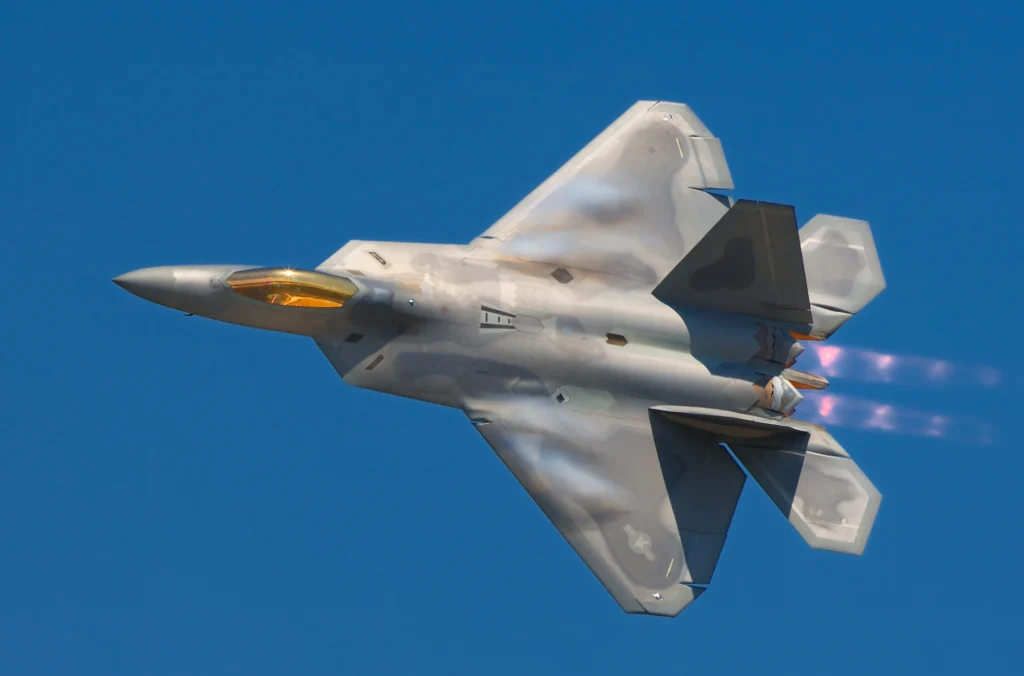
Unlike older fighters that relied on afterburners to achieve maximum speed, the F-22 can maintain supersonic flight without afterburners, a capability known as supercruise. That seemingly small difference changes everything.
Afterburners burn enormous amounts of fuel and produce an intense infrared signature, making an aircraft easier to detect. Supercruise allows the Raptor to travel quickly while conserving fuel and remaining significantly harder to track.
Developed by Lockheed Martin in partnership with Boeing, the F-22 entered service in 2005 as the world’s first operational fifth-generation air-superiority fighter.
Its design philosophy marked a dramatic shift in military aviation. Instead of chasing ever-higher top speeds, engineers balanced speed with stealth, agility, sensor fusion, and situational awareness.
| Specification | F-22 Raptor |
| Maximum Speed | Mach 2.25 |
| Supercruise Speed | Approx. Mach 1.8 |
| Engines | 2 × Pratt & Whitney F119 Turbofans |
| Service Entry | 2005 |
| Primary Role | Air Superiority Fighter |
| Crew | 1 |
Another feature that sets the Raptor apart is its two-dimensional thrust-vectoring nozzles. By directing engine thrust up or down, the aircraft can perform aggressive maneuvers that would be impossible for conventional fighters. In close-range dogfights, this gives pilots exceptional control, especially at high angles of attack.
Ironically, the F-22 is capable of flying faster than pilots usually allow it to. Routine operations rarely require maximum speed because sustained high-Mach flight increases maintenance demands and places additional stress on stealth coatings. In modern combat, remaining unseen often matters far more than arriving a few seconds earlier.
Although only 187 operational F-22s were built before production ended in 2012, the aircraft remains one of the most capable fighters ever fielded by the United States. It proves an important lesson in modern air warfare: the fastest US fighter jet isn’t always the one with the highest published speed.
Sometimes, the fighter that reaches the battle first, without being detected, is the one that truly controls the skies.
When the F-104 Starfighter first appeared in the late 1950s, it looked like it had arrived from the future. Its pencil-thin fuselage, razor-sharp wings, and towering vertical stabilizer made it unlike any fighter that had flown before. Pilots quickly gave it a memorable nickname, “the missile with a man in it.” It wasn’t hard to see why.
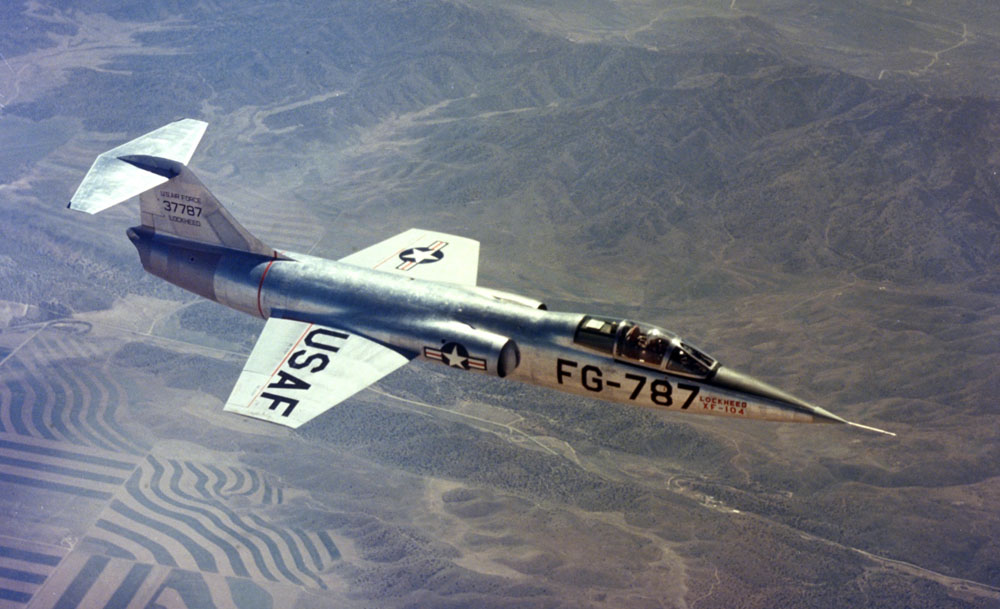
Designed by Lockheed Corporation under the leadership of Clarence, the F-104 was built around a simple philosophy: climb fast, fly faster, intercept the target, and head home.
Everything that didn’t contribute to speed was stripped away. The aircraft’s incredibly small wings reduced drag, while its powerful turbojet engine delivered astonishing acceleration for its era.
With a published top speed of Mach 2.2 (around 1,470 mph or 2,365 km/h) at high altitude, the Starfighter became one of America’s first operational fighters capable of sustained flight beyond Mach 2. That achievement was groundbreaking during the Cold War, when speed often meant the ability to intercept Soviet bombers before they reached their targets.
| Specification | F-104 Starfighter |
| Maximum Speed | Mach 2.2 |
| Engine | General Electric J79 Turbojet |
| Service Entry | 1958 |
| Primary Role | Interceptor / Fighter |
| Crew | 1 |
| Combat Radius | Approx. 420 miles (676 km) |
Yet the F-104’s quest for speed came with compromises. Its tiny wings produced excellent high-speed performance but demanded high landing speeds and left little margin for error during takeoff and low-speed maneuvers.
Flying the aircraft required precision and constant attention, earning it a reputation as one of the most demanding fighters of its generation.
Despite those challenges, the Starfighter achieved remarkable international success. More than 2,500 aircraft were produced, and it served with over a dozen air forces across Europe, Asia, and North America.
Many nations continued flying the F-104 well into the 1990s, proving that its sleek design offered far more than headline-grabbing speed.
The F-104 may rank fifth on this list of the fastest US fighter jets ever built, but its influence stretches far beyond its Mach number. It demonstrated that aerodynamic efficiency could unlock entirely new levels of performance and paved the way for the high-speed fighters that followed. For many aviation historians, it marked the moment America truly entered the Mach 2 era.
Looking at top speed alone can be misleading. A difference of just 0.1 Mach may seem minor on paper, but at high altitude it can translate to dozens of miles per hour, potentially giving a pilot valuable seconds during an interception or allowing an aircraft to disengage from a dangerous situation more quickly.
There’s another important detail many articles overlook: published top speed doesn’t always reflect operational reality. Fighter aircraft rarely spend extended periods at maximum speed.
Flying at Mach 2 or higher dramatically increases fuel consumption, creates intense aerodynamic heating, and places tremendous stress on engines and airframes. In real combat, pilots usually fly at speeds that balance performance, fuel efficiency, and tactical flexibility.
The table below compares the five aircraft featured in this ranking.
| Rank | Aircraft | Top Speed | Primary Role | First Entered Service |
| 1 | F-15 Eagle | Mach 2.5 | Air Superiority | 1976 |
| 2 | F-111 Aardvark | Mach 2.5 | Strike / Fighter-Bomber | 1967 |
| 3 | F-14 Tomcat | Mach 2.34 | Fleet Defense Fighter | 1974 |
| 4 | F-22 Raptor | Mach 2.25 | Stealth Air Superiority | 2005 |
| 5 | F-104 Starfighter | Mach 2.2 | Interceptor | 1958 |
One pattern immediately stands out: three of the five fastest American fighter aircraft were designed during the Cold War. That wasn’t a coincidence.
During the 1950s through the 1970s, military planners believed the greatest threat came from high-speed nuclear bombers. Fighters had to launch quickly, climb rapidly, and intercept those bombers before they reached their targets.
Today’s combat environment is different. Modern fighters such as the F-22 prioritize stealth, advanced sensors, electronic warfare, and information dominance over absolute top speed. As a result, the race to build the fastest fighter has largely given way to the race to build the smartest one.
Even so, these aircraft remain remarkable engineering achievements. Each represents a different chapter in America’s pursuit of air superiority, showing how advances in engines, aerodynamics, and mission requirements shaped the evolution of high-speed military aviation.