Follow Us:
Follow Us:

The Type 076 Amphibious Assault Ship isn’t just another warship joining China’s rapidly expanding fleet. It represents a noticeable shift in how modern amphibious operations may be fought in the decades ahead.
While traditional landing helicopter docks focus on transporting troops and helicopters close to shore, the Type 076 appears designed to project combat power much farther from the coastline, using advanced drones, helicopters, and cutting-edge launch technology from a single platform.
That’s precisely why defense analysts around the world are paying close attention.
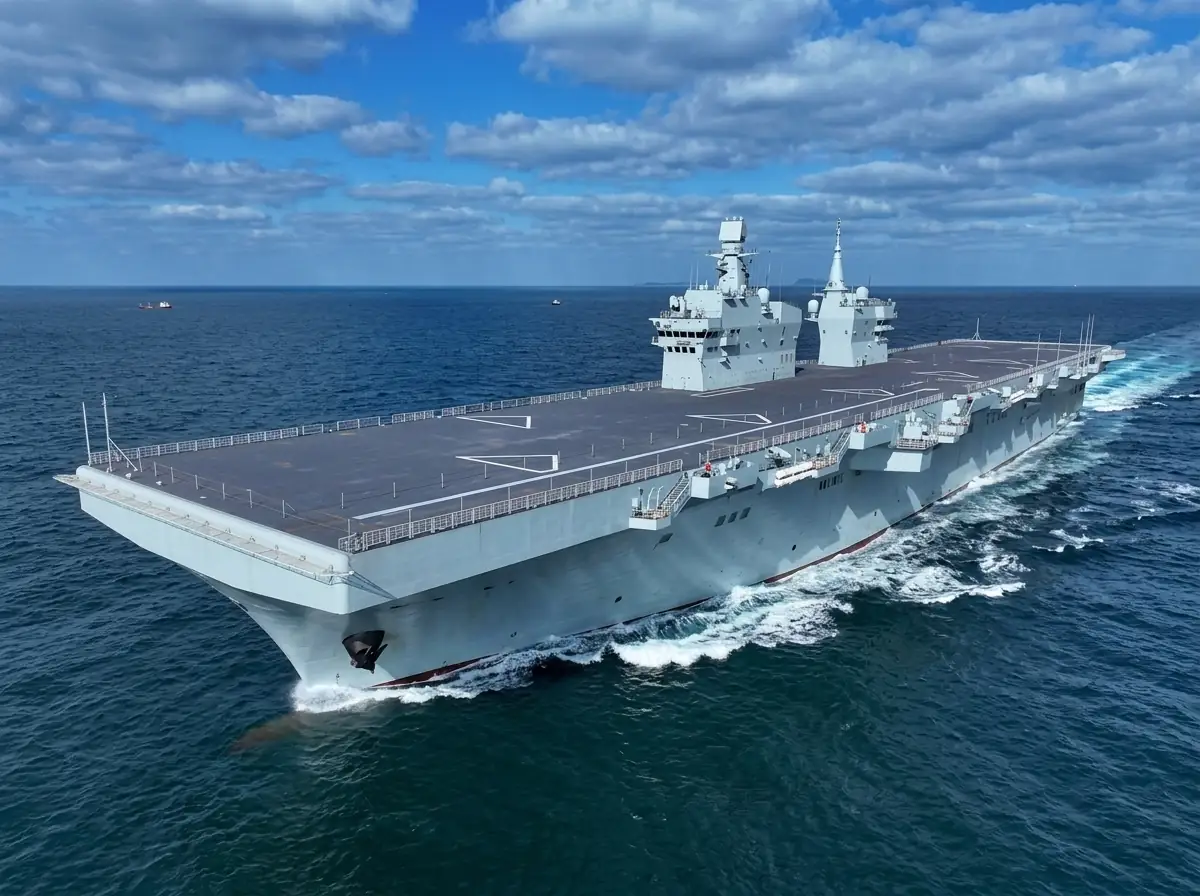
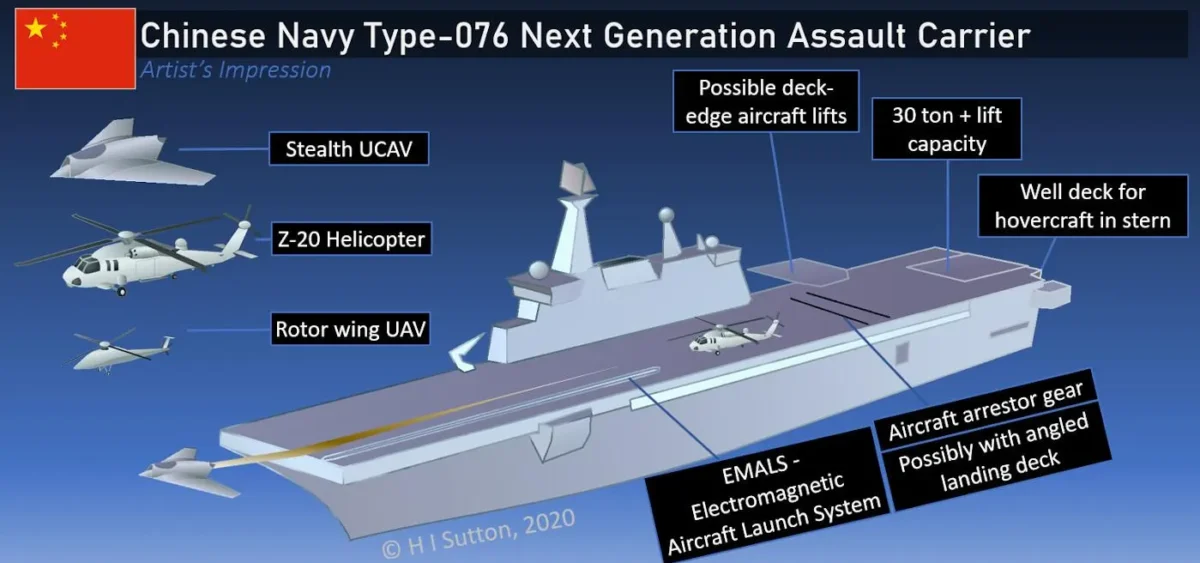
At first glance, the China Type 076 Amphibious Assault Ship resembles its predecessor, the Type 075. Look closer, however, and the differences become difficult to ignore. Reports indicate the new vessel features an electromagnetic aircraft launch system (EMALS), making it the world’s first known amphibious assault ship equipped with catapult technology.
Rather than relying solely on helicopters, it could launch heavier unmanned combat aerial vehicles (UCAVs) and reconnaissance drones, dramatically expanding the ship’s reach during expeditionary operations.
This evolution reflects a broader trend in naval warfare. Today’s battles are increasingly shaped by intelligence, surveillance, electronic warfare, and long-range precision strikes, missions that unmanned aircraft can perform continuously without exposing pilots to unnecessary risk.
In that environment, a ship capable of carrying marines while operating an advanced drone air wing offers a level of operational flexibility few existing amphibious assault ships can match.
In this post, we’ll examine the Type 076 Amphibious Assault Ship in detail, from its design and expected specifications to its aircraft capabilities, comparison with the Type 075, and the strategic role it could play across the Indo-Pacific.
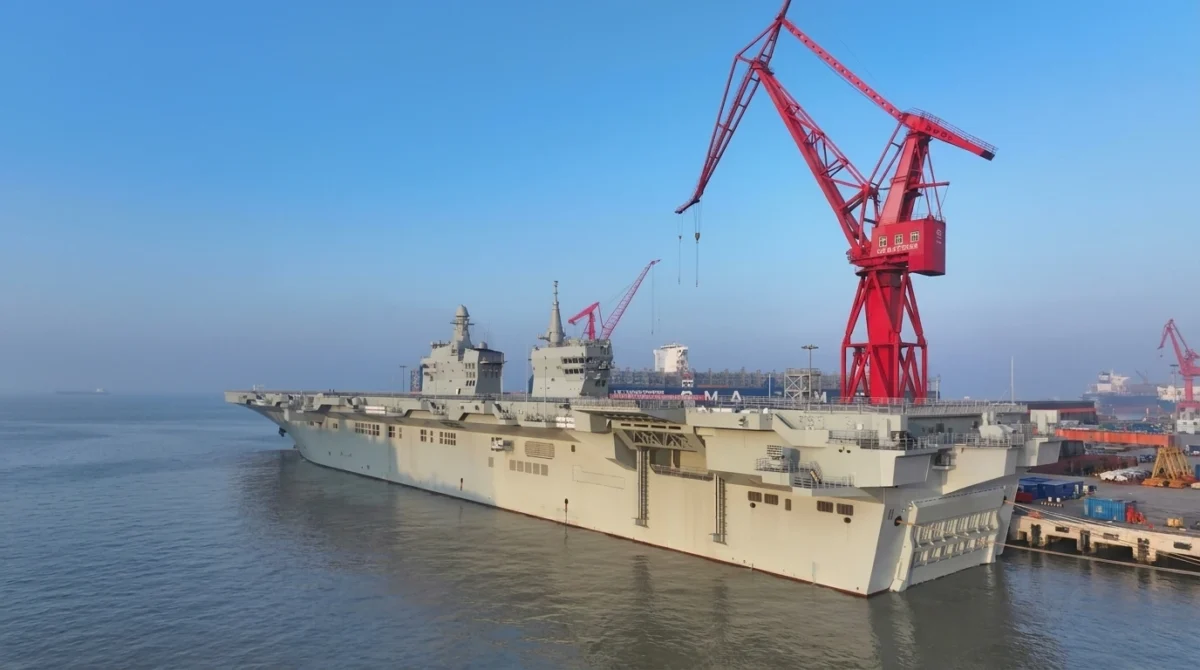
Because the Type 076 Amphibious Assault Ship is still undergoing testing and official details remain limited, many of its specifications are based on satellite imagery, shipyard observations, and assessments from defense analysts. Even so, a fairly clear picture of the vessel has begun to emerge.
Compared with the Type 075, the new ship is expected to be both larger and more capable. Analysts estimate a full-load displacement exceeding 50,000 tons, placing it among the world’s largest amphibious assault ships.
The most distinctive feature is its long, unobstructed flight deck paired with an electromagnetic aircraft launch system (EMALS), a capability never before confirmed on an amphibious assault ship.
| Specification | Estimated Details |
| Class | Type 076 Landing Helicopter Dock (LHD) |
| Country | China |
| Operator | People’s Liberation Army Navy (PLAN) |
| Estimated Full-Load Displacement | 50,000+ tons |
| Length | Approximately 260 meters (853 feet) |
| Flight Deck | Full-length with EMALS catapult |
| Aircraft Elevators | Two large deck-edge elevators |
| Propulsion | Integrated electric propulsion (estimated) |
| Well Deck | Yes, for landing craft and amphibious vehicles |
| Primary Air Wing | Helicopters, UAVs, and UCAVs |
Beyond the numbers, the layout reveals the ship’s intended role. A spacious hangar, large aircraft elevators, and a stern well deck allow the Type 076 to conduct several missions simultaneously.
Helicopters can insert troops inland while landing craft deploy armored vehicles from the rear, and unmanned aircraft provide continuous intelligence or strike support overhead.
This combination transforms the Type 076 Amphibious Assault Ship into more than a transport vessel. Instead, it functions as a floating expeditionary base capable of coordinating air, sea, and ground operations from a single platform.
As additional official information becomes available following sea trials, these specifications may evolve, but the overall design already signals one thing clearly: China is building one of the most advanced amphibious warships ever put to sea.
If there’s one feature that separates the type 076 Amphibious Assault ship from every other landing helicopter dock in the world, it’s the reported integration of an Electromagnetic Aircraft Launch System (EMALS). This isn’t a minor upgrade; it fundamentally changes what an amphibious assault ship can do.
Traditional amphibious assault ships rely on helicopters that lift off vertically. While versatile, helicopters have limitations in speed, range, payload, and endurance.
EMALS changes the equation by using electromagnetic force rather than steam to accelerate aircraft down a short catapult track. The result is a smoother launch, reduced stress on airframes, and the ability to launch heavier aircraft with greater efficiency.

For the Type 076, the greatest advantage isn’t launching fighter jets, at least not based on current evidence. Instead, analysts believe EMALS is primarily intended to operate fixed-wing unmanned aerial vehicles (UAVs) and unmanned combat aerial vehicles (UCAVs).
These aircraft can remain airborne for hours, conducting intelligence, surveillance, reconnaissance (ISR), electronic warfare, target acquisition, or precision strike missions far beyond the reach of helicopters.
This capability could reshape amphibious operations. Imagine marines preparing for a beach landing while drones launched from the same ship map enemy defenses, jam radar systems, identify missile batteries, and relay real-time targeting data. By the time troops reach shore, commanders would have a far clearer picture of the battlefield.
EMALS also offers practical operational benefits. It requires less maintenance than traditional steam catapults, enables faster launch cycles, and supports a wider variety of aircraft as new unmanned systems enter service.
In many respects, the Type 076 Amphibious Assault Ship blurs the line between a conventional amphibious assault ship and a light aircraft carrier.
Rather than simply delivering forces to the battlefield, it can help shape the battlefield before the first landing craft ever leaves the well deck, a significant evolution in China’s approach to expeditionary warfare.
The air wing is where the Type 076 Amphibious Assault Ship truly stands apart from earlier Chinese amphibious vessels.
Rather than relying almost exclusively on helicopters, the ship is expected to field a diverse mix of crewed aircraft and unmanned systems, giving commanders far greater flexibility during both combat and humanitarian missions.
Helicopters will still form the backbone of its aviation group. Medium-lift aircraft such as the Z-20 can rapidly transport troops, while larger helicopters like the Z-8 are well suited for moving heavy equipment, conducting search-and-rescue operations, or supporting disaster relief.
Attack helicopters are also expected to provide close air support during amphibious landings, engaging armored vehicles and fortified positions near the shoreline.
The real game-changer, however, is the ship’s anticipated ability to launch fixed-wing drones using its electromagnetic catapult.
Defense analysts believe aircraft such as the GJ-11 stealth unmanned combat aerial vehicle, or similar future designs, could conduct long-range reconnaissance, electronic warfare, and precision strike missions.
Unlike helicopters, these drones can fly faster, cover greater distances, and remain on station for extended periods, delivering continuous battlefield awareness.
| Aircraft Type | Expected Role |
| Z-20 Helicopter | Troop transport and utility missions |
| Z-8 Helicopter | Heavy lift and logistics |
| Attack Helicopters | Close air support |
| Fixed-Wing UAVs | Intelligence, surveillance, and reconnaissance (ISR) |
| UCAVs | Precision strikes and electronic warfare |
This layered air wing gives the China Type 076 Amphibious Assault Ship the ability to conduct several missions at once. While helicopters deliver marines inland, drones can scout enemy positions, monitor naval movements, identify air-defense systems, or relay targeting data in real time.
That combination reflects a broader shift in modern naval doctrine. Increasingly, success depends not only on how many troops a ship can carry, but also on how effectively it can gather information, dominate the electromagnetic spectrum, and strike targets before the enemy has time to react. The Type 076 appears purpose-built for that new reality.
At its core, the Type 076 Amphibious Assault Ship is still built for one mission above all else: delivering combat forces from sea to shore. But unlike earlier generations of amphibious warships, it is designed to support landings that are faster, more coordinated, and informed by real-time intelligence.
The ship is expected to feature a large well deck at the stern, allowing it to deploy landing craft and amphibious armored vehicles without entering shallow coastal waters. This enables over-the-horizon assaults, where troops can launch from dozens of kilometers offshore, reducing the risk posed by coastal missiles, naval mines, and enemy artillery.
Meanwhile, helicopters operating from the flight deck can insert marines well beyond the beachhead. This vertical assault capability allows forces to seize critical objectives, such as airfields, bridges, or command centers, while amphibious vehicles approach from the sea.
Conducting both operations simultaneously complicates an enemy’s defense by forcing it to respond to threats from multiple directions.
The addition of unmanned aircraft further strengthens this concept. Before landing craft even begin their approach, drones can monitor enemy troop movements, identify defensive positions, and transmit live battlefield data back to commanders. If equipped with strike capabilities, they could also suppress key targets ahead of the assault.
| Capability | Operational Benefit |
| Well Deck | Launches landing craft and amphibious vehicles |
| Flight Deck | Supports helicopter and drone operations |
| Over-the-Horizon Assault | Keeps the ship farther from enemy defenses |
| Air Assault | Rapid troop insertion inland |
| ISR Support | Improves battlefield awareness before landings |
This combination makes the Type 076 Amphibious Assault Ship far more than a troop transport. It functions as a command hub that integrates sea, air, and ground operations into a single coordinated campaign.
Whether supporting large-scale amphibious assaults, evacuating civilians during crises, or delivering humanitarian aid after natural disasters, the ship offers the PLAN a level of operational flexibility that previous Chinese amphibious vessels could not achieve.
At first glance, the Type 076 Amphibious Assault Ship looks like a natural evolution of the Type 075. Both are large landing helicopter docks designed to transport marines, helicopters, landing craft, and armored vehicles. But beneath the similar appearance lies a major leap in capability.
The Type 076 isn’t simply a larger Type 075, it’s a fundamentally different platform built for a new style of naval warfare.
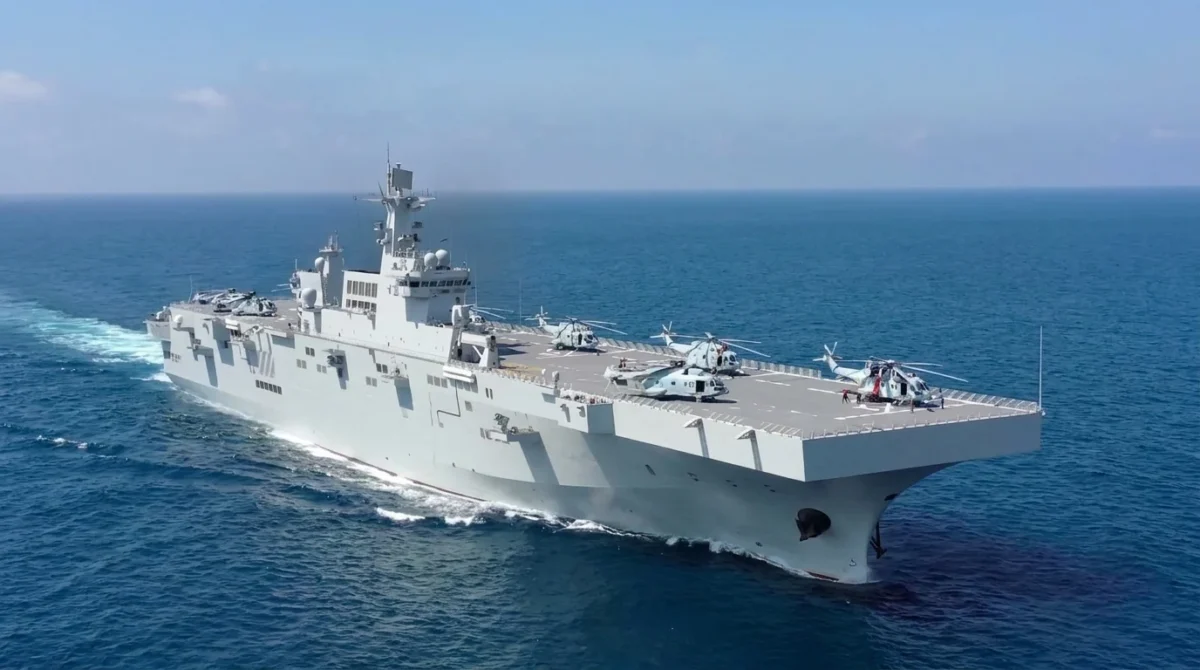
The most significant difference is the addition of an electromagnetic aircraft launch system (EMALS).
The Type 075 relies entirely on helicopters for air operations, while the Type 076 is expected to launch fixed-wing unmanned aircraft capable of conducting intelligence, surveillance, electronic warfare, and precision strikes. That single feature dramatically expands the ship’s operational reach.
The newer vessel is also believed to feature integrated electric propulsion, providing the electrical power required for EMALS and future high-energy systems.
Combined with its larger flight deck and enhanced aviation facilities, the Type 076 is expected to support a more diverse and capable air wing.
| Feature | Type 075 | Type 076 |
| Primary Role | Amphibious assault | Multi-role expeditionary warfare |
| Full-Load Displacement | ~40,000 tons | 50,000+ tons (estimated) |
| Aircraft Launch | Helicopters only | Helicopters + catapult-launched UAVs |
| EMALS | No | Yes |
| Propulsion | Conventional | Integrated electric (estimated) |
| Aviation Focus | Air assault | Air assault, ISR, and drone operations |
The comparison also highlights a shift in doctrine. The Type 075 was designed to move forces efficiently from sea to shore.
The Type 076 Amphibious Assault Ship, by contrast, is expected to influence the battlefield long before troops land. Its drones can gather intelligence, monitor enemy movements, and potentially strike key targets while helicopters and landing craft prepare the assault.
In short, the Type 075 extends China’s amphibious capacity. The Type 076 expands what an amphibious assault ship can actually do, bringing carrier-like aviation capabilities into a platform traditionally focused on troop transport and amphibious landings.
Although China has released few official details about the Type 076 Amphibious Assault Ship’s armament, its defensive layout is expected to follow the layered protection strategy seen on other modern People’s Liberation Army Navy (PLAN) warships.
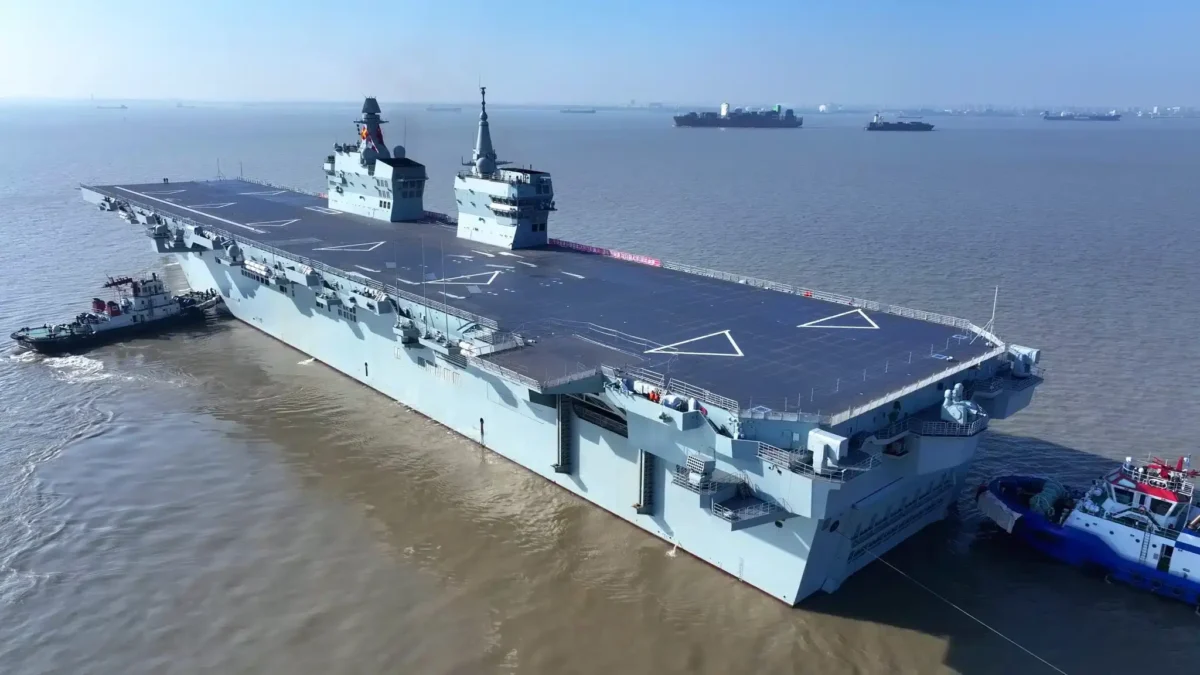
Rather than relying on a single weapon, the ship will likely combine missiles, rapid-fire guns, electronic warfare systems, and advanced sensors to defend itself against threats from the air, sea, and below the surface.
Because the Type 076 is primarily an expeditionary platform, not a frontline surface combatant, it is designed to operate as part of a larger naval task force.
Destroyers, frigates, submarines, and carrier-based aircraft would provide the outer layers of defense, allowing the amphibious assault ship to focus on launching and supporting operations.
The ship is nevertheless expected to carry several self-defense systems.
| System | Expected Purpose |
| Close-In Weapon System (CIWS) | Intercepts incoming anti-ship missiles and aircraft |
| Short-Range Surface-to-Air Missiles | Defends against aircraft, drones, and cruise missiles |
| Electronic Warfare Suite | Detects, jams, and deceives enemy radar and missiles |
| Decoy Launchers | Diverts radar-guided and infrared-guided missiles |
| Advanced Radar Systems | Air and surface surveillance, fire control, and target tracking |
Equally important are the ship’s sensors. Modern phased-array radars, infrared search-and-track systems, and electronic support measures enable the crew to detect threats long before they enter weapon range. When operating alongside escort ships, these sensors contribute to a shared tactical picture, allowing the entire task group to respond more quickly to evolving threats.
As missile technology continues to advance, survivability increasingly depends on integrated defense rather than heavy armament alone.
In that respect, the Type 076 Amphibious Assault Ship is expected to follow the same philosophy as other modern amphibious assault ships around the world: protect itself against immediate threats while relying on the broader fleet for layered air and missile defense.
This approach maximizes space for aircraft, troops, and mission equipment without compromising operational effectiveness.
The Type 076 Amphibious Assault Ship is more than a new addition to China’s fleet, it offers a glimpse into how the People’s Liberation Army Navy (PLAN) expects future conflicts to unfold.
Rather than building a ship optimized for a single mission, China appears to be investing in a platform that combines amphibious assault, air operations, and unmanned warfare into one integrated capability.
One of the most discussed scenarios is a potential contingency involving Taiwan.
In any large-scale amphibious operation, success would depend on more than landing troops. Commanders would need persistent intelligence, electronic warfare, and real-time battlefield awareness before forces ever reached the shoreline. A ship capable of launching reconnaissance and strike drones while transporting marines could help provide that advantage.
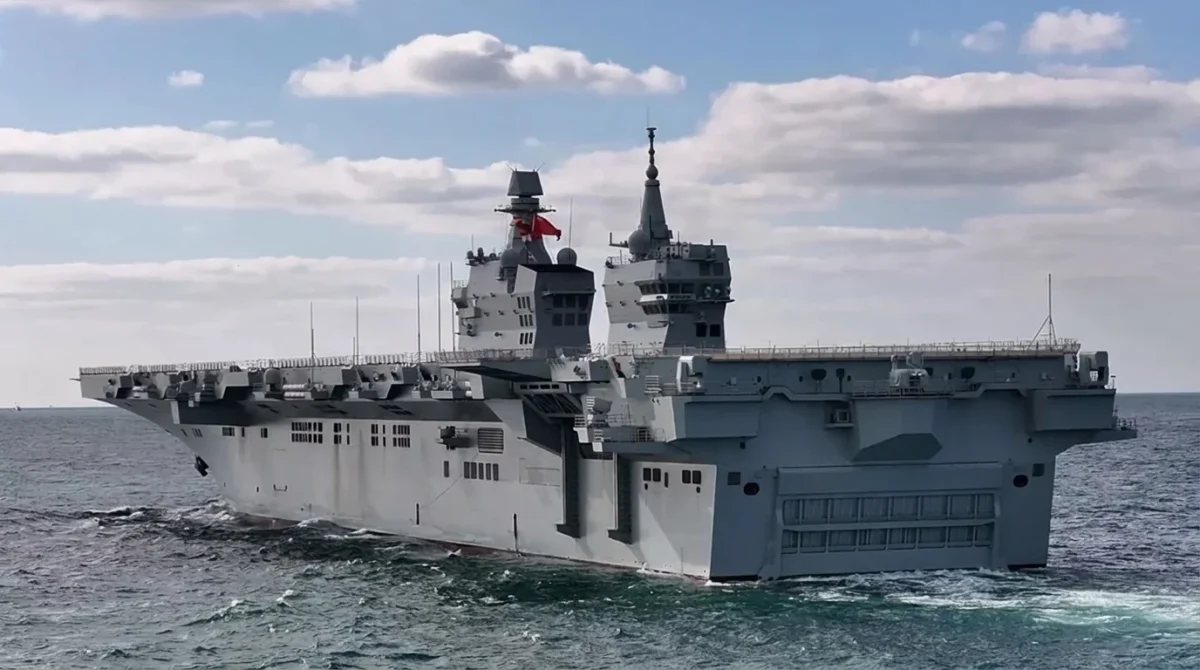
The Type 076 Amphibious Assault Ship also supports China’s expanding presence beyond its coastal waters.
As the PLAN increases deployments in the South China Sea, the East China Sea, and the wider Indo-Pacific, expeditionary ships become valuable tools for protecting sea lanes, supporting overseas operations, conducting evacuation missions, and responding to regional crises.
Another strategic factor is deterrence. Even if the ship is never used in combat, its capabilities may influence how neighboring countries plan their defenses.
Nations throughout the Indo-Pacific are already investing in longer-range anti-ship missiles, integrated air-defense systems, and counter-drone technologies in response to evolving naval capabilities.
Perhaps the biggest takeaway is that the Type 076 reflects a broader shift in naval thinking. For decades, amphibious assault ships primarily delivered troops to the battlefield.
The China Type 076 Amphibious Assault Ship is expected to shape the battlefield before those troops arrive, using drones, networked sensors, and advanced aviation systems to gather intelligence and support precision operations.
That evolution makes the Type 076 more than just another warship. It represents China’s continued move toward a modern, blue-water navy capable of projecting power, coordinating joint operations, and adapting to the increasingly technology-driven nature of maritime conflict.