Follow Us:
Follow Us:

A helicopter that can lift a vehicle, haul tons of cargo, or carry an entire squad into a battlefield is already an impressive machine.
But the biggest military helicopter in the world operates on a different scale altogether. These are not simply oversized aircraft with larger rotors. They are flying logistics hubs, part truck, part crane, part emergency lifeline, with enough power to move loads that would otherwise require convoys, transport aircraft, or hours of ground preparation.
When people search for the biggest military helicopter, they often focus on length or rotor diameter first. That makes sense; a massive rotor stretching across the sky is hard to ignore.
Yet physical size tells only part of the story. A helicopter with a slightly smaller airframe may carry more useful cargo, lift heavier external loads, or deliver far greater performance in demanding conditions.
That is why this ranking looks beyond appearance. We’ll compare the world’s largest military helicopters using the measurements that matter in real operations: maximum takeoff weight, payload capacity, engine power, dimensions, cargo capability, and battlefield role.
From the enormous Soviet-designed Mil Mi-26 to powerful Western heavy-lift machines such as the CH-53K King Stallion and CH-47 Chinook, these helicopters represent decades of engineering ambition.
Some were designed to move armored vehicles. Others became indispensable for expeditionary warfare, disaster relief, and long-distance military logistics.
So, which aircraft truly deserves the title of the world’s biggest military helicopter, and how close are its rivals? Let’s start with the machines that make “heavy lift” sound almost like an understatement.
Calling a helicopter “big” sounds simple until you try to rank one against another. Is the longest airframe the biggest? The one with the widest rotor? Or the aircraft capable of lifting the heaviest load?
That’s where things get interesting.
For this list, the biggest military helicopter is judged using a combination of physical size and practical lifting ability. A helicopter may have an enormous fuselage, but if it cannot carry a comparable payload, its size is less useful in the real world. Think of it like comparing trucks: the longest truck is not automatically the one that can haul the most weight.
The first major factor is maximum takeoff weight (MTOW). This includes the helicopter itself, fuel, crew, equipment, and payload. It provides a useful picture of the aircraft’s total lifting capability.
Next comes payload capacity, arguably the most important measurement for heavy-lift military helicopters. Payload can include troops, vehicles, artillery, supplies, or cargo suspended beneath the aircraft on a sling.
Physical dimensions also matter. Overall length and rotor diameter reveal the sheer scale of the aircraft, while engine power helps explain how that mass gets off the ground in the first place.
Finally, operational importance matters. A helicopter that has actually served in military logistics, combat support, disaster response, or large-scale transport deserves more weight than an impressive prototype that never became a practical workhorse.
The result is a ranking based not on one impressive number, but on the complete picture: size, payload, power, and what the helicopter can genuinely do when the ground below becomes a problem.
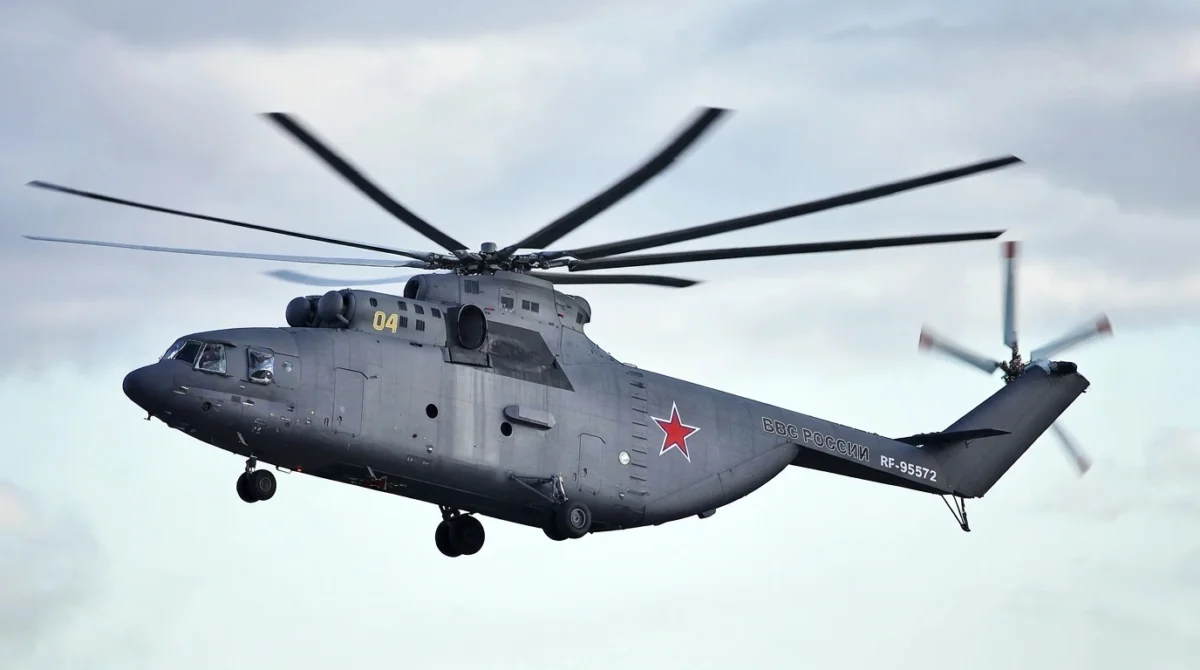
If there is one aircraft that defines the phrase biggest military helicopter, it is the Mil Mi-26 Halo. Introduced by the Soviet Union in the early 1980s, the Mi-26 was built with a single purpose: to carry cargo that no other helicopter could. More than four decades later, it still holds that title.
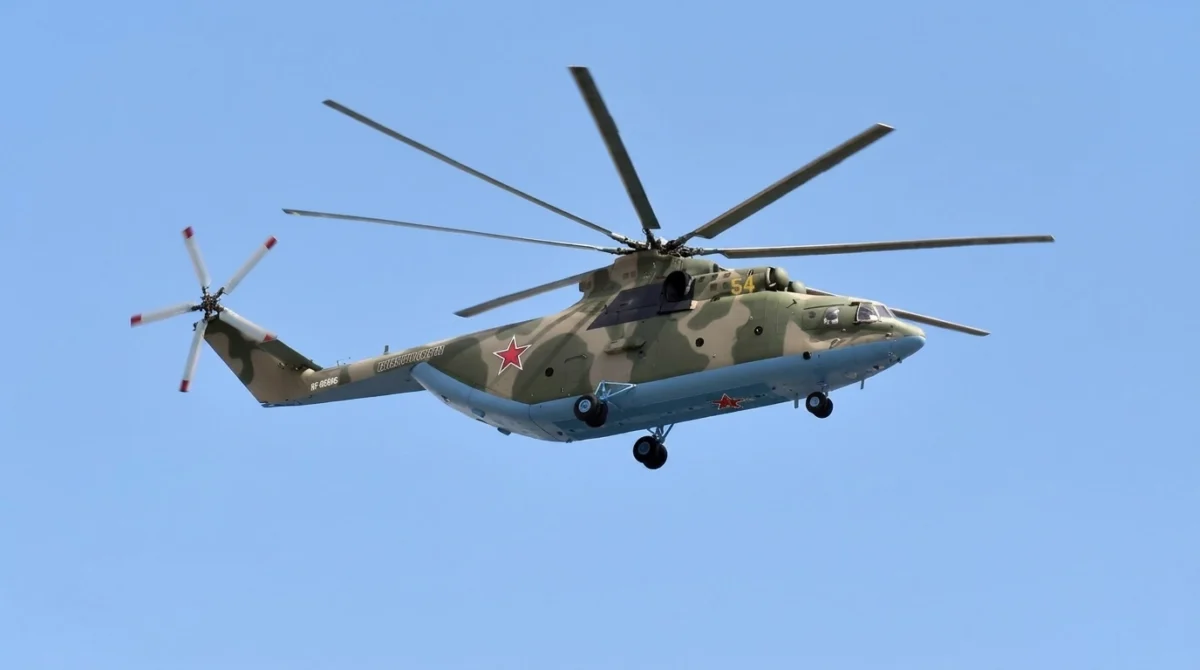
What makes the Mi-26 remarkable isn’t just its size, it’s what that size allows it to do. With a maximum takeoff weight of approximately 56 tonnes and an internal or external payload of up to 20 tonnes, the helicopter can transport armored vehicles, artillery pieces, engineering equipment, or more than 80 fully equipped troops in a single mission.
In many cases, it can move cargo that would otherwise require multiple helicopters or fixed-wing transport aircraft.
Key Specifications
| Specification | Mil Mi-26 Halo |
| Country | Soviet Union / Russia |
| First Flight | 1977 |
| Entered Service | 1983 |
| Crew | 5–6 |
| Overall Length | 40 m (131 ft) |
| Main Rotor Diameter | 32 m (105 ft) |
| Maximum Takeoff Weight | 56,000 kg |
| Maximum Payload | 20,000 kg |
| Maximum Speed | 295 km/h (183 mph) |
| Range | Up to 800 km |
Powering this giant are two Lotarev D-136 turboshaft engines, each producing around 11,400 shaft horsepower. Together they generate enough thrust to lift loads that seem almost impossible for a rotary-wing aircraft.
The Mi-26 has repeatedly demonstrated those capabilities in real-world operations. It has recovered crashed helicopters from remote mountains, transported armored personnel carriers across difficult terrain, delivered humanitarian aid after natural disasters, and supported military logistics in places where roads were damaged or simply didn’t exist.
Even today, no production helicopter combines physical size, payload capacity, and operational versatility quite like the Mi-26. It’s less a helicopter and more a flying heavy-duty crane, setting a benchmark that competitors continue to chase.
The Sikorsky CH-53K King Stallion takes a different route to becoming one of the biggest military helicopters in the world.
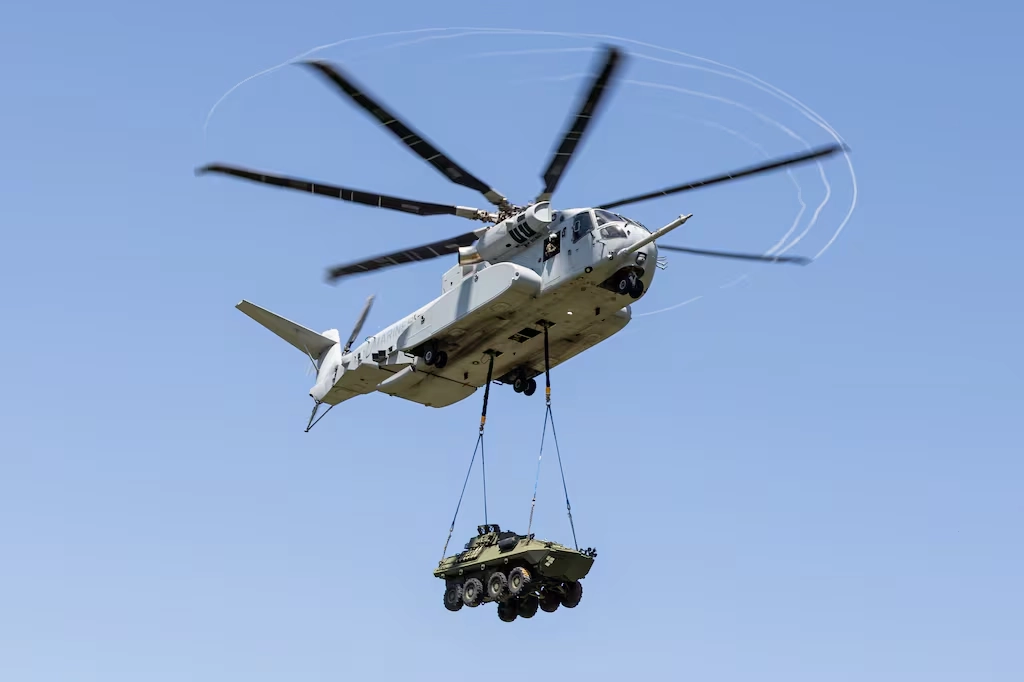
Unlike the enormous Mi-26, the CH-53K was designed around a more specific challenge: give the U.S. Marine Corps enough lifting power to move heavy equipment from ship to shore, and then keep doing it in difficult combat environments.
The result is a machine with a maximum gross weight of roughly 39.9 tonnes and a maximum external load of approximately 15.9 tonnes. That is an extraordinary figure for a helicopter intended to operate as part of expeditionary forces.
Key Specifications
| Specification | CH-53K King Stallion |
| Country | United States |
| First Flight | 2015 |
| Crew | 5 |
| Overall Length | 30.2 m (99 ft) |
| Main Rotor Diameter | 35 m (114.8 ft) |
| Maximum Gross Weight | Approx. 39.9 tonnes |
| External Lift Capacity | Approx. 15.9 tonnes |
| Engines | 3 × GE T408 |
| Engine Power | Approx. 7,500 shp each |
Three General Electric T408 engines provide the muscle. But raw horsepower is only part of the story.
The CH-53K also uses a modern composite rotor system, an upgraded transmission, digital flight controls, and a wider cabin than earlier Super Stallion variants.
That combination gives the King Stallion a useful advantage: it can carry heavy loads while reducing the number of aircraft required for a mission.
One helicopter moving a large load is often more efficient than sending several smaller aircraft, and in a contested environment, fewer flight movements can mean fewer opportunities for something to go wrong.
The CH-53K is also built with future growth in mind. Its digital systems make it easier to manage complex loads and demanding flight conditions, while its enormous rotor diameter helps generate the lift needed for heavy external cargo.
So, is it the biggest military helicopter overall?
No, the Mi-26 remains larger and carries more. But the CH-53K may be one of the clearest examples of how modern engineering can turn a very large helicopter into a highly specialized lifting machine. It is big, yes. But more importantly, it is built to make that size useful.
Before the CH-53K King Stallion arrived, the CH-53E Super Stallion was the United States Marine Corps’ heavyweight champion. It was designed for a world where helicopters had to do more than carry troops.
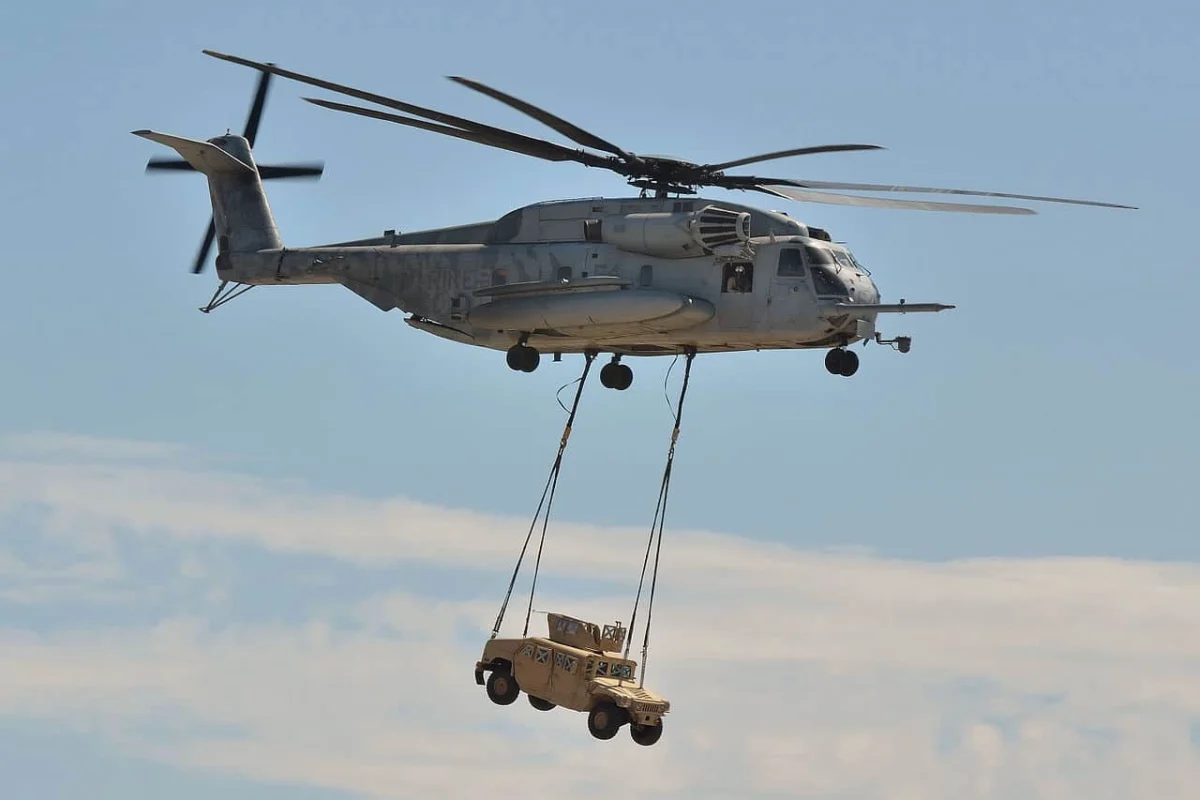
They needed to move artillery, vehicles, fuel, supplies, and sometimes entire pieces of the battlefield that could not be easily transported by road.
With a maximum gross weight of roughly 33.3 tonnes and a payload capacity of around 16 tonnes, the CH-53E remains one of the largest and most capable military helicopters ever placed into widespread service.
Key Specifications
| Specification | CH-53E Super Stallion |
| Country | United States |
| First Flight | 1974 |
| Entered Service | 1981 |
| Crew | 5 |
| Overall Length | 30.2 m (99 ft) |
| Main Rotor Diameter | 24.1 m (79 ft) |
| Maximum Gross Weight | Approx. 33.3 tonnes |
| Maximum Payload | Approx. 16 tonnes |
| Engines | 3 × T64-GE-416/427 |
| Primary Role | Heavy-lift transport |
The helicopter’s distinctive three-engine configuration gives it the power needed to lift heavy cargo, while its external sling-load capability allows crews to transport equipment that cannot fit inside the fuselage. That flexibility has always been one of the Super Stallion’s greatest strengths.
Its operational history is equally important. The CH-53E supported Marine Corps operations across multiple decades and conflicts, moving heavy equipment in conditions where conventional ground transport was slow, vulnerable, or simply unavailable.
A large artillery piece, engineering vehicle, or pallet of supplies could be moved directly from one location to another without waiting for roads to be cleared.
That kind of capability changes military planning. A mountain, river, destroyed bridge, or muddy road stops being an absolute barrier. It becomes a flight-planning problem.
The CH-53E is also an interesting reminder that size alone does not determine a helicopter’s value. It is an older design, yet its lifting performance made it a benchmark for the more advanced CH-53K.
In many ways, the King Stallion is not a completely new idea; it is the next chapter in a heavy-lift story the Super Stallion helped write.
The Boeing CH-47 Chinook may not be the heaviest helicopter on this list, but it might be the most recognizable. Its tandem-rotor layout, with one large rotor at the front and another at the rear, gives the aircraft a distinctive profile, and a practical advantage.
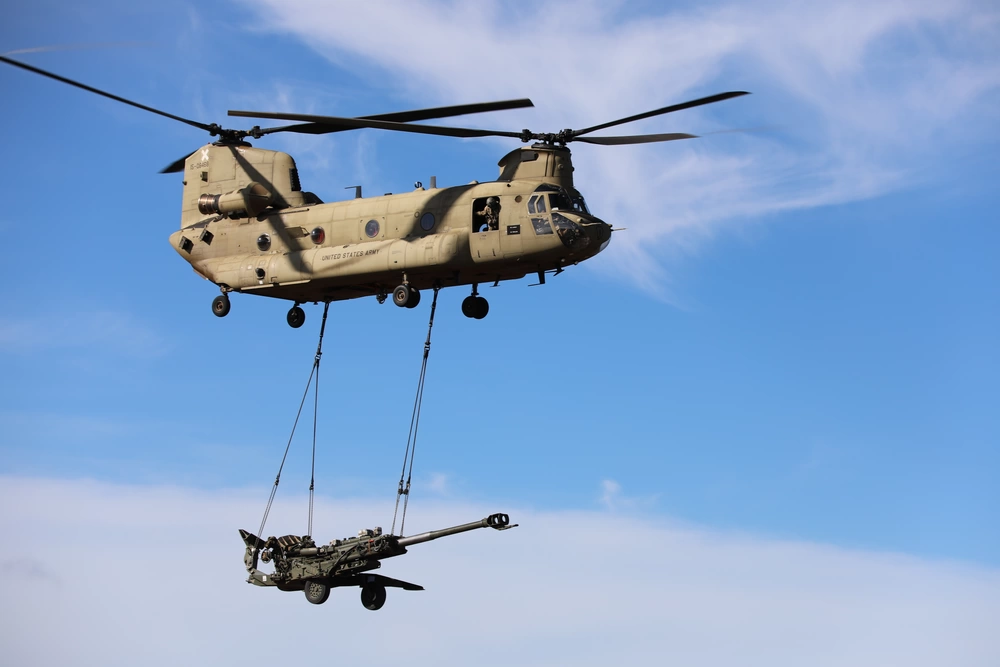
The design frees much of the fuselage for cargo while eliminating the need for a conventional tail rotor.
That makes the Chinook one of the most versatile heavy-lift military helicopters ever built.
Modern variants such as the CH-47F can reach a maximum gross weight of roughly 24.5 tonnes and carry around 10 tonnes of useful payload, depending on configuration and mission conditions. It can transport troops internally, carry cargo, or lift heavy equipment externally beneath the aircraft.
Key Specifications
| Specification | CH-47F Chinook |
| Country | United States |
| First Flight | 1961 |
| Entered Service | 1962 |
| Crew | 3–5 |
| Overall Length | 30.1 m (98.7 ft) |
| Rotor Diameter | 18.3 m (60 ft) |
| Maximum Gross Weight | Approx. 24.5 tonnes |
| Useful Payload | Around 10 tonnes |
| Engines | 2 × T55 turboshaft |
| Primary Role | Troop and cargo transport |
One of the Chinook’s greatest strengths is not a single record-breaking statistic. It’s the way the aircraft fits into military operations. It can move troops, sling-load artillery, resupply remote bases, evacuate casualties, and transport cargo over terrain that would make a truck driver quietly reconsider their career choices.
The tandem-rotor arrangement also provides excellent lifting capability without requiring a tail rotor to counter torque. Both rotors contribute directly to lift, making the aircraft exceptionally useful for cargo missions.
The CH-47’s long service history is another reason it belongs among the world’s biggest military helicopters. Few heavy-lift rotorcraft have been used so widely by different countries or adapted to so many missions.
Compared with the Mi-26 or CH-53K, the Chinook is smaller. But that is almost beside the point. Its real achievement is balance: enough size to move serious loads, enough flexibility to perform many missions, and a design mature enough to remain relevant across generations of warfare.
Long before the Mi-26 became the biggest military helicopter in the world, the Soviet Union had already built another machine that pushed heavy-lift aviation into unfamiliar territory: the Mil Mi-6 Hook.
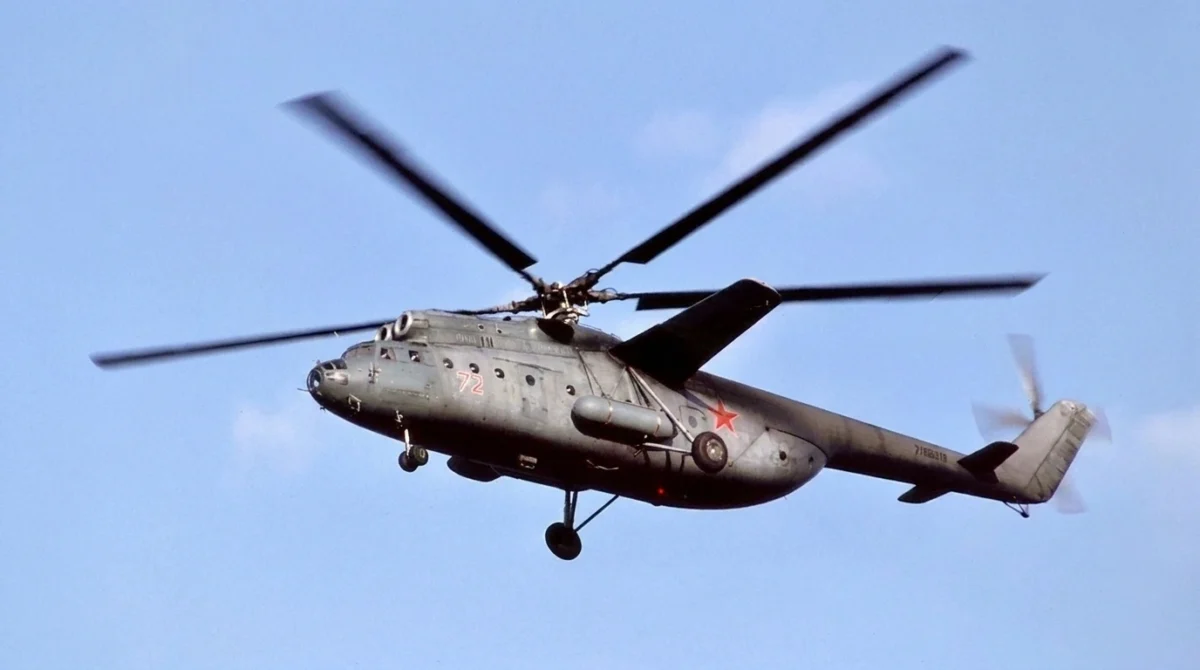
When it first flew in 1957, the Mi-6 was enormous by helicopter standards. In fact, it was widely regarded as the world’s largest helicopter for many years. Its arrival marked a turning point. Helicopters were no longer limited to carrying small teams and light cargo.
The Mi-6 demonstrated that a rotary-wing aircraft could move vehicles, artillery, troops, and heavy equipment in quantities that had previously seemed unrealistic.
Key Specifications
| Specification | Mil Mi-6 Hook |
| Country | Soviet Union |
| First Flight | 1957 |
| Entered Service | 1959 |
| Overall Length | 33.2 m (109 ft) |
| Main Rotor Diameter | 35 m (115 ft) |
| Maximum Takeoff Weight | Approx. 42 tonnes |
| Payload | Up to 12 tonnes |
| Engines | 2 × Soloviev D-25V |
| Primary Role | Heavy cargo and troop transport |
The Mi-6 could carry substantial loads inside its large cargo cabin or transport equipment externally. That flexibility made it useful for military logistics, engineering work, and operations across the vast distances of the Soviet Union.
Its design also revealed an important truth about heavy-lift helicopters: the aircraft does not need to be elegant to be effective.
The Mi-6 was large, powerful, and built around practical utility. Its cavernous interior could swallow cargo that would have been difficult to move by road or impossible to deliver quickly by fixed-wing aircraft.
The helicopter’s influence extended beyond its own service life. The experience gained from developing and operating the Mi-6 helped Soviet engineers pursue even more ambitious designs, eventually leading to the Mi-26.
So while the Mi-6 is no longer the biggest military helicopter on the planet, its place in aviation history is secure. It helped prove that helicopters could become airborne heavy haulers, and once that door opened, aircraft designers began asking a much bigger question: how much can a helicopter possibly lift?
Looking at each helicopter individually tells only part of the story. Place them side by side, however, and clear patterns begin to emerge. Some aircraft dominate in raw lifting power, while others strike a better balance between size, versatility, and operational efficiency.
The Mil Mi-26 remains the undisputed heavyweight. With a payload of up to 20 tonnes, it can carry cargo that pushes the limits of rotary-wing aviation. Its massive cargo hold has transported armored personnel carriers, military trucks, engineering equipment, and even disabled helicopters that needed recovery from remote locations.
The CH-53K King Stallion follows closely behind. Although physically smaller than the Mi-26, it benefits from modern materials, powerful engines, and advanced flight systems that allow it to lift heavy loads with greater efficiency, especially during expeditionary operations.
Meanwhile, the CH-53E Super Stallion and CH-47 Chinook continue to prove that operational flexibility is just as valuable as outright lifting capacity. Both helicopters have logged millions of flight hours across combat zones, humanitarian missions, and disaster relief operations, earning reputations as dependable workhorses.
| Helicopter | MTOW | Max Payload | Troop Capacity | Primary Strength |
| Mil Mi-26 Halo | 56 t | 20 t | Up to 90 | World’s highest payload |
| CH-53K King Stallion | 39.9 t | 15.9 t | Up to 37 | Advanced heavy-lift technology |
| CH-53E Super Stallion | 33.3 t | ~16 t | Up to 55 | Proven combat logistics |
| CH-47F Chinook | 24.5 t | ~10 t | Up to 55 | Versatility and reliability |
| Mil Mi-6 Hook | 42 t | 12 t | Up to 90 | Historic heavy-lift pioneer |
One interesting takeaway is that bigger doesn’t always mean better.
The Mi-26 clearly leads in sheer size and lifting power, but transporting a 20-tonne load isn’t required for every mission. Military planners often choose the aircraft that best matches the task rather than the one with the highest specifications.
That’s why the Chinook remains one of the world’s most widely operated heavy-lift helicopters despite being considerably smaller than the Mi-26. Likewise, the CH-53K’s cutting-edge avionics and expeditionary design make it exceptionally effective in modern amphibious and rapid-response operations.
In the end, these helicopters represent different engineering philosophies. Some were built to carry the absolute heaviest loads. Others were designed to balance payload, mobility, maintainability, and mission flexibility. Together, they define what heavy-lift rotary-wing aviation is capable of today.