Follow Us:
Follow Us:


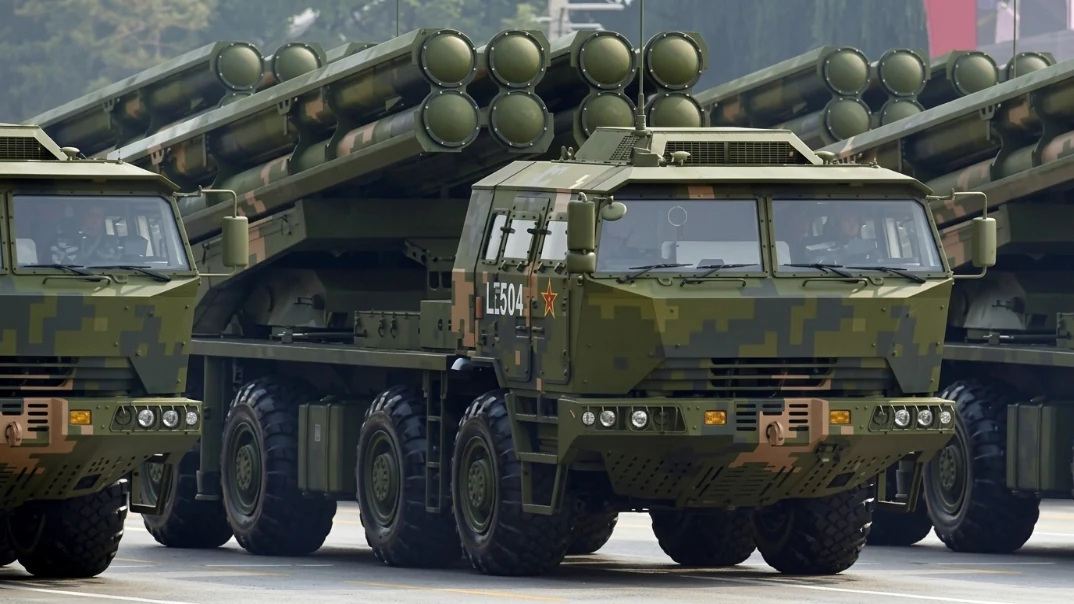
Defense Feeds, Beijing – China showcases PHL-191 MLRS airburst munitions capability, drawing attention to the evolving role of precision rocket artillery in modern land warfare. The demonstration highlights how programmable airburst ammunition can expand the effectiveness of long-range multiple launch rocket systems (MLRS) against dispersed targets while increasing operational flexibility for artillery units.
The development reflects a broader trend among major military powers to combine extended-range rocket systems with increasingly sophisticated munition technologies capable of addressing a wider range of battlefield scenarios.
The latest demonstration as China showcases PHL-191 MLRS airburst munitions capability illustrates how the People’s Liberation Army (PLA) continues to enhance the versatility of its long-range rocket artillery.
The PHL-191 is one of China’s most advanced multiple launch rocket systems, designed to employ different calibers of guided rockets and tactical missiles from a common launcher platform. This modular approach enables operators to tailor ammunition loads according to mission requirements while maintaining high operational flexibility.
The reported airburst capability allows rockets to detonate above their intended target area rather than on impact. By dispersing fragments over a wider area, this type of munition is intended to increase effectiveness against exposed personnel, lightly protected positions and certain battlefield assets that may be less vulnerable to conventional point-detonating warheads.
Integrating programmable fuzing with guided rocket technology also enables artillery commanders to select detonation profiles that best match the tactical environment, expanding the range of missions a single launcher can perform.
Airburst technology has become increasingly common across modern artillery systems because it offers greater flexibility than traditional impact-fuzed ammunition. Rather than relying solely on direct ground impact, airburst munitions are designed to optimize fragment distribution above a designated target area, potentially improving effectiveness against dispersed forces or positions shielded by terrain features.
For rocket artillery, this capability complements advances in precision guidance, digital fire-control systems and reconnaissance assets that enable more accurate target identification and engagement.
Modern battlefields are also becoming more dynamic, with forces frequently operating in smaller, dispersed formations while relying on drones and sensor networks to locate opposing units. Artillery systems capable of employing multiple munition types provide commanders with additional options when responding to changing tactical conditions.
Although airburst munitions are not unique to China, their integration into long-range rocket artillery reflects a broader international trend toward multi-role indirect fire systems capable of adapting to diverse operational requirements.
The continued development of the PHL-191 aligns with China’s wider investment in long-range precision fires, which have become a central element of the PLA’s modernization strategy. Rocket artillery is increasingly viewed as a means of delivering rapid, high-volume precision effects across extended distances while complementing conventional tube artillery, missile forces and air power.
Beyond the munition itself, the PHL-191 benefits from a modular architecture that supports multiple rocket and missile configurations. This flexibility allows operators to adapt the system for different mission profiles while simplifying logistics through the use of a common launch platform.
From a strategic perspective, expanding ammunition options enhances operational versatility without requiring entirely new launcher systems. As military planners seek to maximize the effectiveness of existing platforms, integrating advanced warhead technologies represents a cost-effective way to increase combat capability.
The fact that China showcases PHL-191 MLRS airburst munitions capability demonstrates the continuing evolution of rocket artillery beyond simply extending range.
Future effectiveness will increasingly depend on the ability to combine precision guidance, adaptable warhead options and integrated battlefield networks that allow commanders to deliver the most appropriate effects against a wide variety of targets. As long-range fires remain a priority for militaries worldwide, developments such as programmable airburst munitions are likely to shape the next generation of artillery operations.