Follow Us:
Follow Us:

The evolution of armored warfare has always been a race between firepower, protection, and mobility. Among the many tanks that have shaped this battlefield competition, the T-80 tank holds a unique place. As the first production tank to use a gas turbine engine, the T-80 MBT represented a bold step in Soviet military innovation. From its debut in the late 1970s to its continued use in modern conflicts, this tank’s legacy is both technically impressive and strategically significant.
First entering service in 1976, the T-80 was designed to outperform existing Soviet tanks like the T-64 and T-72. Its turbine engine gave it unmatched acceleration and high-speed mobility, especially in cold climates where conventional diesel engines struggled.
Over time, the family grew to include key T-80 variants such as the T-80B, T-80BV, and the export-focused T-80UD tank, with Ukraine producing its own diesel-powered versions. The more advanced T-80U tank introduced reactive armor and upgraded fire control systems, setting the stage for future upgrades like the T-80BVM tank, which remains in active Russian service today.

In this post, we’ll explore the rich history, technical evolution, and operational significance of the T-80, from the original T-80A and T-80B models to the modern T-80BVM. Whether you’re curious about its battlefield performance or how it compares to other tanks worldwide, this article offers an in-depth look at one of history’s most fascinating armored vehicles.
The development story of the T-80 tank began in the late 1960s as the Soviet Union sought a new main battle tank that could overcome the limitations of its existing armored fleet. The preceding T-64 and T-72 models were groundbreaking in their own right, but each came with trade-offs—cost, weight, and engine reliability—that Soviet designers aimed to resolve with the creation of the T-80 MBT.
Designed by Nikolay Popov at the Kirov Plant in Leningrad, the T-80 project (initially called Object 219) was the Soviet military’s attempt to field a faster, more mobile tank that could deliver overwhelming firepower while retaining survivability on modern battlefields.
What made the T-80 revolutionary was its gas turbine engine, the same type of powerplant used in jet aircraft. The T-80 tank engine delivered unparalleled acceleration and performance in cold climates—an important advantage in the vast and often harsh terrain of the Soviet Union.
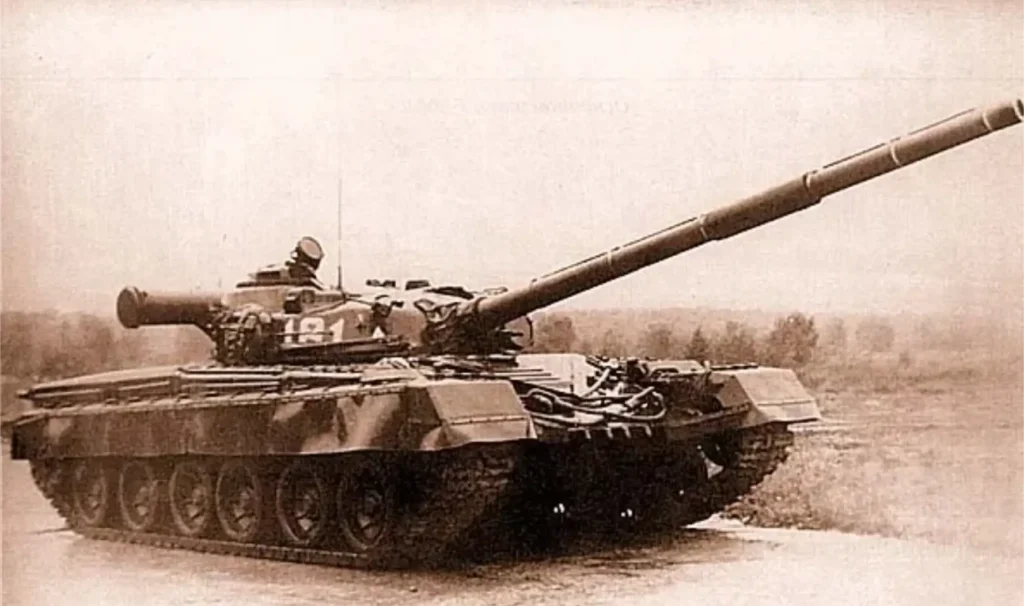
The first version, simply called the T-80, entered service in 1976, quickly followed by improved models like the T-80B and later the T-80BV, which introduced Kontakt-1 explosive reactive armor (ERA) to improve protection against anti-tank missiles and shaped-charge warheads. These early T-80 variants laid the foundation for what would become a family of tanks continuously updated over the next four decades.
As the Cold War escalated, further refinements led to the creation of the T-80U, a significantly upgraded version boasting enhanced composite armor, thermal imaging sights, and a more advanced fire control system. Yet one of the most important deviations in the T-80’s lineage was the Ukrainian T-80UD tank, which swapped the gas turbine for a diesel engine to reduce costs and simplify logistics.
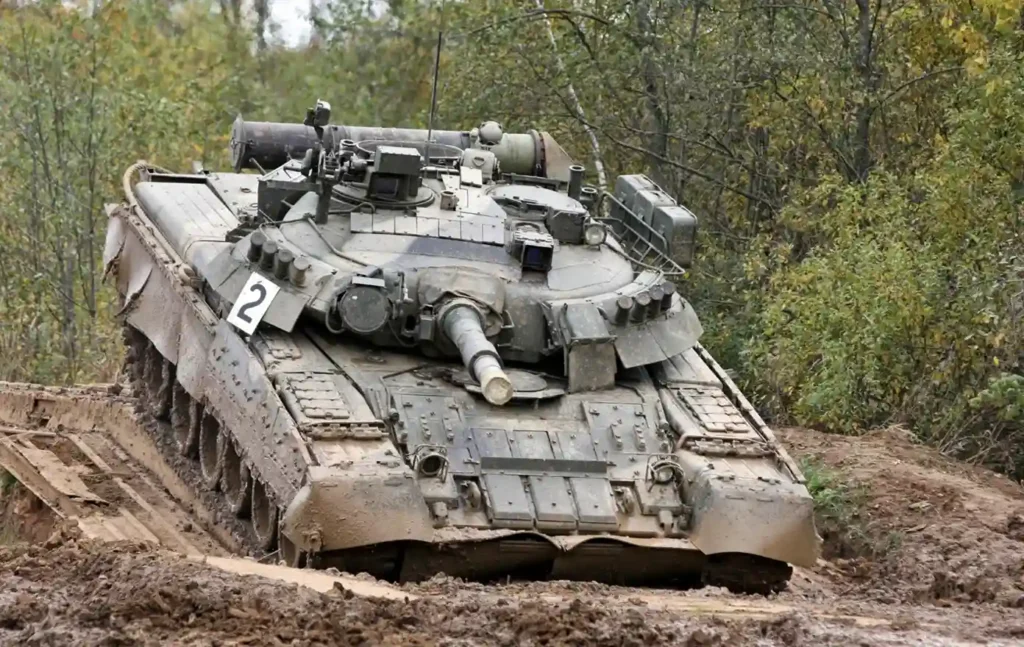
The T-80UD, and its further development into the T-84, served both domestic Ukrainian forces and export customers such as Pakistan. Meanwhile, Russia continued to modernize the T-80 line, introducing the T-80UK command variant and, more recently, the T-80BVM tank, featuring Relikt ERA, upgraded optics, and digital fire control to keep the tank relevant in 21st-century warfare.
The technical makeup of the T-80 tank reflects decades of Soviet and Russian innovation aimed at crafting a main battle tank that could deliver superior performance on the modern battlefield. One of the T-80’s most distinctive features has always been its engine.
Unlike the diesel engines found in tanks like the T-72, the original T-80 tank model was the first operational tank in the world to employ a gas turbine engine—specifically the GTD-1000T, later improved to the GTD-1250 in the T-80U and T-80BVM tank variants.
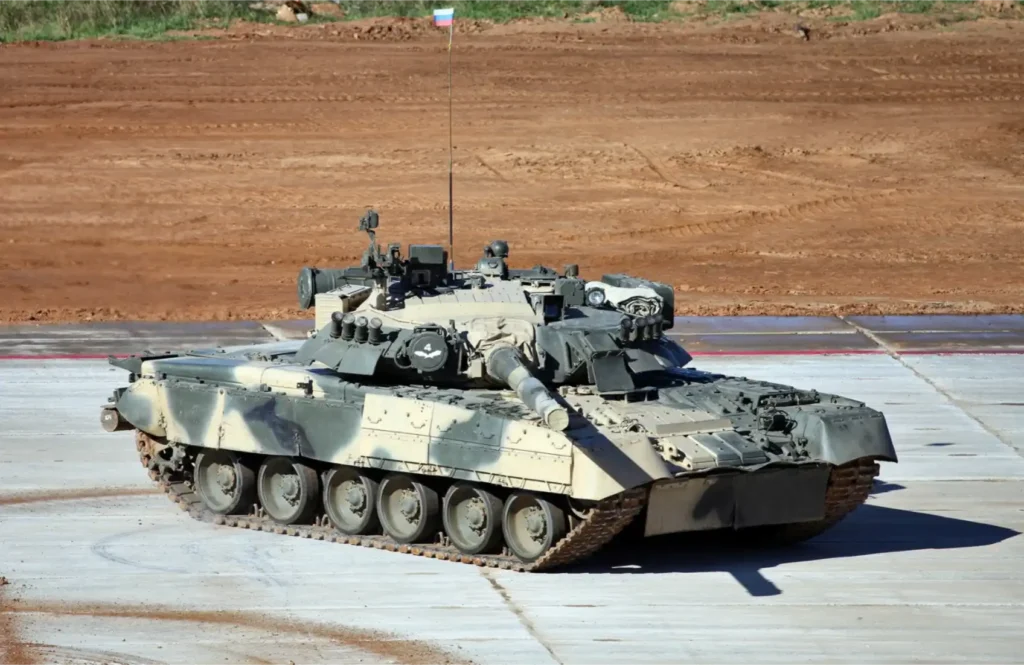
This T-80 tank engine gave the vehicle an impressive 1,000 to 1,250 horsepower output, enabling it to reach speeds up to 70 km/h on roads, which was remarkable for such a heavily armored machine. This unique propulsion system also made the T-80 exceptionally agile in cold and arctic conditions, a reason why the Russian military continues to deploy T-80BVM tanks in its northern and Siberian units today.
In terms of firepower, the T-80 MBT is armed with a formidable 125mm 2A46 smoothbore gun, capable of firing a variety of projectiles, including armor-piercing fin-stabilized discarding sabot (APFSDS) rounds, high-explosive anti-tank (HEAT) shells, and high-explosive fragmentation rounds.
Additionally, the main gun can launch 9M112 Kobra or 9M119 Refleks anti-tank guided missiles (ATGMs), providing the tank with the ability to engage enemy armor at ranges far beyond conventional shellfire. Secondary armaments include a coaxial 7.62mm PKT machine gun and a 12.7mm NSVT anti-aircraft machine gun mounted on the turret. These systems are standard across most T-80 variants, including the T-80B, T-80BV, T-80U tank, and the diesel-powered T-80UD tank, offering consistent battlefield lethality.
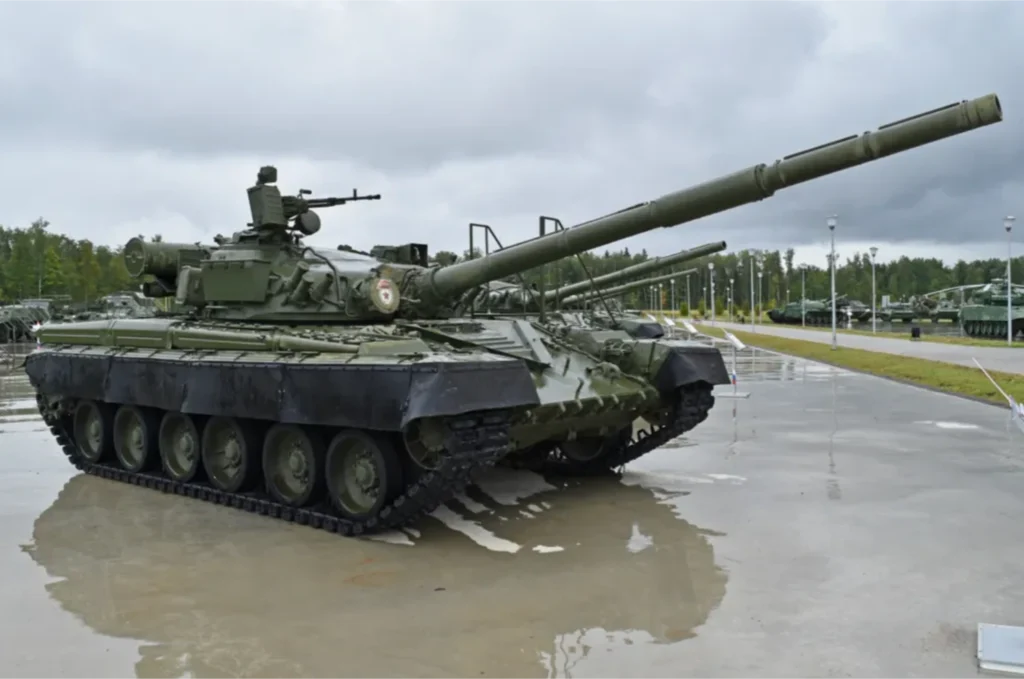
Protection was another focus area in the T-80’s design. Early versions like the T-80A and T-80B utilized composite armor, but later models such as the T-80BV and T-80BVM tank introduced explosive reactive armor (ERA) systems, like Kontakt-1 and Relikt, to defend against modern anti-tank weapons.
The T-80UK variant, designed as a command vehicle, incorporated additional communication and navigation equipment, enhancing its battlefield coordination capabilities. Across the entire T-80 MBT family—including the export-oriented T-80UD and the highly modernized T-80BVM—these tanks maintain a robust balance of firepower, protection, and mobility.
The T-80 tank family expanded into numerous variants over its decades-long service life, with each version introducing specific upgrades to meet the evolving demands of modern warfare. These T-80 variants reflected both technological advances and battlefield lessons learned from conflicts where the T-80 was deployed.
Among the earliest versions was the T-80A, which laid the groundwork for more advanced models but remained limited in distribution due to its transitional design. Shortly after, the T-80B entered production, offering improved fire control systems and enhanced composite armor, making it the backbone of Soviet armored units during the late Cold War.
Following this, the T-80BV was introduced, incorporating Kontakt-1 explosive reactive armor (ERA) to better withstand anti-tank guided missiles and shaped charges, a critical defensive improvement during an era of advancing NATO anti-tank capabilities.
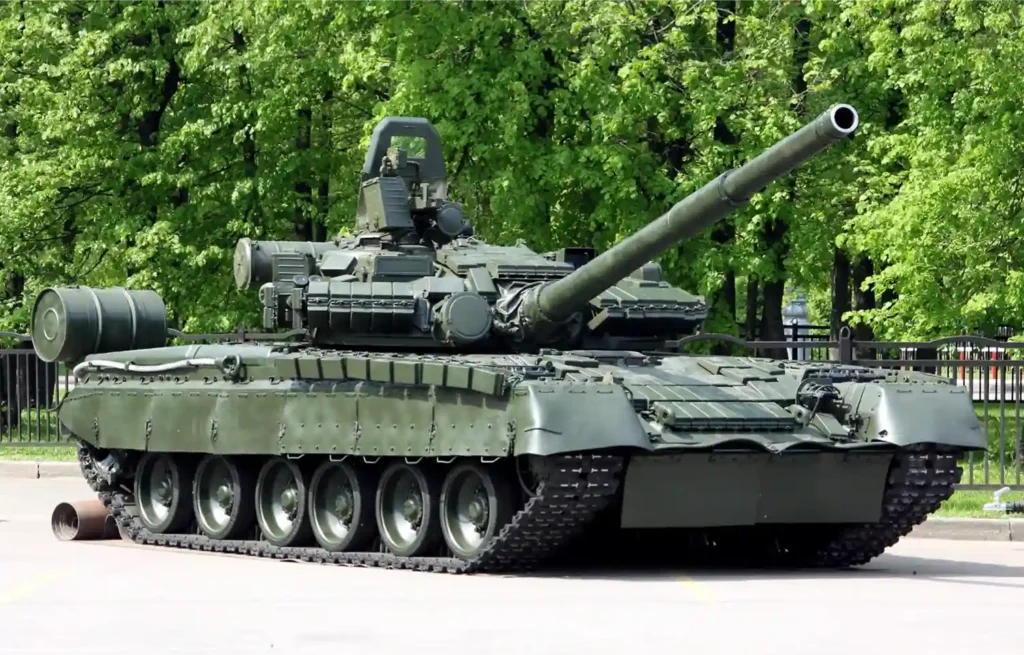
The T-80U tank marked a significant leap forward, arriving with upgraded Relikt ERA, advanced optics, thermal sights, and a more powerful T-80 tank engine rated at 1,250 horsepower. This made the T-80U one of the most formidable MBTs in the Soviet arsenal. Alongside the U model came the T-80UK, a command version featuring superior communications gear, allowing for better coordination among armored formations in large-scale operations.
A pivotal development in the T-80 lineage was the T-80UD tank, produced in Ukraine. Unlike its turbine-powered siblings, the T-80UD ran on a diesel engine, addressing concerns over the high operational costs and maintenance complexity of the gas turbine system.
The T-80UD offered nearly the same firepower and protection as the T-80U but with lower logistical burdens, making it attractive for export markets such as Pakistan, where the T-80UD tank remains in service today. This variant eventually led to the creation of Ukraine’s T-84 series.
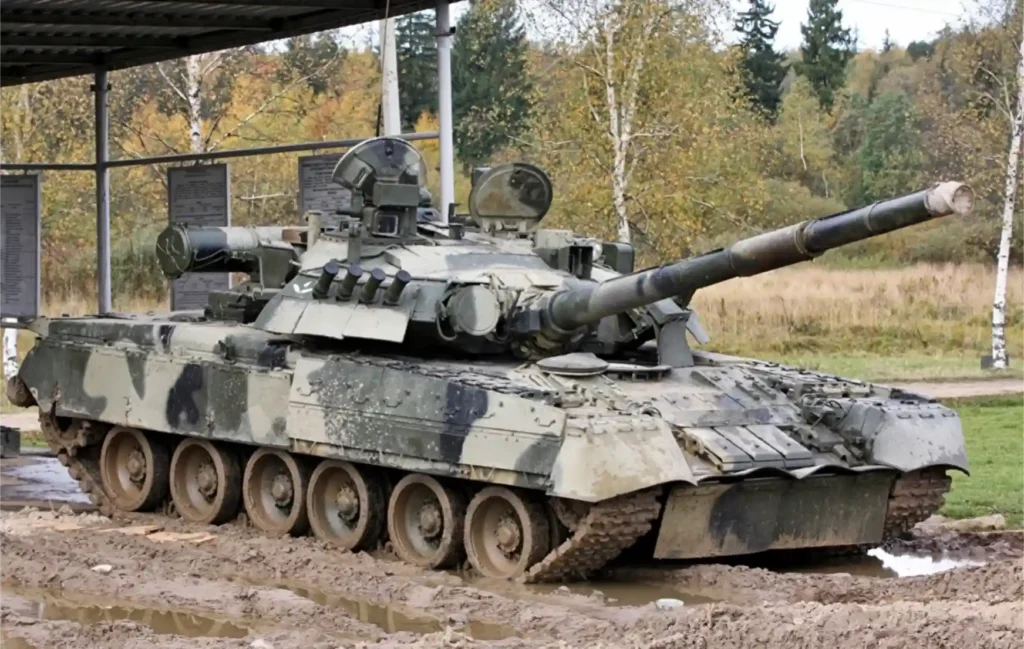
In recent years, Russia has turned to upgrading its existing T-80 fleet rather than developing entirely new models. The most advanced of these modernizations is the T-80BVM tank, featuring cutting-edge Relikt ERA, new thermal imaging systems, upgraded digital fire control, and reinforced protection against modern threats.
The T-80BVM is tailored for the Arctic brigades, where its gas turbine performs better than diesel engines in sub-zero environments. This version of the T80 tank reflects Russia’s confidence in the platform’s adaptability to future warfare, despite its original design dating back to the 1970s.
The combat performance of the T-80 tank has been a subject of both admiration and controversy since its introduction into active service. While the T-80 MBT was designed with superior mobility and firepower in mind, its battlefield reputation has been shaped by a mix of real-world deployments, training exercises, and wartime losses that highlighted both its strengths and shortcomings.
The first notable combat use of the T-80 tank model occurred during the First Chechen War in the mid-1990s. Here, Russian T-80BV tanks were deployed in urban environments like Grozny, where they suffered significant losses due to ambush tactics, inadequate infantry support, and a lack of proper urban combat doctrine. Many of these losses were blamed not on the technical faults of the T80 tank itself but on poor operational planning and crew training.
In open terrain, where the tank’s speed and T-80 tank engine power could be properly exploited, the vehicle fared much better, displaying excellent maneuverability and responsiveness thanks to its gas turbine propulsion system—a feature that still distinguishes the T-80U tank and T-80BVM tank variants from diesel-powered counterparts like the T-72 tank.
In recent years, the T-80BVM tank variant has been deployed by Russian forces in the ongoing conflict in Ukraine. Its modernized armor, optics, and fire control systems aim to address the vulnerabilities that earlier T-80 variants displayed in past conflicts.
Arctic brigades in Russia also favor the T80BVM due to its reliability in extreme cold—conditions that degrade the performance of conventional diesel engines but where the T-80 tank engine thrives. Despite its high T-80 tank cost and operational demands, Russian military doctrine still sees value in the T-80 platform, especially when rapid mobility and climate adaptability are critical factors.
When evaluating the T-80 tank against other prominent main battle tanks (MBTs) such as the American M1 Abrams, German Leopard 2, and the Russian T-72, its unique features become even more apparent. The most defining characteristic of the T-80 MBT is its gas turbine engine, which offers exceptional speed and cold-weather performance compared to the diesel-powered propulsion systems used in most Western tanks.
The T-80 tank engine gives the vehicle a power-to-weight ratio that allows for rapid acceleration and maneuverability, making it ideal for quick flanking maneuvers or fast redeployments on the battlefield. This agility often surpasses that of the T-72 and even modern variants like the T-90, which share more conventional diesel engines.
However, this same turbine engine contributes to the T-80 tank cost, which has historically been higher than that of its Soviet stablemates like the T-72 and T-90. The maintenance burden of the gas turbine—especially in dusty, hot environments—has been a limiting factor in its broader deployment.
In contrast, Western tanks like the M1 Abrams also feature a gas turbine but benefit from far superior logistical and support networks, particularly in NATO countries. When it comes to protection, advanced T-80 variants like the T-80BVM tank and T-80U tank employ Relikt and Kontakt ERA, comparable in concept to the composite and reactive armors found on Western MBTs, though generally rated slightly below the latest NATO tanks in terms of all-around survivability.
In terms of firepower, the T-80 MBT uses the 125mm 2A46 smoothbore gun—standard for Soviet and Russian tanks—which offers compatibility with a wide range of ammunition types, including gun-launched ATGMs. This gives the T80 tank a distinct advantage over tanks like the Leopard 2 and Challenger 2, which lack integral missile capability.
Overall, while the T-80 tank model may not surpass the latest Western tanks in every category, its balance of speed, firepower, and cold-climate specialization makes it uniquely suited to Russia’s strategic needs. The continuing upgrades and adaptations across various T-80 variants, including the T80U, T80UD, and T80BVM, illustrate the enduring value of this Cold War-era design in an era of fifth-generation tank development.
The story of the T-80 tank is one of innovation, adaptation, and enduring relevance. Originally envisioned as a breakthrough design to outclass Western MBTs, the T-80 MBT introduced features like a gas turbine engine and advanced armor that were unmatched in its time. These bold design choices made the tank faster, more agile, and highly effective in extreme environments, but they also contributed to its high operational cost, limiting its widespread adoption both at home and abroad. The T-80 tank cost and complexity confined it largely to elite units within the Soviet and later Russian armies, setting it apart from the more ubiquitous T-72.
Throughout its lifespan, the T-80 tank model has evolved through numerous variants—T-80B, T-80BV, T-80U, T-80UK, T-80UD tank, and the modern T-80BVM tank—each bringing refinements to firepower, protection, and mobility. The T-80UD, in particular, found success in export markets like Pakistan, where its diesel engine provided a practical alternative to the turbine-powered versions. Meanwhile, Russia’s T80BVM tank represents the pinnacle of these developments, integrating state-of-the-art ERA and thermal imaging systems to keep the platform viable against today’s threats.
Looking forward, the T80 tank is set to remain a key component of Russia’s armored forces, especially in specialized roles such as Arctic warfare, where its turbine engine outperforms diesel rivals. While its high T-80 tank price and logistical demands may deter new customers, its performance, proven adaptability, and continuous upgrades ensure that the T-80 MBT remains a respected name in armored warfare history. Whether in the frozen north, the deserts of foreign clients, or the urban battlefields of modern conflicts, the legacy of the T-80 tank is far from over.