Follow Us:
Follow Us:


Defense Feeds – Three Nations Collaborate in Landmark Aircraft Carrier Exercise in the Philippine Sea on August 10, 2025
The United States, United Kingdom, and Japan brought together three of their aircraft carriers in close formation — a historic moment in multinational naval cooperation.
This unprecedented exercise featured the British HMS Prince of Wales, American USS George Washington, and Japanese JS Kaga sailing side by side, escorted by the American amphibious assault ship USS America and backed by a robust aerial and naval task force.
This rare coalition, combining the strengths of three advanced carrier strike groups, represents a major step forward in allied interoperability and projects formidable combined naval power in one of the world’s most strategic maritime regions.
Supporting vessels from Norway, Spain, and Australia further enhanced protection and logistical capabilities during this complex operation.
The HMS Prince of Wales represents the UK’s Queen Elizabeth-class carriers, optimized for operations with F-35B short takeoff and vertical landing (STOVL) fighters plus a complement of support helicopters.
The USS George Washington, a Nimitz-class nuclear-powered aircraft carrier, hosted Carrier Air Wing 5, which includes a diverse air fleet such as multirole F/A-18E/F Super Hornets, E-2D early warning planes, and EA-18G electronic attack jets.
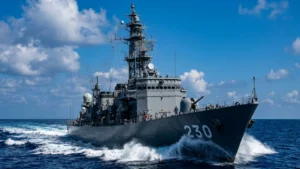
Meanwhile, the JS Kaga reflects Japan’s evolving maritime strategy, being an Izumo-class helicopter carrier undergoing conversion to accommodate F-35B jets, indicating a strategic expansion towards enhanced fixed-wing air operations.
The USS America amphibious assault ship provided additional STOVL aviation capability and amphibious landing force deployment options, underscoring the integrated combat and support facets of this multinational task group.
Escorting the carriers were U.S. Navy warships USS Robert Smalls (a Ticonderoga-class cruiser specialized in area air defense) and USS Shoup (an Arleigh Burke-class destroyer skilled in anti-submarine, anti-air, and surface warfare).
This layered defense grid was further strengthened by allied frigates and destroyers from Norway, Spain, and Australia.
The multifaceted training spanned anti-submarine warfare, cross-deck flight operations (notably British and American F-35B fighters operating from Japan’s JS Kaga), interoperable refueling and aircraft maintenance drills, and real-time tactical data exchange over secure networks.
This operational synergy enables these diverse naval forces to harmonize various doctrines, combat systems, and operational cultures into a cohesive fighting unit, significantly enhancing their collective responsiveness.
The utilization of the F-35 platform as a shared air system served as a linchpin of interoperability.
With its advanced sensor fusion and networked data-sharing, the F-35 jets from different nations relayed targeting data across the task force, streamlining air operations and accelerating response times.
This common technology platform exemplifies how allied naval aviation can synchronize in challenging, multi-domain threat environments, boosting deterrence and survivability.
Beyond technical execution, this exercise sends a clear message in the context of geopolitical tensions in the Indo-Pacific region.
For the AUKUS alliance members—the US, UK, and Australia—joint operations alongside close allies including Japan, Norway, and Spain signify their mutual dedication to preserving freedom of navigation and preventing unilateral alterations to regional status quo.
The rapid assembly and sustained presence of such a powerful multinational naval force underscores their ability to deter potential regional threats.
Scheduled to conclude on August 12, this nine-day drill showcases not only the coordination of multinational maritime assets but also highlights the capability to project credible naval power swiftly into strategically sensitive waters.
By conducting synchronized operations with three carriers and a broad network of support vessels and aircraft, this deployment stands as a rare, potent example of collective maritime strength in a critical global hotspot.
This operation underscores the evolving dynamics of naval alliances in the Indo-Pacific and reinforces the commitment among partner nations to collaborative security and defense readiness, reflecting a shared vision for a stable and open maritime environment.