Follow Us:
Follow Us:


Defense Feeds – China Debuts KJ-600 “Nezha”, its next-generation carrier-based airborne early warning (AEW) and control aircraft, marking a significant milestone in naval aviation.
The new platform has attracted global attention following the commissioning of China’s third aircraft carrier, the Fujian.
Developed by the Aviation Industry Corporation of China (AVIC), the KJ-600 “Nezha” embodies a major leap forward in the People’s Liberation Army Navy’s (PLAN) drive for blue-water operational capability.
The name, inspired by the mythic hero Nezha, highlights how China blends its cultural heritage with advances in modern military aviation.
The KJ-600’s design combines advanced radar technology with a unique cultural narrative.
In a recent broadcast by China Central Television (CCTV), Geng Yansheng, head of the First Aircraft Institute under AVIC, explained that the aircraft’s engines, landing gear, and nose collectively evoke Nezha’s three heads, while its foldable wings and four vertical tails symbolize the deity’s six arms.
Even the spinning propellers are likened to Nezha’s “wind-and-fire wheels,” representing agility, speed, and divine power. Yet beneath this cultural metaphor lies a complex engineering achievement.
The aircraft’s most distinctive feature is its large radar dome, which houses a powerful phased array radar capable of detecting aerial and maritime targets at extended ranges.
This radar extends beyond the line-of-sight limitations of surface-based systems, offering a significant advantage in early warning operations.
Geng noted that accommodating such an oversized radar required extensive rebalancing of the aircraft’s center of gravity and control surfaces, pushing the limits of aerodynamic stability and structural integrity.
This combination of technological precision and cultural symbolism illustrates how the KJ-600 embodies both China’s engineering sophistication and its desire to project a distinct national identity through its defense innovations.
The “Nezha” moniker, therefore, is not merely symbolic but an intentional reflection of the aircraft’s power, resilience, and transformative purpose within the PLAN’s expanding naval strategy.
The KJ-600’s introduction marks a critical step toward enhancing China’s carrier strike group operations.
Defense commentator Zhang Xuefeng, cited by the Global Times, described the aircraft as a “force multiplier” comparable to the U.S. Navy’s E-2D Hawkeye, allowing the Fujian carrier group to conduct complex missions farther from China’s coastline.
One of its key strategic functions is bridging the detection gap caused by Earth’s curvature, which limits surface radar coverage against low-flying threats such as sea-skimming cruise missiles or stealth drones.
By operating several hundred kilometers from the carrier, the KJ-600 significantly extends the carrier group’s detection range and situational awareness.
This airborne vantage point enables the early identification of potential threats, giving the fleet more time to respond with defensive or offensive actions.
Additionally, its digital combat systems integrate real-time data collection, analysis, and dissemination, linking seamlessly with other ships, aircraft, and command centers.
CCTV reports emphasize that the KJ-600 also acts as an airborne command post, capable of directing intercept missions and coordinating tactical operations across the carrier strike group.
This network-centric function represents a major evolution in China’s naval doctrine, moving from isolated platform operations toward fully integrated maritime command and control systems.
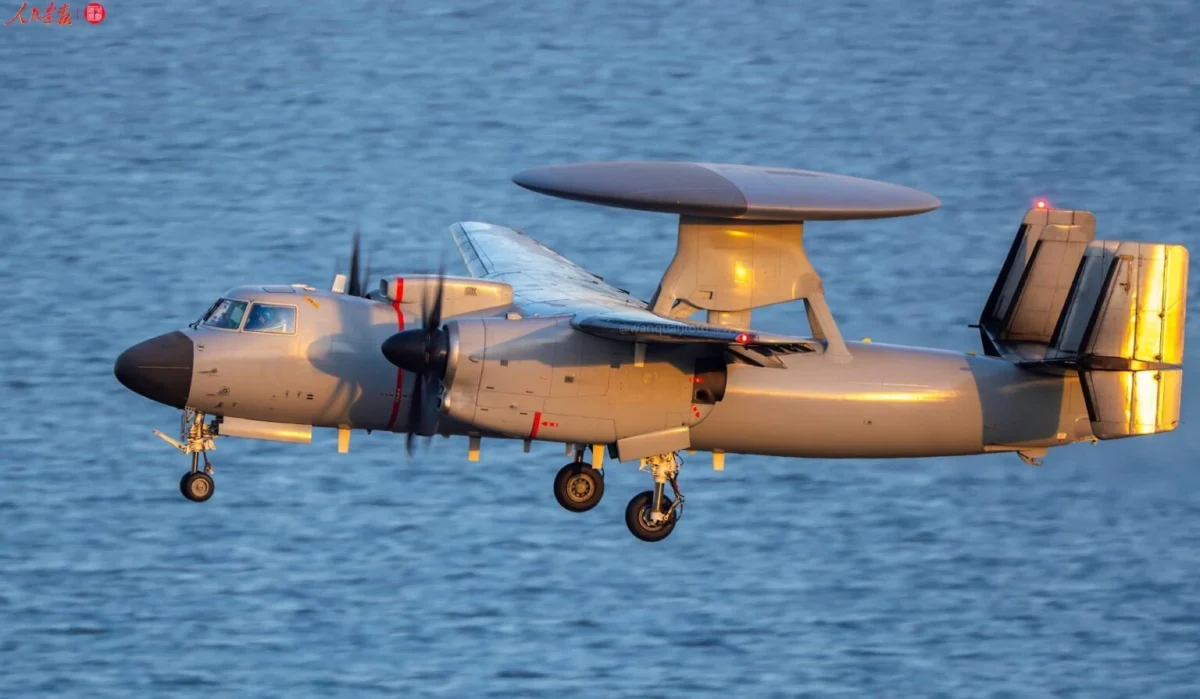
The KJ-600 was built for challenging sea conditions, featuring a carrier-grade turboprop engine with corrosion protection and a reinforced structure for catapult launches and arrested recoveries.
Chinese reports note its versatility across rescue, disaster response, and airspace management missions.
Integrated into the Fujian carrier’s air wing, the KJ-600 enhances fleet coordination and long-range awareness, marking China’s step toward global naval parity.
More than advanced engineering, the “Nezha” reflects China’s aim to blend cultural identity with expanding maritime power.