Follow Us:
Follow Us:

When you think of “Navy power,” your mind probably goes straight to those massive aircraft carriers or sleek fighter jets screaming off the deck.
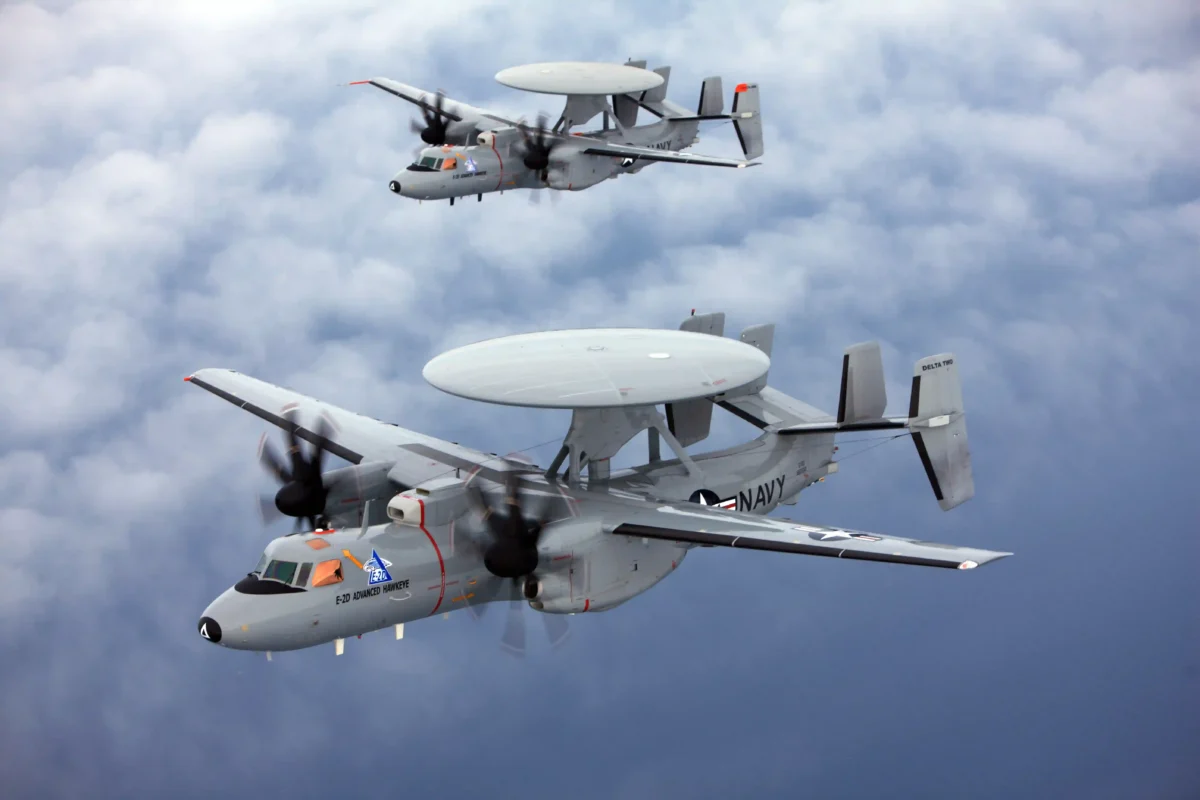
But honestly? There’s a good chance the most important plane in the sky is the one that looks a bit like it’s carrying a giant frisbee. We’re talking about the E-2D Advanced Hawkeye.
If you’ve followed naval aviation for a while, you might be thinking, “Wait, hasn’t that plane been around forever?” Well, yes and no. While it definitely shares a silhouette with the older E-2C Hawkeye, the “Delta” model is a completely different beast under the hood. It’s not just an “upgrade”; it’s more like a total digital rebirth.

The basic E-2D Hawkeye’s purpose is to act as the “quarterback” for the entire fleet. It sits up there at 30,000 feet, seeing things that ships on the surface simply can’t. It’s pretty safe to say that without this E-2D aircraft circling overhead, the Navy’s high-tech fighters would basically be flying blind.
In this post, we’re going to dig into why the E-2D Advanced Hawkeye radar is such a game-changer and why this platform is likely the glue holding the US maritime strategy together.
It’s probably best to think of the E-2D Advanced Hawkeye as a massive technological bridge. If you were to park it next to the older E-2C Hawkeye, you’d struggle to see much of a difference at first glance.
They have the same twin-turboprop look and that unmistakable radar rotodome. But once you get into the cockpit and the mission systems, it’s clear that the E-2D aircraft, or the guts of the “Delta” are almost entirely new.
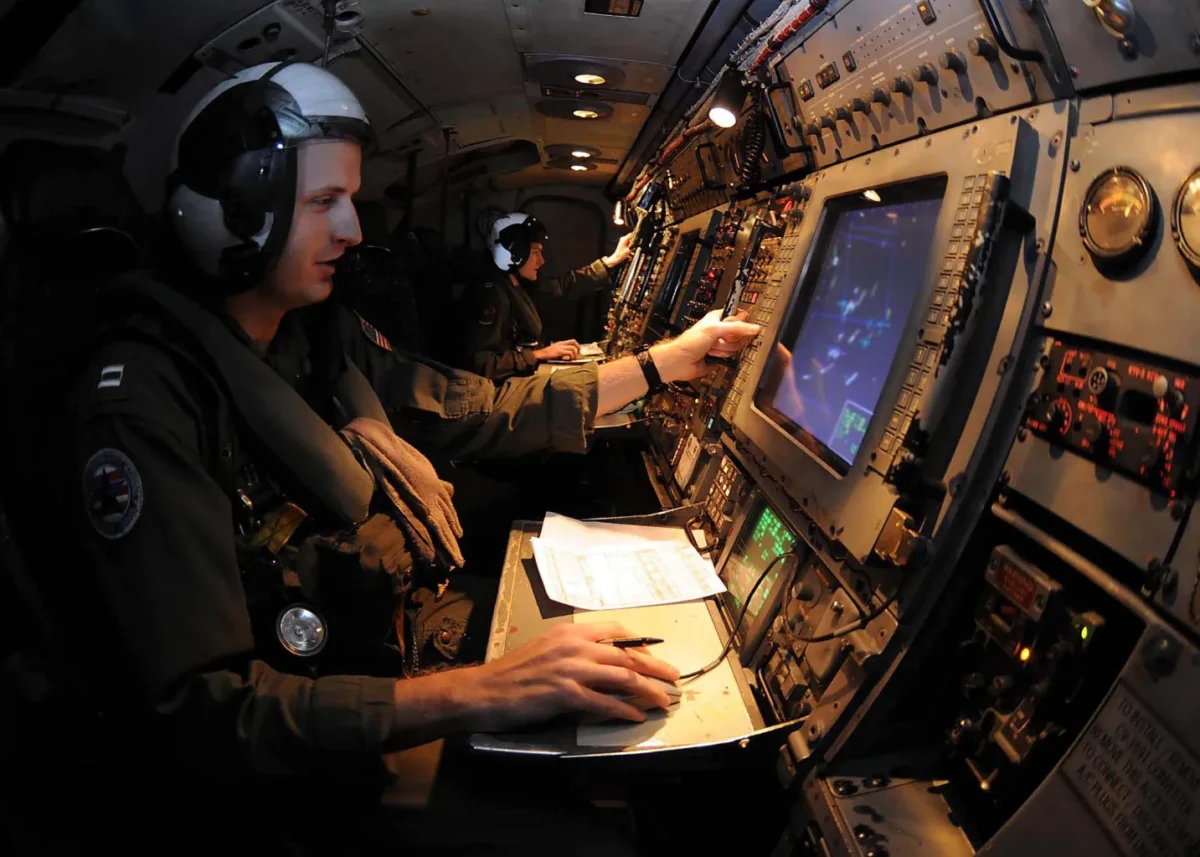
The shift from the C to the D model was really about moving from an analog-heavy era into an entirely digital one. While the E-2C was great for its time, it arguably started to hit a ceiling when it came to tracking modern, “quiet” threats. The E-2D was built to fix that. It’s basically a flying command center.
Within the Navy fleet, its role is pretty unique. It’s essentially the eyes and ears of the carrier strike group. Because the Earth is curved (a simple fact that makes life hard for ship-based sensors), the ships can’t see over the horizon.
The E-2D Hawkeye’s purpose is to get high enough to “look down” and spot threats long before they ever get close to the fleet. It’s a bit of a cliché to call it the “quarterback,” but it’s probably the most accurate way to describe how it manages the flow of information for everyone else in the air and on the water.
If you’ve ever stood on the deck of a ship, you’ve probably noticed that the horizon feels like a hard limit. Because of the Earth’s curvature, even the most expensive shipboard radars are essentially blind to anything happening low to the water once it gets a certain distance away.
In modern naval warfare, that “blind spot” is where the most dangerous threats, like sea-skimming cruise missiles or low-flying strike jets, tend to hide.
Read also: AWACS Aircraft – How They Dominate the Skies with Radar Power
This is arguably where the E-2D Hawkeye’s purpose becomes most apparent. By taking the radar up to 30,000 feet, you’re effectively pushing that horizon back by hundreds of miles. It’s the difference between having thirty seconds to react to an incoming missile and having twenty or thirty minutes.
Beyond just “seeing” things, early warning is essential because it fundamentally changes how the Navy fights. Without the E-2D aircraft acting as a high-altitude sensor, the rest of the fleet is forced to play a defensive, reactive game. With it, the Navy can transition to an offensive posture.
It allows commanders to see the “whole board,” identifying threats while they’re still far enough away to be intercepted by fighters or long-range missiles. It’s hard to overstate how much of a force multiplier this is; having that “eye in the sky” basically removes the element of surprise from the enemy’s playbook, which is usually the one thing they’re banking on.
When people talk about the “secret sauce” of this platform, they’re almost always talking about the E-2D Advanced Hawkeye radar, specifically the AN/APY-9. If the aircraft is the body, this radar is the brain.
It’s a bit of a technical marvel because it manages to combine two different worlds: it uses a mechanical rotation to give you that full 360-degree “look” around the horizon, but it also uses an electronically scanned array to focus in on specific targets with incredible precision.
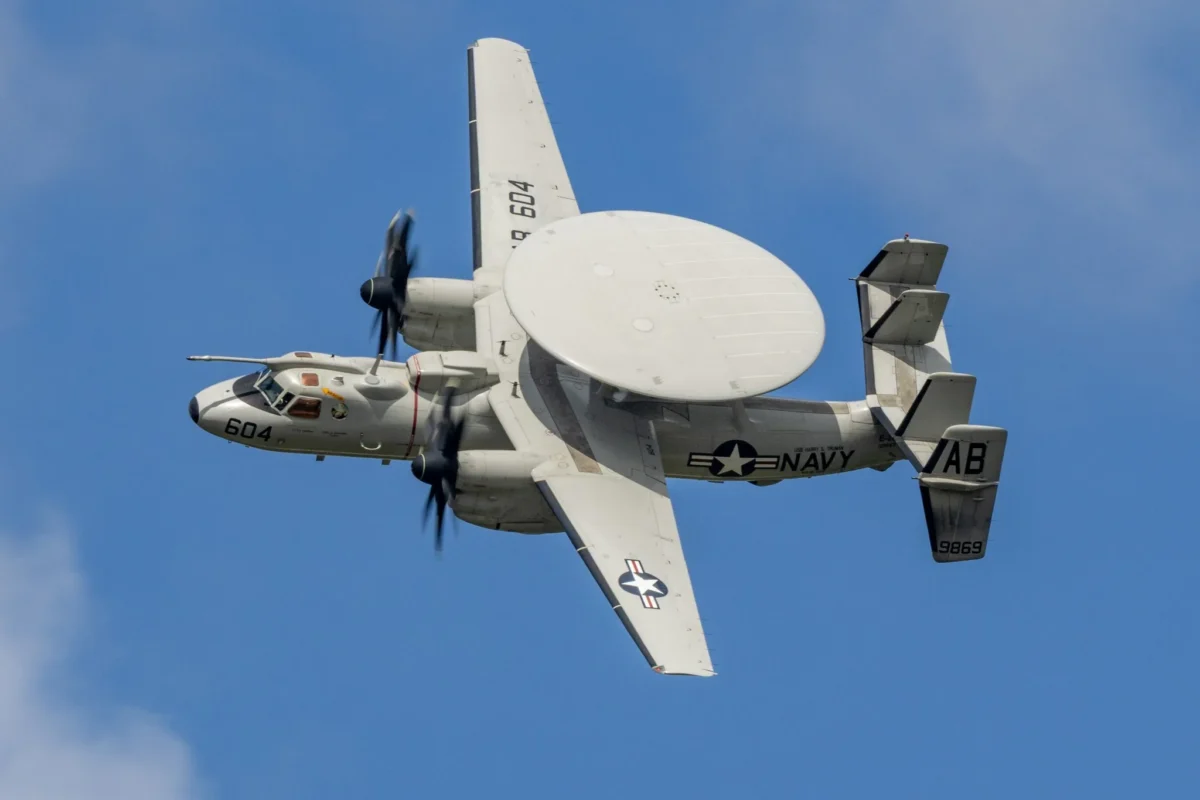
Here is a breakdown of why this specific tech is such a big deal:
In the past, different types of aircraft often felt like they were living in their own little worlds, only sharing basic info over the radio. But with the E-2D Advanced Hawkeye, that’s mostly a thing of the past.
Nowadays, it’s all about “sensor fusion,” basically taking the data from every plane, ship, and drone and blending it into one big, crystal-clear picture of the sky.
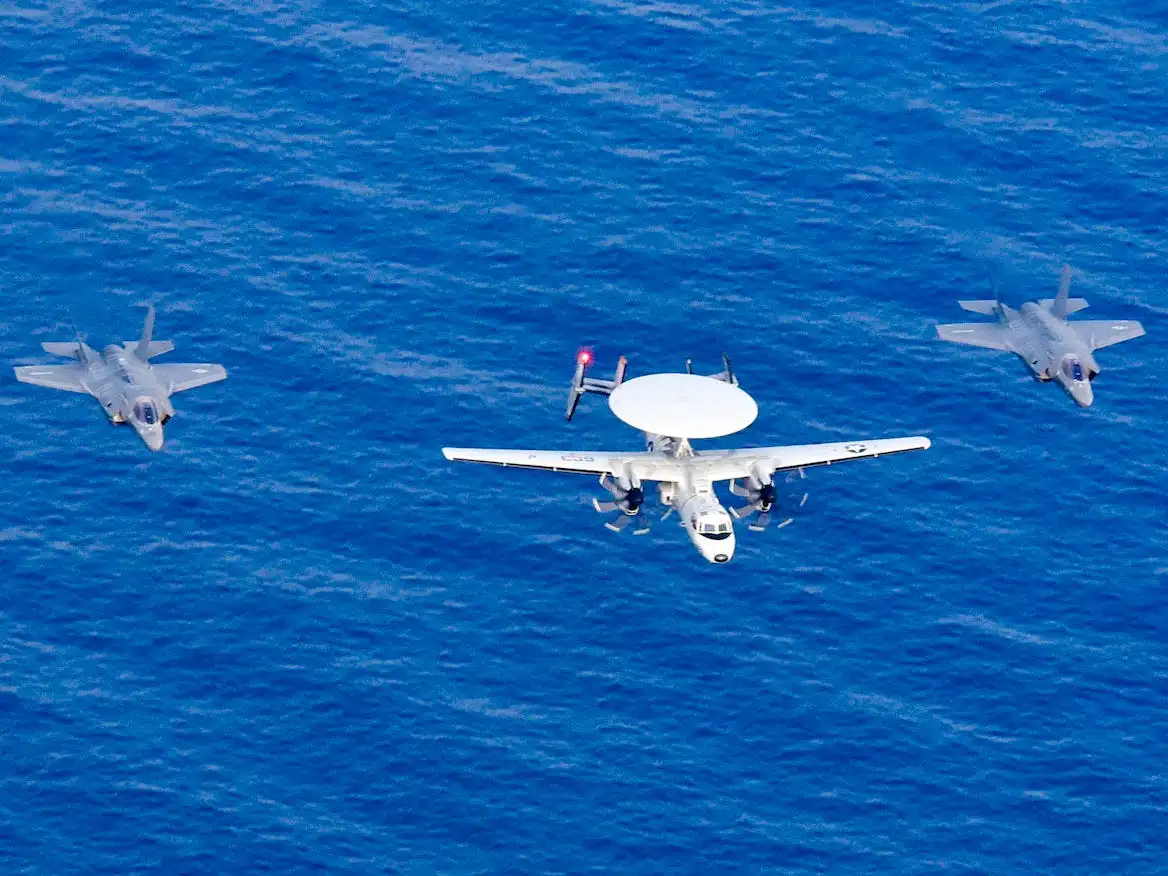
Here’s how that actually looks in practice:
Linking the High-Tech Crowd: The E-2D acts as a bridge between older jets like the F/A-18 Super Hornet and the newer, stealthy F-35 Lightning II. It uses something called the Naval Integrated Fire Control-Counter Air (NIFC-CA) architecture.
It’s a bit technical, but essentially it means an F-35 can sneak forward with its radar off to stay hidden, “see” an enemy with its passive sensors, and then pass that data to the E-2D. The Hawkeye then shares that target with a ship or another fighter to take the shot.
Shared Battlespace Awareness: The E-2D aircraft is not just sending coordinates; it’s sharing “quality” data that’s good enough to guide a missile.
This allows everyone, including allied aircraft from partners like Japan or France, to see exactly what the Hawkeye sees. It removes the guesswork. If one pilot spots a threat, the whole fleet knows about it instantly.
The Ultimate Relay: Think of the E-2D as a high-altitude Wi-Fi router for the military. Since stealth jets have limited range on their own specialized data links, the Hawkeye sits in the middle, translating and boosting those signals so the carrier group hundreds of miles away stays in the loop.
It’s probably safe to say that the F-35 is a lot more lethal when it has a Hawkeye backing it up.
By combining the stealth and sensors of the 5th-gen fighters with the massive “look-down” power of the E-2D Advanced Hawkeye radar, the Navy creates a “kill web” that’s incredibly hard for an adversary to untangle.
How exactly does the E-2D aircraft stay relevant when facing the massive military machine of a peer competitor? It’s a fair question, especially given how much the global landscape has shifted lately.
While the Hawkeye isn’t out there picking fights, it acts as the primary shield for the Navy by dismantling the “bubbles” of protection that adversaries try to build around themselves.
When we talk about countering the Anti-Access/Area Denial (A2/AD) strategies used by countries like China and Russia, we’re essentially talking about a giant game of “keep away.” Their goal is to use long-range missiles and advanced sensors to push U.S. carriers so far back that they can’t effectively join the fight.
The E-2D Advanced Hawkeye is probably the best tool the Navy has for popping that bubble. Because its E-2D Advanced Hawkeye radar can see through a lot of the noise and decoys these nations use, it allows the carrier strike group to move closer with a much clearer picture of where the real dangers are hiding. It basically takes away the “home field advantage” that A2/AD is supposed to provide.
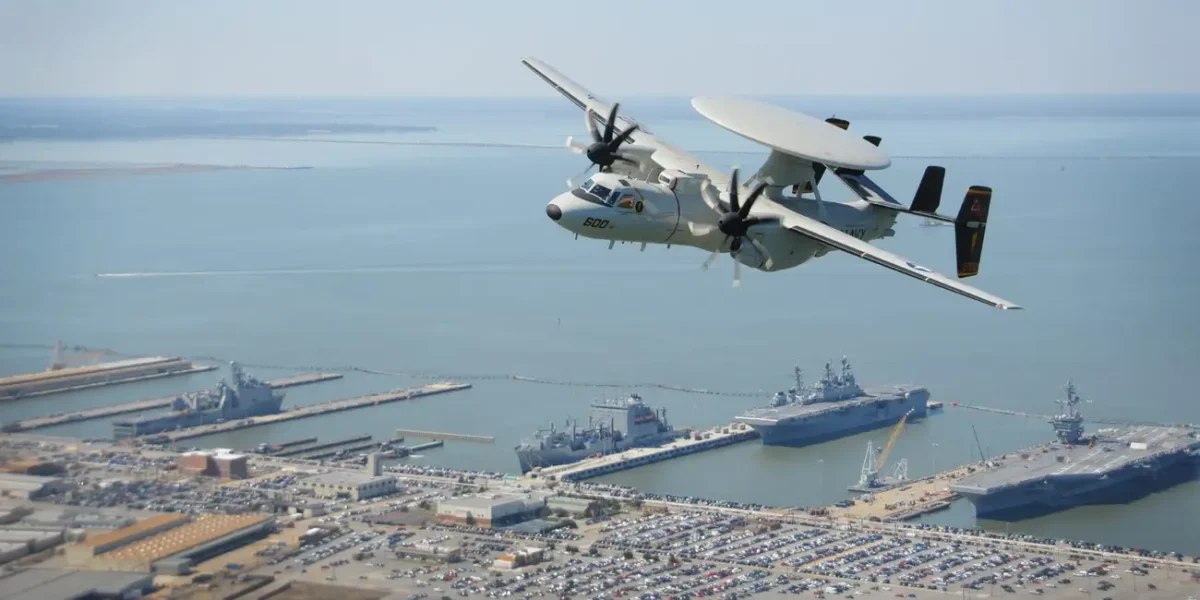
One of the scariest things on the modern battlefield right now is the rise of hypersonic missiles. This is where the E-2D Hawkeye’s purpose shifts into high gear.
By sitting high in the air, the Hawkeye can spot these high-speed threats much earlier in their flight path. While it might not be able to “intercept” a hypersonic missile itself, it can pass that tracking data to a destroyer or an F-35 in real-time, giving the fleet’s defense systems the precious seconds they need to actually react. It’s essentially the only way to build a reliable “look-down” defense against things that are designed to bypass traditional radar.
At the end of the day, all of this tech exists for one main reason: protecting the aircraft carriers and the forward-deployed forces that rely on them. A carrier is a massive, high-value target, and keeping it safe in a high-threat environment is an exhausting job.
The Hawkeye manages this by creating a massive “buffer zone” around the fleet. It’s constantly scanning for everything from swarming small boats to stealthy strike jets, ensuring that no one gets close enough to take a shot without the Navy knowing about it first.
For the sailors and pilots working in those forward positions, the E-2D aircraft is basically the ultimate insurance policy.
Ultimately, you have to ask: why is no carrier strike group considered complete without a Hawkeye? It really comes down to the fact that operating without one is basically like trying to win a game of chess while wearing a blindfold. Without that airborne early warning, the operational risks are just staggering.
You’re essentially betting the lives of thousands of sailors on the hope that your ship’s sensors, which are inherently limited by the horizon, will catch a supersonic missile or a stealth jet with only seconds to spare. In a modern high-end fight, that’s a bet most commanders aren’t willing to make.
When you look at how other navies do things, the E-2D Advanced Hawkeye stands in a league of its own. Most allied and adversary systems either rely on helicopters with smaller, less powerful radars or much heavier land-based planes that can’t stay with the fleet.
Neither option really compares to the E-2D aircraft in terms of endurance or the sheer sophistication of the E-2D Advanced Hawkeye radar.
This platform is arguably the only reason the US Navy can project power so far from home; it turns a vulnerable group of ships into an impenetrable, interconnected network. Without it, a carrier strike group is dangerously exposed.