Follow Us:
Follow Us:


Defense Feeds – UK Expands Challenger 2 Tank Fleet as the British Army significantly strengthens its heavy armour capabilities, adding up to 288 main battle tanks in service as of April 2025.
The expansion, detailed in the Ministry of Defence’s UK Armed Forces Equipment and Formations 2025 report, marks a major rise from 219 tanks recorded the previous year.
This surge reflects London’s renewed commitment to a powerful heavy land force under NATO’s evolving defence posture.
The latest data shows that while the total figure of 288 represents the whole Challenger 2 inventory, not all vehicles are combat-ready.
Many of the tanks remain in storage, assigned to training duties or undergoing refurbishment for spare parts recovery.
Defence analysts note that the real value of this increase lies in the UK’s effort to rebuild depth and resilience in its armoured formations rather than just inflating numbers.
The Challenger 2 remains the backbone of Britain’s heavy battle fleet. Designed with Dorchester/Chobham composite armour and equipped with the 120 mm L30A1 rifled gun, it has proven reliable in urban and desert operations.
However, the reliance on a rifled gun restricts ammunition compatibility with standard NATO 120 mm smoothbore rounds used by platforms like the Leopard 2 and Abrams.
Because of these limitations and ageing components, the Ministry of Defence initiated modernization under the Challenger 3 program to ensure the UK Expands Challenger 2 Tank Fleet into a more modern and formidable system for future combat environments.
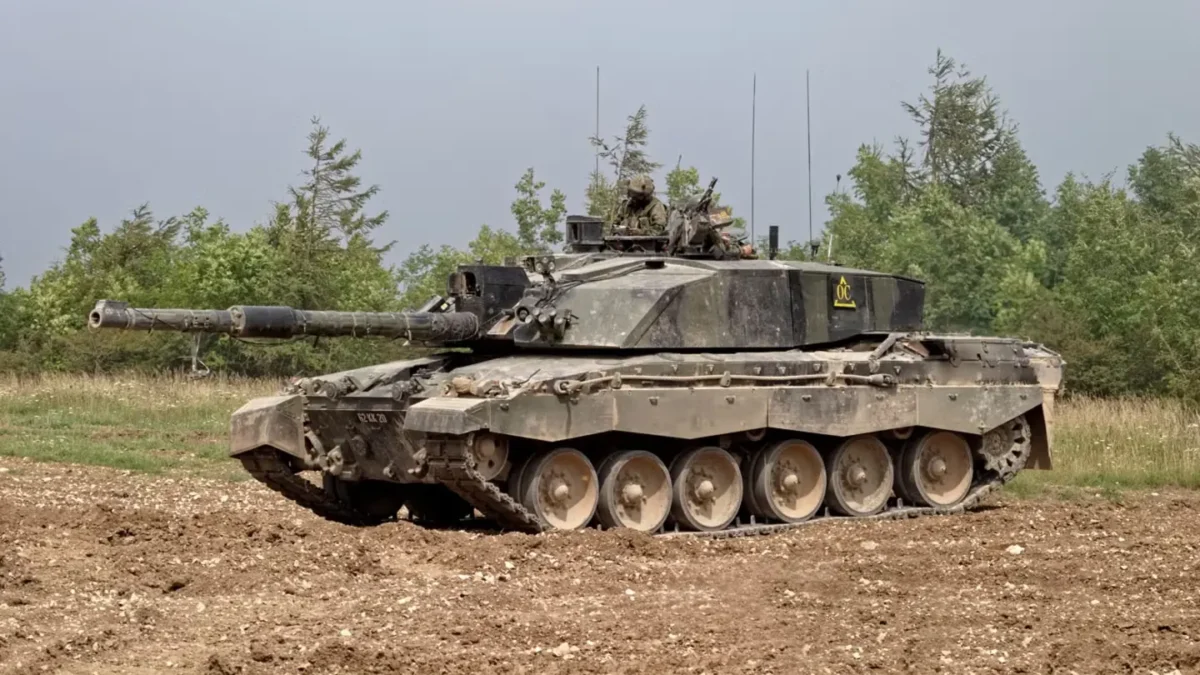
The cornerstone of Britain’s armoured renewal lies in the Challenger 3 upgrade initiative.
Announced in 2021, the £800 million contract with Rheinmetall BAE Systems Land (RBSL) covers the conversion of 148 existing Challenger 2s into the new configuration.
The upgrade includes an entirely new turret fitted with Rheinmetall’s 120 mm L55 smoothbore gun, advanced digital systems, improved optics and an active protection suite designed to intercept modern anti-tank threats.
This program will align the British Army’s heavy armour with common NATO ammunition and electronics standards, bridging the capability gap with leading European tank fleets.
Germany continues to modernise its Leopard 2A7 and A8 variants, while Poland is expanding its armour pool with K2 Black Panther and Abrams tanks.
For London, the Challenger 3 fleet will provide interoperability, improved lethality and enhanced survivability for decades to come. The 288 declared Challenger 2 inventory forms the foundation for this transformation.
Many older hulls are being preserved and refurbished, ensuring the Army can sustain maintenance cycles and balance operational readiness with steady modernization.
Once delivered, Challenger 3 tanks are expected to enter active service gradually through the late 2020s, replacing older platforms on a rolling basis and ensuring Britain maintains credible heavy formations on NATO’s eastern flank.
Beyond capability, the industrial dimension is equally critical. The Challenger 3 program reinforces the UK’s domestic defence industry, providing long-term roles for British suppliers in turret production, sensor delivery and vehicle assembly.
The effort strengthens the country’s manufacturing resilience while maintaining key expertise in heavy vehicle engineering.
The Ministry of Defence’s updated numbers carry both practical and symbolic implications.
Strategically, the restored tank inventory provides the Army with long-term depth to support training, maintenance and operational rotations without overstretching its limited frontline assets.
It also ensures that the UK can sustain forces in high-intensity conflict environments, augment NATO’s forward defences, and retain the flexibility to respond to emerging crises.
Politically, the announcement sends a clear signal to European allies that London remains committed to conventional defence.
The decision to maintain a robust heavy armour backbone counters earlier speculation that Britain would downsize its tank capability after donating units to Ukraine.
Instead, the UK is balancing forward support to Kyiv with the ambition to field a capable and modern armoured force at home.
Defence analysts note that the challenge ahead lies not in numbers but in sustained readiness.
Without consistent investment in maintenance and spare parts, the operationally available fleet could drop below 200 deployable tanks, as seen in 2023.
Nonetheless, the combination of refurbishment, industrial backing and modernisation through Challenger 3 places the Army on a stable path toward regeneration.
By declaring a total of 288 tanks, the UK demonstrates that it is rebuilding both its physical and industrial armoured strength.
If modernization goals and maintenance support are met, Britain’s heavy forces will regain the combat credibility and deterrent value essential for NATO operations and national defence well into the next decade.