Follow Us:
Follow Us:

Defense Feeds – Taiwan Deploys First M1A2T Abrams Tank as part of its military modernization, officially bringing the U.S.-made main battle tanks into service.
The commissioning ceremony took place on October 31, 2025, at Hukou base in Hsinchu County, where President Lai Ching-te led the formation of the island’s first Abrams-equipped battalion.
The 3rd Combined Arms Battalion of the 584th Armored Brigade transitioned from older CM11 Brave Tiger tanks to the advanced M1A2T model.
Senior defense officials, including Defense Minister Wellington Koo and representatives from the American Institute in Taiwan, attended the event featuring a 21-gun salute and an inspection ceremony.
President Lai stressed the importance of adopting new training doctrines and operational concepts to effectively integrate the Abrams tanks into Taiwan’s evolving defense strategy.
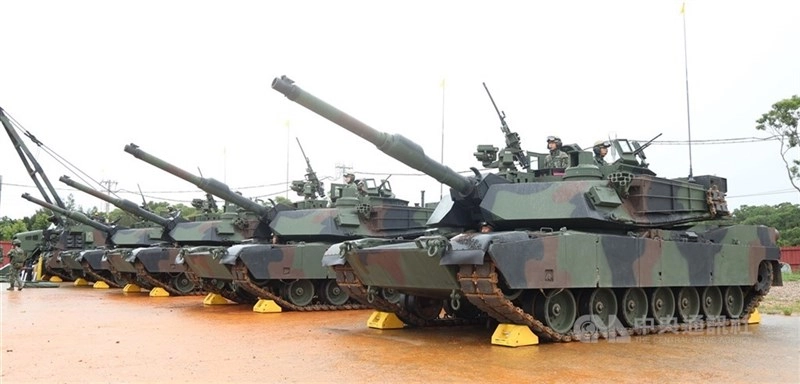
The introduction of the M1A2T completes a major step in the 2019 $2 billion Foreign Military Sales deal with Washington.
The agreement includes 108 Abrams tanks, 14 M88A2 Hercules recovery vehicles, 16 M1070A1 heavy transporters, and 16 M1000 trailers.
Production took place at U.S. Army facilities in Anniston and Lima, Ohio, under strict quality inspection by American liaison officers.
Taiwan received 80 Abrams tanks so far, with 38 delivered in December 2024 followed by 42 more in July 2025.
The remaining 28 are scheduled to arrive in early 2026. Part of the fleet is assigned to armor training, while operational units are now deployed with the 584th Armored Brigade in Hsinchu and the 269th Mechanized Infantry Brigade in Linkou.
These brigades play critical roles in protecting northern Taiwan, including the Taoyuan, Zhubei, and Taipei approach corridors.
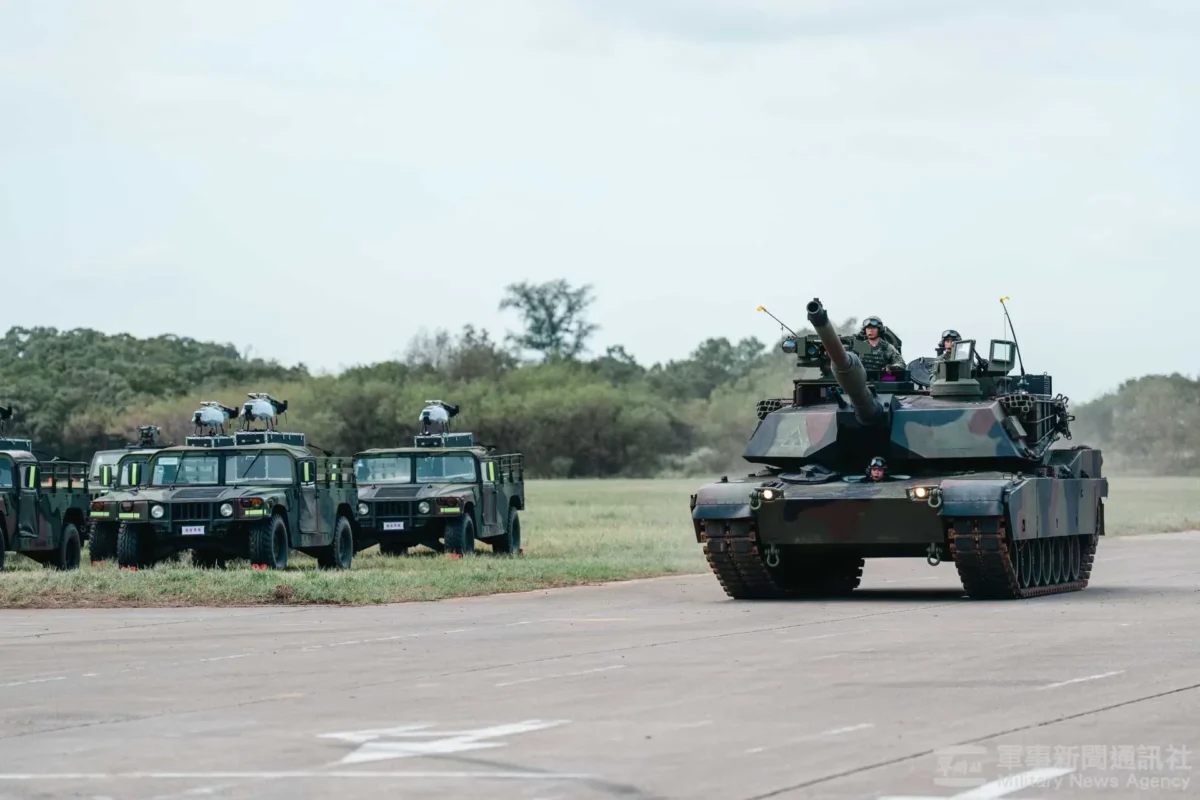
The M1A2T variant was customized for Taiwan based on the U.S. M1A2 SEP v2 platform. It features the same 120 mm M256 L/44 smoothbore gun, capable of firing high-performance APFSDS and HEAT rounds, along with the advanced programmable M1147 AMP munition.
The tank includes a digital fire-control system providing hunter-killer engagement capability, allowing both commander and gunner to target independently with high precision.
To comply with export limits, the M1A2T uses advanced composite armor and explosive reactive panels instead of the depleted uranium plating found on U.S. versions.
It lacks the Trophy active protection system but integrates electronic battle management, thermal sensors, and a low-profile CROWS system for defensive fire.
With a Honeywell AGT1500C gas turbine engine generating 1,500 horsepower, the 68–72-ton tank reaches speeds of up to 67 km/h and has an operational range near 426 km.
Training for Abrams crews began in early 2025, including live-fire drills at the newly built Kengzikou Range during the Han Kuang 41 exercise.
The tanks demonstrated accurate hits on both static and moving targets, underscoring their precision in simulated combat against PLA-style threats.
The deployment of the M1A2T Abrams fits into Taiwan’s broader five-layered coastal defense concept, which integrates missile systems, air defenses, and mechanized counterattack units.
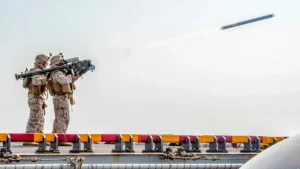
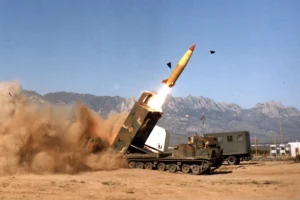
The Ministry of National Defense is also fielding complementary U.S. systems such as M142 HIMARS rocket launchers, ATACMS tactical missiles, Volcano mine-layers, PAC-3 MSE interceptors, Javelin and TOW-2B missiles, and FIM-92 Stingers.
By 2026, both the Abrams and HIMARS platforms are expected to reach full integration into Taiwan’s C4ISR network, significantly enhancing battlefield awareness and maneuverability.
Analysts believe the new tanks will play a defensive role in inland urban counteroffensives rather than on vulnerable coastal lines, ensuring stronger deterrence against potential incursions.
President Lai reaffirmed Taiwan’s stance that strengthening defense capabilities is essential for peace, declaring that every investment in defense represents an investment in stability and sovereignty.