Follow Us:
Follow Us:

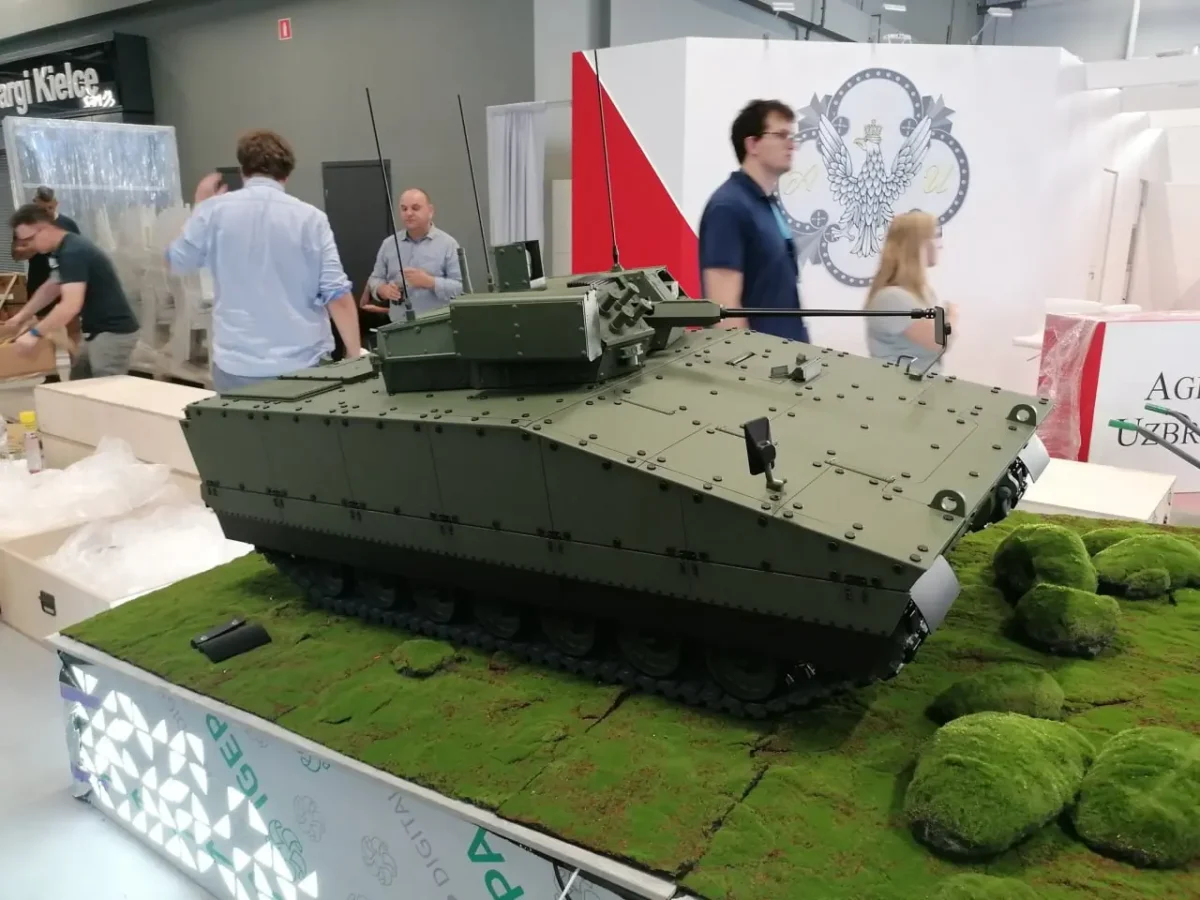
Defense Feeds – Polish HSW Heavy IFV was officially unveiled at MSPO 2025 in Kielce, marking a critical advancement in Warsaw’s effort to modernize its army and expand defense production.
On September 2, 2025, defense consortium PGZ and its subsidiary Huta Stalowa Wola (HSW) introduced the concept vehicle during the MSPO 2025 international defense exhibition.
Built for high-intensity warfare, the tracked heavy infantry fighting vehicle strengthens the Polish Army as it rivals next-generation armored systems from Asia and Europe.
The unveiling of the Polish HSW Heavy IFV comes at a pivotal time as Poland accelerates investment in modern weapon systems in response to the war in Ukraine and growing threats on NATO’s eastern flank.
Unlike foreign imports, this indigenous platform reflects Poland’s ambition to boost defense autonomy while also positioning the country as a competitive exporter in the global armored vehicle market.
The proposed Polish heavy IFV takes lessons from recent combat experiences in Ukraine, where armored vehicles must operate in environments saturated with artillery fire, drones, precision-guided weapons, and improvised explosive devices.
Built on a rugged tracked chassis, the new vehicle has been engineered for high maneuverability across multiple terrains, from urban battlegrounds to muddy fields.
The crew configuration supports a driver, a commander, and up to eight dismounted troops, allowing the safe transport of a fully equipped infantry squad directly into contested zones.
Compared to the existing Borsuk infantry fighting vehicle, which is lighter, this new design emphasizes heavier armor, higher survivability, and firepower, making it more suitable for frontline mechanized brigades.
The vehicle is constructed with NATO STANAG-standard ballistic protection, providing resistance against modern anti-armor threats, mines, and improvised explosives that have proven highly lethal in recent conflicts.
In addition, the modular armor approach creates room for future reinforcement as adversaries introduce more sophisticated weapons systems.
At the heart of the HIFV’s offensive capability lies the ZSSW-30 remote-controlled turret, capable of mounting a 30 to 40mm automatic cannon, a coaxial machine gun, and integrated Spike anti-tank guided missile launchers.
This lethal package ensures that the vehicle can deal with a wide range of battlefield threats — from infantry and fortified enemy positions to the most advanced main battle tanks.
In addition to traditional armaments, Poland’s new IFV is being designed with next-generation survivability systems, ensuring relevance in rapidly evolving war zones. These include:
Furthermore, the HIFV integrates fully with Poland’s digital battlefield management systems, enhancing NATO interoperability and ensuring smoother coordination with allied forces.
Soldiers inside are also protected by NBC (nuclear, biological, chemical) filtration systems, ensuring survivability in extreme environments.
This layered mix of protection and firepower highlights Poland’s determination to address not only present combat needs but also challenges anticipated in the next decade.
Poland’s unveiling of the heavy infantry fighting vehicle underscores a broader national strategy to diversify its defense procurement while boosting domestic production capabilities.
In recent years, Warsaw has acquired advanced foreign systems such as the American M1A2 Abrams tanks, South Korean K2 Black Panther tanks, and K9 Thunder howitzers.
While these acquisitions have rapidly modernized Poland’s land forces, officials also recognize the importance of building self-reliance in defense manufacturing.
The heavy IFV program is therefore not only about equipping the Polish Armed Forces with a modern tracked armored vehicle, but also about strengthening Poland’s defense industrial base.
By developing an indigenous platform, PGZ and HSW are positioning themselves as competitive suppliers in the global armored fighting vehicle market, challenging established Western European defense firms while offering a NATO-compatible system.
If formally adopted into Polish service, the HIFV would complement the Borsuk IFV, creating a mixed fleet where lighter Borsuks handle rapid maneuver operations while the heavier variant leads mechanized assaults in high-threat environments.
This dual approach would significantly enhance Poland’s military flexibility on NATO’s frontline.
Military experts note that Poland is leveraging its strategic location as NATO’s eastern flank, investing not only in deterrence but also in becoming a regional hub for defense innovation and production.
With demand for armored fighting vehicles surging among European nations since the outbreak of the Ukraine war, Poland’s domestic IFV project has the potential to capture foreign interest, particularly among NATO members seeking proven battlefield survivability.