Follow Us:
Follow Us:

It seems like the K2 Black Panther is often considered one of the most advanced main battle tanks in the world today, or at least that is what many experts tend to suggest.
When you look at the Korean K2 Black Panther, it appears to be a pretty remarkable piece of engineering, though, of course, “best” can be a bit subjective depending on who you ask.
The platform is certainly having a significant moment right now, especially with recent reports suggesting a major expansion into Latin America. Peru has reportedly signed a framework agreement for dozens of units, likely because the k2 black panther suspension is so well-suited for rugged, mountainous terrain.
In this look at the k2 black panther tank, we’ll try to explore its various components to help determine if it truly lives up to the reputation.
So, if you’ve ever asked yourself, “Is K2 Black Panther a good tank?” or how it holds up in a k2 black panther vs M1 Abrams comparison, we’re going to dive into all of that.
So, what exactly is the K2 Black Panther?
At its core, you could say it’s South Korea’s answer to the evolving demands of modern armored warfare. Developed by the Agency for Defense Development and manufactured by Hyundai Rotem, it’s often described as a “fourth-generation” main battle tank.
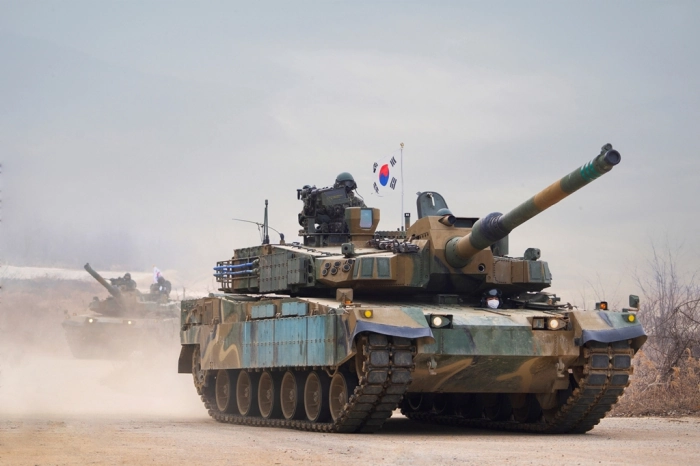
The story behind why the Korean K2 black panther exists is actually pretty interesting. For a long time, South Korea relied on modified versions of American tanks (like the M48 Patton and the later K1, which the Abrams heavily influenced).
However, given the unique challenges of the Korean Peninsula (e.g., extremely mountainous terrain and a massive, if aging, tank fleet just across the border), Seoul decided it needed something built specifically for their own backyard.
They wanted a “digital-native” platform. The goal was to create a K2 black panther tank that could handle “network-centric warfare”. It was also a massive point of national pride to develop this indigenously so they wouldn’t have to rely on foreign tech during a crisis.
Interestingly, while it was originally meant to complement the existing K1 series, the K2 ended up being such a leap forward that it’s now basically the star of the show. It’s designed to be fast, smart, and perhaps most importantly for Korea, capable of fighting in places where traditional, heavier tanks might struggle.
Whether it’s “the best” is always up for debate, but it’s definitely one of the most ambitious projects in modern defense.
Before we get into the “why” and “how,” here is a quick look at the raw numbers that make the Korean K2 black panther such a powerhouse.
| Feature | Specification |
| Main Armament | 120mm / L55 Smoothbore Gun (Hyundai WIA CN08) |
| Secondary Armament | 12.7mm K6 Heavy MG, 7.62mm Coaxial MG |
| Ammunition Capacity | 40 rounds (16 in autoloader, 24 in hull) |
| Autoloader Rate | ~10–15 rounds per minute (approx. 4–6 seconds per shot) |
| Engine | 1,500 hp Diesel (MTU 883 or Doosan DV27K) |
| Transmission | Automatic (RENK HSWL 295 or SNT Dynamics EST15K) |
| Top Speed | 70 km/h (Road) / 50 km/h (Off-road) |
| Weight | ~55–56 Metric Tons |
| Crew | 3 (Commander, Gunner, Driver) |
| Suspension | In-arm Suspension Unit (ISU) – Hydropneumatic |
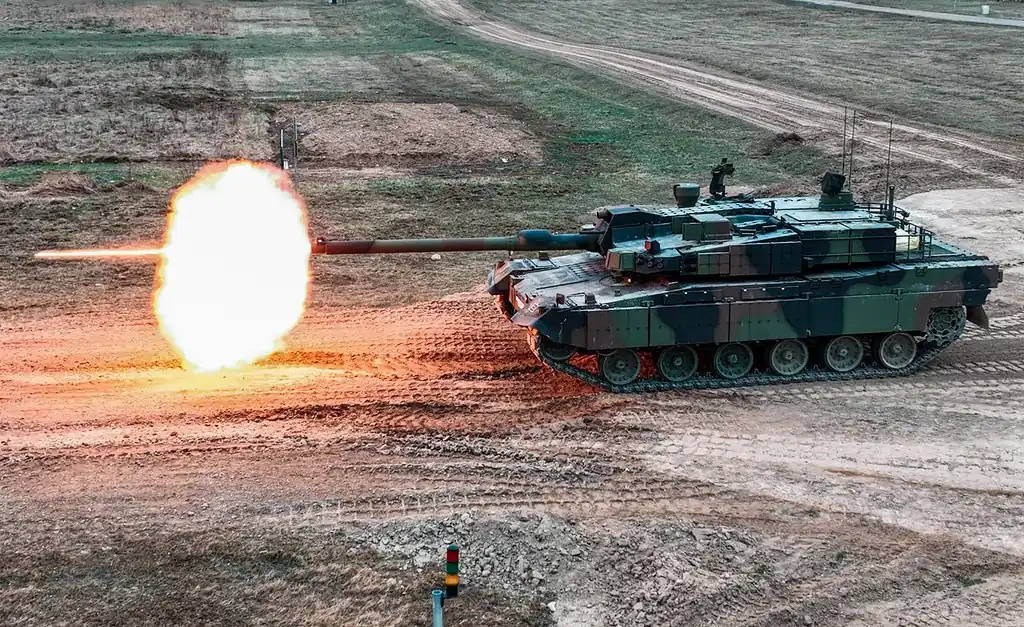
The heart of the K2 black panther tank is its 120mm/L55 smoothbore gun. If that sounds familiar, it’s because the L55 is essentially the same length as the one on the German Leopard 2A7. It’s longer than the L44 found on the M1 Abrams, which might give it a slight edge in muzzle velocity.
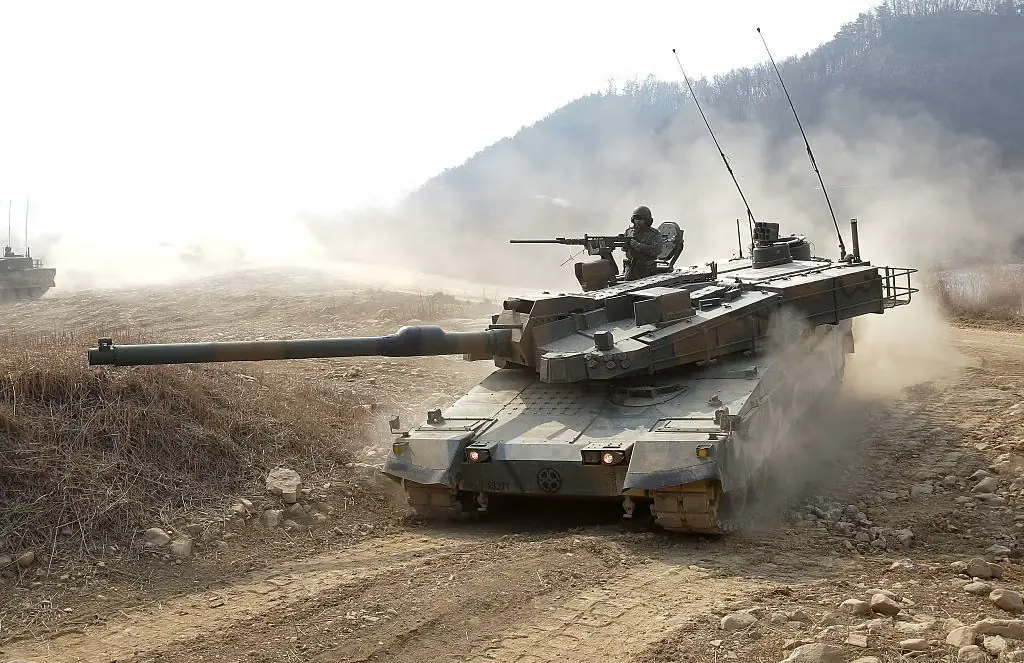
The K2 black panther autoloader is a huge departure from American philosophy. While the Abrams uses a human loader (who can be incredibly fast but gets tired), the K2 uses a mechanical conveyor-belt system in the turret bustle.
It can reportedly cycle a new round every 4 to 6 seconds. This keeps the rate of fire consistent, regardless of whether the tank is bouncing over a trench or the crew has been fighting for ten hours.
Because the machine does the heavy lifting, the crew is cut down to just three people. This makes the tank smaller and lighter.
The trade-off is that with only three people, things like changing a thrown track or doing field maintenance become much more exhausting. Plus, if the autoloader jams, you’re essentially looking at a very expensive, very heavy paperweight until it’s fixed.
Read also: Tank Autoloaders Explained: Are They Better Than Manual Loaders?
The K2 black panther engine is a 1,500 hp beast that gives this 55-ton machine some serious “get up and go.” It can hit 0 to 32 km/h in about 7 seconds, which is pretty snappy for something that heavy.
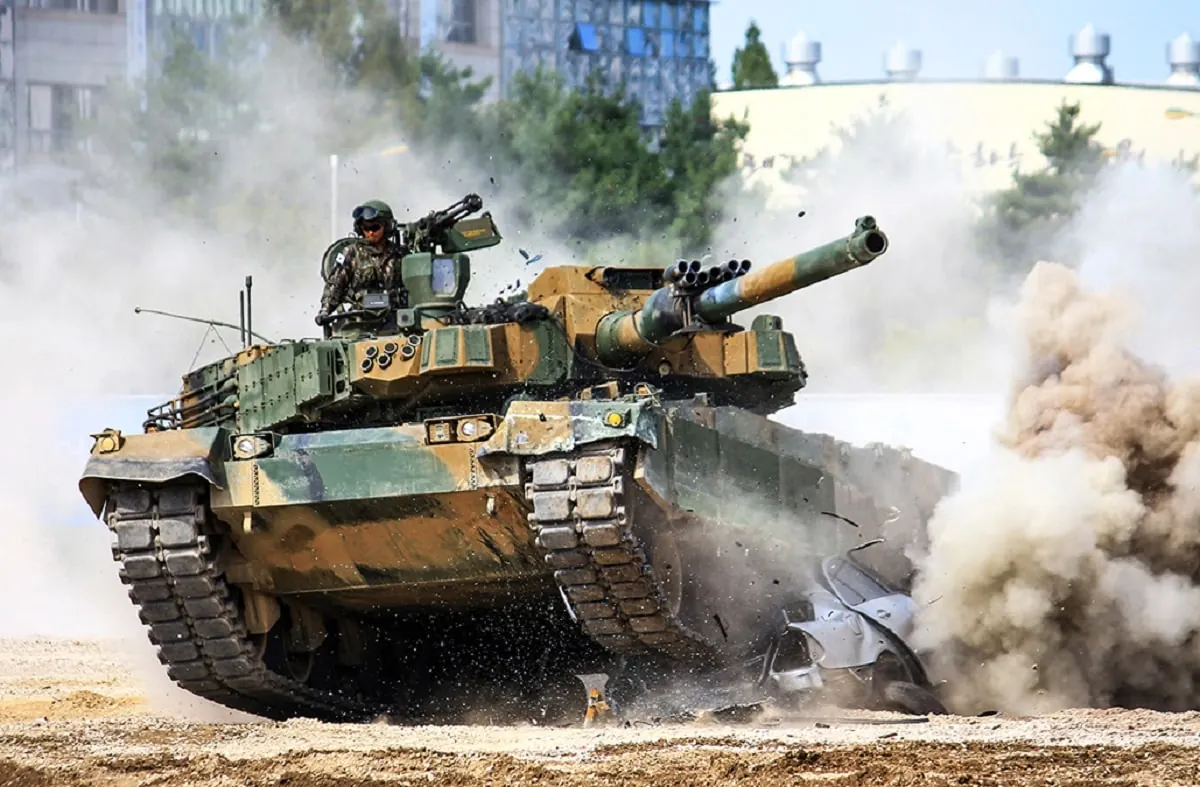
When it comes to staying mobile and staying alive, the K2 Black Panther takes a pretty unique approach compared to the heavy-hitters we usually see in the West. It doesn’t just rely on thick slabs of steel; it uses a mix of “gymnastic” agility and some very high-tech shields to handle the chaos of a modern battlefield.
The K2 black panther suspension is arguably its most famous party trick. It uses a “semi-active” hydropneumatic system that lets the tank adjust its posture in almost any direction. It can “kneel” to lower its profile, “sit” on its haunches to aim the K2 black panther gun higher at low-flying threats, or even “lean” to one side.
In the mountainous terrain of Korea (or the Andes, as Peru recently noted), this is a massive tactical win because it allows the tank to fire from behind ridges while exposing almost none of its hull. It basically turns the entire environment into a custom-made defensive fighting hole.
On the protection side, the Korean K2 black panther uses a sophisticated “layered” defense. While it has the standard composite armor you’d expect on a top-tier MBT, it’s designed to be modular, so if a section gets damaged or a better armor tech comes out, they can just swap the blocks.
However, the real magic is in its Active Protection Systems (APS). It has sensors that “feel” when a laser is painting it and automatically pops multispectral smoke to hide its signature.
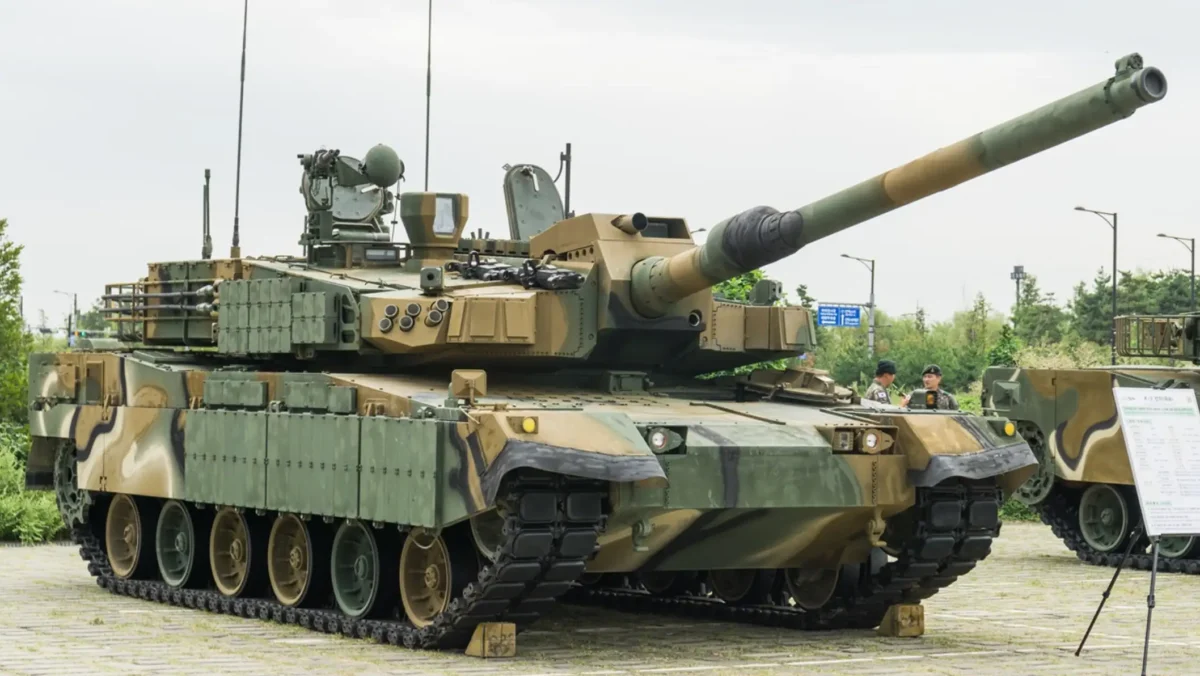
There’s been a lot of recent news about the “Product Improvement Plan” (PIP), which is moving toward hard-kill systems (like the Israeli Trophy system) that can actually shoot down incoming missiles before they even touch the tank.
For a long time, the K2 Black Panther held a bit of a reputation as the “most expensive tank in the world.” If you were to look at a baseline unit produced for the South Korean army, the K2 black panther price usually sits around $8.5 million.
However, that’s just the starting point. When countries like Poland or Peru buy them, they aren’t just buying a vehicle; they’re buying a massive support package that includes spare parts, training, and sometimes even the rights to build them locally.
Because of those extras, the price tag on recent export deals has climbed significantly, sometimes reaching over $30 million per tank in “all-inclusive” contracts that involve setting up entire domestic factories.
As for whether it’s actually “worth it” for a modern army, the consensus seems to be a cautious “yes,” particularly for countries that need to modernize quickly.
One of the biggest selling points is the delivery speed. While other manufacturers might have backlogs stretching out for a decade, South Korea has shown an incredible ability to churn these out and get them on ships fast.
In the K2 black panther vs M1 Abrams debate, the K2 is often seen as the more “efficient” choice for smaller nations because its three-man crew reduces the long-term cost of training and feeding soldiers.
Of course, the trade-off is that you’re buying into a very complex system that requires a high level of technical expertise to maintain.
But if a nation is looking for a tank that can handle the modern “digital” battlefield while being agile enough for mountains and marshes, most analysts would say that the Korean k2 black panther offers a pretty compelling value proposition. It’s a huge investment, sure, but it’s a tool built for the next thirty years of warfare, not the last thirty.
When you put the K2 Black Panther and the M1 Abrams in the same ring, it’s really a clash of two very different philosophies.
Firepower and the “Loader” Debate
Comparing the k2 black panther gun to the Abrams’ M256 is interesting because the K2 uses a longer L55 barrel, which generally offers more muzzle velocity and punch at long range.
The biggest divide, though, is how those rounds get into the gun. The K2 uses a mechanical k2 black panther autoloader, which keeps the rate of fire at a steady, lightning-fast 10–15 rounds per minute.
The Abrams still uses a human loader. While a well-trained American loader can be incredibly fast for a few minutes, humans get tired, and they take up a lot of space.
By swapping the human for a machine, the K2 is able to be smaller and lighter, though the Abrams’ crew of four means they have an extra set of hands for maintenance or security.
Mobility and the “Gas Guzzler” Factor
The Abrams uses a gas turbine engine that sounds like a jet plane and can run on almost anything, but it is notoriously thirsty, especially when idling.
The K2 black panther engine, being a high-performance diesel, is much more fuel-efficient, giving it a longer operational range. Plus, the K2 weighs about 55 tons compared to the 70+ tons of a modern M1A2 SEPv3.
This weight difference, combined with the legendary K2 black panther suspension, makes the Korean tank much more agile in mud and mountains. While the Abrams can feel like a heavy hammer, the K2 is more like a scalpel that can “kneel” and “tilt” to use terrain as cover.
Protection Philosophies
When it comes to staying alive, the Abrams is the king of “soaking it up.” It has some of the thickest armor in the world, especially on the turret face.
The K2, however, focuses on “soft-kill” and “hard-kill” systems. It uses radar to detect incoming missiles and can automatically deploy smoke or even shoot down projectiles.
Interestingly, as of late 2025, there’s been news about integrating the Israeli Trophy system into the K2, which would bring its active protection right up to par with the latest Abrams.
The trade-off is that the K2’s side armor is arguably thinner to keep that weight down, meaning it relies heavily on its tech to not get hit in the first place.
So, Is the K2 Black Panther Better Than the Abrams?
It probably isn’t fair to say one is objectively “better” across the board, but for many modern militaries, the K2 might be the smarter choice.
If you’re fighting in the open deserts of the Middle East, where you have massive supply lines to feed a thirsty turbine, the Abrams is a terrifying beast. But if you’re a country like Poland or Peru, dealing with mud, mountains, or limited manpower, the Korean K2 black panther starts to look like the winner.
It’s faster, more fuel-efficient, and can hide in ways the Abrams just can’t. Ultimately, the K2 is a 21st-century tank built for a digital battlefield, while the Abrams is a 20th-century legend that has been masterfully upgraded to keep up.