Follow Us:
Follow Us:


The SPEAR Hellfire Missile is the latest advancement in U.S. Special Operations’ arsenal, featuring a cutting-edge selectable precision effects articulated warhead.
This innovative missile allows operators to control whether the blast focuses forward or in a radial pattern, significantly enhancing strike flexibility for platforms such as the MQ-9 Reaper drone and AC-130J Ghostrider gunship.
Designed to provide tactical advantages across diverse battlefield targets, the SPEAR Hellfire Missile also aims to minimize collateral damage during precision strikes.
The Hellfire missile family has long been a cornerstone of U.S. military precision strikes, primarily designed as laser-guided air-to-ground weapons.
The newly developing SPEAR variant, highlighted in the Pentagon’s 2026 Fiscal Year budget briefings, seeks to refine the warhead’s blast orientation as a game-changing feature.
Testing reportedly began in 2021 under the U.S. Special Operations Command’s (SOCOM) Stand-off Precision Guided Munitions (SOPGM) program, which focuses on enhancing special operations’ air-launched weaponry.
SOCOM is requesting nearly $50 million for SOPGM procurement in 2026, partly to support integration of these SPEAR-equipped Hellfires onto MQ-9 drones and AC-130J gunships.
The dual-mode warhead provides the capability to switch between a “forward” blast mode, ideal for striking armored vehicles and boats, and a “radial” clustering blast option, which is more effective in enclosed environments or for engaging personnel behind cover.
This articulation within the warhead allows a single missile to adapt quickly to varied targets, eliminating the need for mixed missile loads and enabling crews to respond dynamically to emerging threats.
The versatility of the SPEAR warhead could transform how missions are planned and executed. Traditional Hellfire warheads combine a shaped charge for piercing armor with a fragmentation sleeve that produces a 360-degree blast.
However, this design locks the shaped charge forward, limiting effect focus. With SPEAR’s directional blast control, operators can now tailor the weapon’s explosion based on mission needs—using an airburst forward attack to neutralize enemies in trenches or behind barriers, or a radial blast for targets inside structures or clustered personnel.
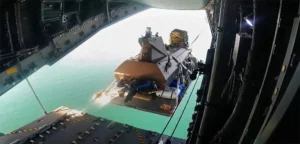
The following video showcases an AC-130J Ghostrider executing a live Hellfire missile strike, demonstrating the kind of precision engagement capabilities that the SPEAR variant is designed to enhance.
These platforms often remain on station for hours waiting for the perfect moment to strike or provide overwatch for friendly ground forces.
Such capability significantly enhances operational flexibility, especially during the prolonged sorties typical for MQ-9 drones and AC-130 gunships.
By giving a single missile variable blast effect, commanders reduce logistical complexity and increase responsiveness to fluid combat scenarios, including rapidly emerging targets or changing battlefield conditions.
Additionally, the new warhead design offers potential reduction in unintended damage to nearby civilians or infrastructure, a prime concern in modern precision warfare.
By controlling the blast direction, operators can concentrate destructive force exactly where needed, lowering the chance of collateral harm—a critical advantage in urban or sensitive operational theaters.
The SPEAR warhead is a part of a broader trend of specialized Hellfire variants developed for different missions within SOCOM.
For example, classified variants like the AGM-114R9X, known for its non-explosive “bladed” warhead used in assassination strikes, highlight the missile’s adaptability.
SPEAR adds to this arsenal, addressing the need for selectable effects rather than fixed blast patterns.
Integration is initially slated for the MQ-9 and AC-130J, platforms heavily utilized by special operations due to their long endurance and precision strike capabilities.
MQ-9 Reapers can carry multiple Hellfires, a capability that has recently been expanded by software upgrades allowing up to eight Hellfires per sortie. AC-130Js similarly benefit from air-to-ground munitions versatility.
Introducing SPEAR-fitted missiles enhances both platforms’ lethality and survivability by enabling engagement from safer standoff distances.
Beyond these initial users, SPEAR’s adaptable blast technology may eventually migrate to other Hellfire-compatible platforms and missions.
The AGM-114 family, renowned for its laser-guided precision, also includes radar-guided variants like the AGM-114L Longbow used in counter-drone roles.
The selectable directional warhead could add significant value in this anti-aircraft context by tailoring blasts to intercept diverse aerial threats.
Moreover, the SPEAR concept might influence new missile development, including the AGM-179A Joint Air-to-Ground Missile (JAGM), which inherits the Hellfire’s multi-purpose warhead framework.
Notably, the Air Force is exploring related technologies under the Missile Utility Transformation via Articulated Nose Technology (MUTANT) project, which tests missiles with articulating nose sections to improve hit probability against moving aerial targets.
While MUTANT primarily focuses on air-to-air roles, some technological crossover with SPEAR’s articulated warhead concept could be feasible in the future.
The advent of the SPEAR Hellfire marks a significant milestone in missile warhead design, optimally balancing firepower, precision, and flexibility.
As SOCOM moves forward with integration on proven strike platforms, this new munition is poised to elevate U.S. special operations’ combat effectiveness, reducing collateral damage and expanding tactical options across varied conflict environments.
With more details expected in coming years, the SPEAR warhead underscores the continuing evolution of precision-guided munitions in modern warfare.