Follow Us:
Follow Us:


Defense Feeds – The new Ukrainian Neptune Missile has been officially revealed, marking a major step forward in Kyiv’s long-range strike capability.
Ukraine showcased the upgraded cruise missile, an extended-range version of its domestically developed Neptune system, which can reportedly hit targets up to 1,000 kilometers away.
Often referred to as the “Long Neptune”, the new missile represents a substantial improvement over the original R-360 anti-ship variant.
The unveiling confirms weeks of speculation, showing that Ukraine is steadily advancing its missile development despite the ongoing war with Russia.
Defense analysts believe the missile has already been used in combat since March, suggesting Russian forces are not likely to be surprised by its existence.
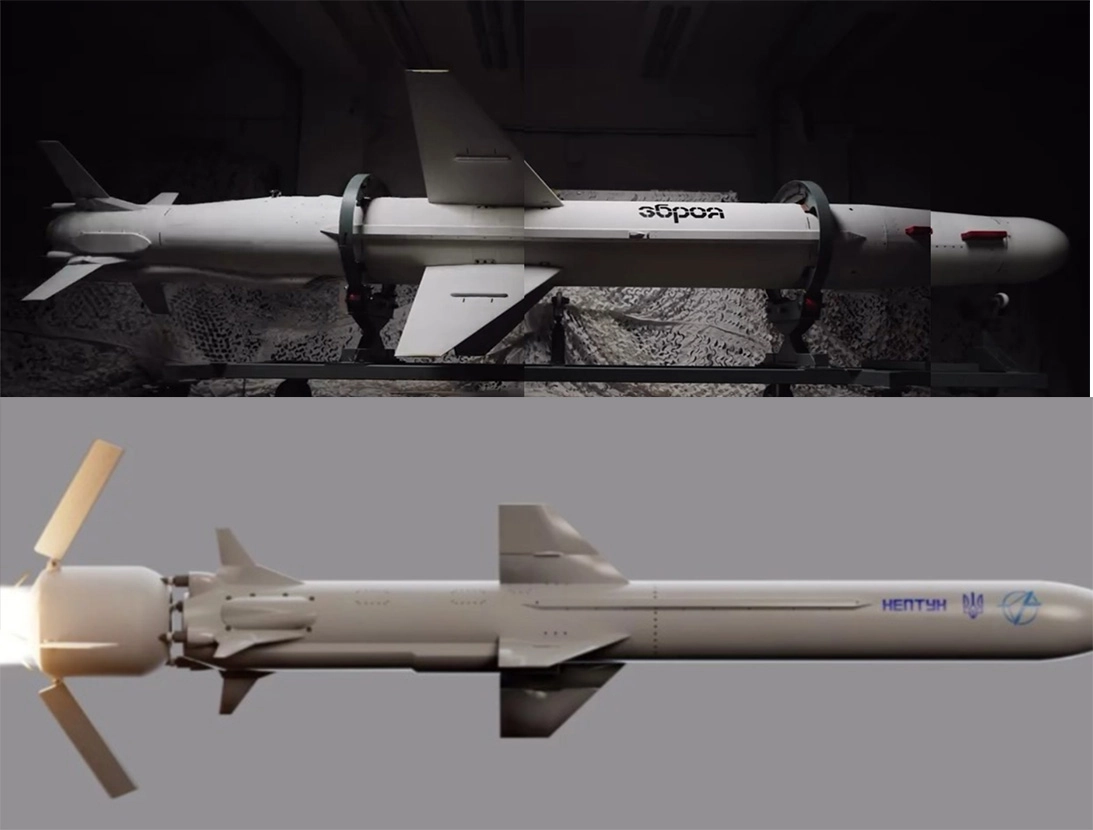
Originally designed as an anti-ship system, the R-360 Neptune missile gained international attention in 2022 when it was credited with hitting the Russian warship Moskva.
The missile’s success gave Ukraine confidence to expand the platform into a multipurpose weapon with land-attack capabilities. The newly presented version represents a dramatic reconfiguration.
While the tail section—where the engine is located—appears almost identical to the older model, the rest of the missile has undergone extensive redesigns.
Expert assessments indicate that the revised missile stretches past six meters, booster excluded, making it nearly 1.5 meters longer than its predecessor, the R-360. Another major change is the widened fuselage.
The missile’s central body measures roughly 50 centimeters in diameter, up from the original 38. This modification is believed to create more fuel capacity, directly translating into a much longer range.
The wider body combined with expanded wing and tail surfaces also suggests engineers worked to balance stability during flight despite the missile’s heavier weight.
The nose cone shape remains consistent with its predecessor, indicating potential similarities in target guidance systems.
However, the broader wings and tail fins show an adaptation meant to handle increased aerodynamic stress during extended missions.
While much of the missile’s physical transformation can be observed, the most critical question remains unanswered—what is the strike
payload? The first-generation Neptune carried a 150-kilogram warhead, originally optimized for striking large naval vessels.
But it remains unclear if the long-range variant retains that warhead size, reduces it for added range, or carries a reinforced explosive package for hardened land-based targets.
Ukrainian officials have not disclosed technical details of the warhead, citing operational security and ongoing combat requirements.
Defense Express, the Ukrainian outlet that reported the missile’s unveiling, suggested that the heavier design and recalibrated structure could allow for either a larger payload or additional fuel tanks.
For now, Western military observers note that the exact warhead type will significantly affect how the missile fits into Ukraine’s broader strategic arsenal.
A lighter payload with maximum range could allow precision strikes deep inside Russian logistical hubs, while a heavier warhead could serve to neutralize fortified infrastructure in occupied territories.
This new Long Neptune missile reflects Ukraine’s determination to reduce reliance on foreign arms by advancing its domestic missile production.
Kyiv continues to face uncertainty around the timing and scale of Western arms deliveries, making locally produced systems a priority.
The fact that the long-range Neptune has already seen combat since at least March indicates Ukraine has been quietly testing and deploying the weapon before unveiling it.
Moscow’s Defense Ministry has claimed on multiple occasions that Ukrainian Neptune missiles were responsible for attacks deep inside Russia as well as on military assets in occupied Crimea.
If accurate, this would mean Ukraine now maintains a significant homegrown ability to launch non-Western precision strikes at distances far beyond the original limits of its arsenal.
Military analysts stress that the missile’s 1,000-kilometer range, if true, places cities, military installations and supply routes across a wide swathe of Russian territory within reach.
For Ukraine, the missile’s introduction reinforces not just military capability but also technological resilience.
Producing and fielding an extended-range cruise missile while under constant attack represents a symbolic and practical milestone.