Follow Us:
Follow Us:

You don’t hear a Kilo-class submarine coming.
That’s the point.
Long before underwater drones and hypersonic headlines grabbed attention, naval crews whispered about a diesel-electric boat so quiet it earned a nickname that stuck like folklore: the Black Hole. Not because it was mysterious, but because sound seemed to vanish around it.
For decades, the kilo-class submarine has prowled shallow seas, slipped through choke points, and reminded far wealthier navies that stealth still beats flash.
Here’s what makes this class fascinating from a fresh angle: it isn’t built to dominate the open ocean. It’s built to ambush geography. Narrow straits. Coastal shelves. Crowded shipping lanes where sonar gets messy, and mistakes are expensive.
In those environments, a Kilo doesn’t need to be fast. It needs to be patient. And it is.
Originally designed by the Soviet Union during the late Cold War, the Kilo-class (Project 877) wasn’t meant to be glamorous. It was meant to be practical, exportable, and brutally effective.
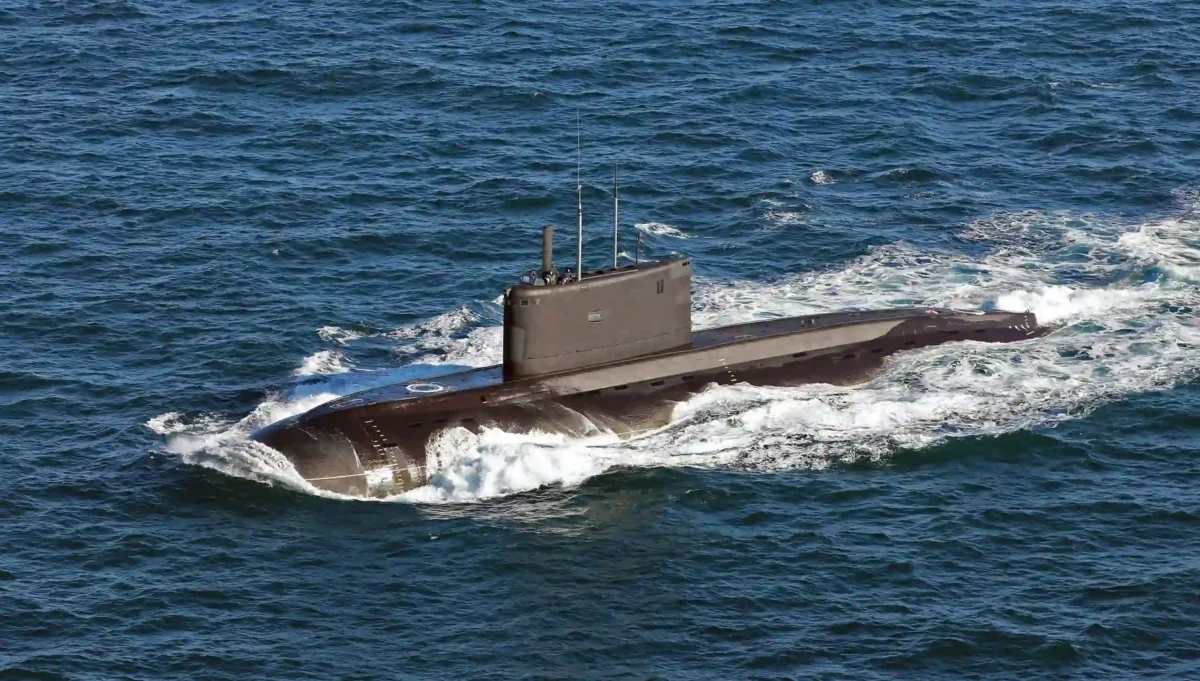
That design philosophy, quiet hulls, simple mechanics, and reliable torpedo systems, turned it into one of the most widely operated attack submarines on Earth.
Even today, improved variants like Project 636 and 636.3 continue to roll out, upgraded rather than replaced. That alone tells you something.
This post takes you beyond the spec sheet. We’ll look at why the Kilo-class submarine still matters, how its design choices quietly shaped modern littoral warfare, and why nations from Vietnam to Algeria keep betting on it. Think of this not as a museum tour, but a close-up of a machine that refuses to age out.
At its core, the kilo-class submarine is a diesel-electric attack submarine built for one job: to control the messy, shallow parts of the ocean where big nuclear boats feel clumsy.
Officially, NATO calls it the Kilo class. Russia calls the original design Project 877 Paltus. Later upgrades fall under Project 636 Varshavyanka, often labeled the Improved Kilo. Different names, same DNA.
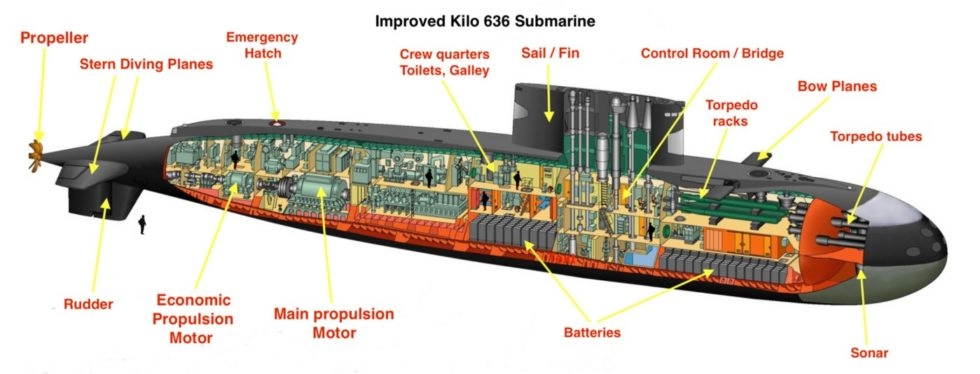
Think of the Kilo as a coastal hunter rather than a deep-sea marathon runner. It runs on batteries when it wants to disappear and diesel engines when it needs to recharge, simple, proven, and surprisingly effective. No nuclear reactor. No exotic propulsion. Just careful engineering focused on silence.
What sets it apart isn’t raw speed or depth. It’s an acoustic discipline. The hull is wrapped in anechoic tiles that swallow sonar pings instead of reflecting them. Internal machinery is mounted on shock-absorbing platforms so vibrations don’t leak into the water.
Even the propeller is designed to minimize cavitation at low speeds. The result? In the right conditions, a Kilo can be quieter than the background noise of the sea itself. That’s not marketing, that’s physics.
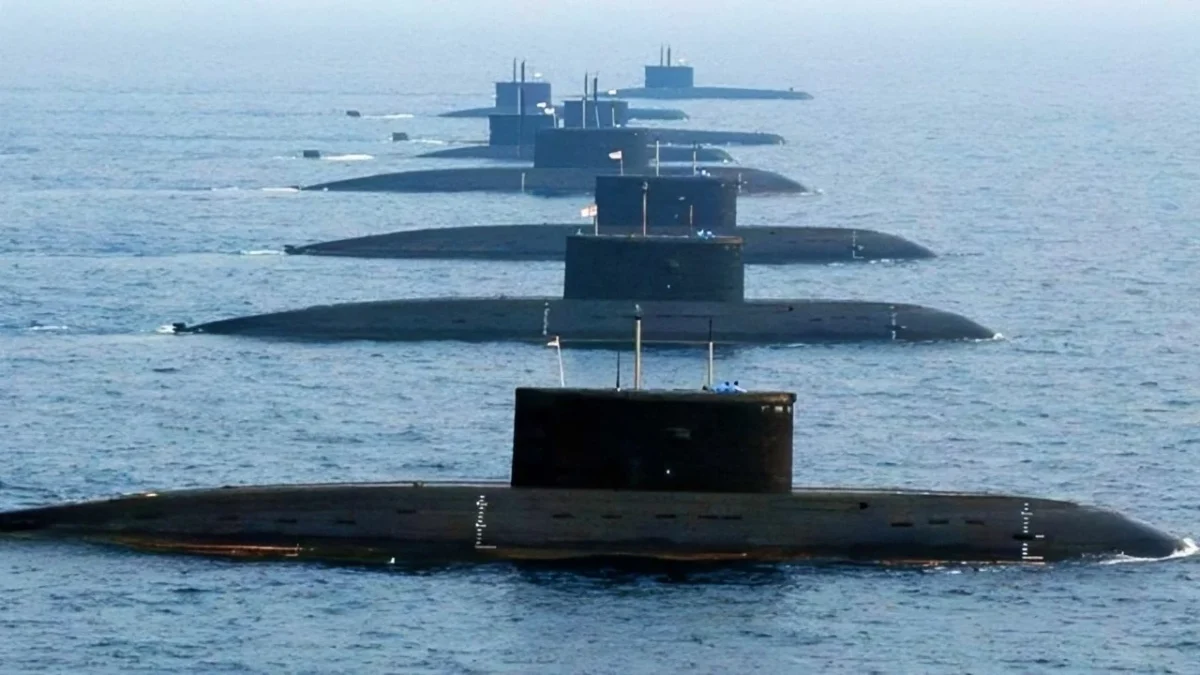
Another underappreciated trait: affordability. Compared to nuclear submarines that cost billions and demand elite infrastructure, Kilo-class boats are accessible. That’s why more than a dozen navies operate them. They’re the submarine equivalent of a reliable tool truck, less flashy than a supercar, but always ready to work.
In practical terms, a Kilo-class submarine excels at ambush missions: tracking surface ships, laying mines, blocking straits, and launching torpedoes or cruise missiles without warning. It doesn’t need to win a war alone. It just needs to make the enemy nervous. And it does that exceptionally well.
Numbers don’t usually feel dramatic until you realize what they enable. The kilo-class submarine looks unassuming on paper, but every measurement reflects a deliberate trade-off between stealth, endurance, and coastal lethality.
Let’s start with size.
A typical Kilo-class boat measures about 72 to 74 meters long, with a beam just under 10 meters. That compact footprint matters. It allows the submarine to maneuver in shallower waters where larger nuclear subs simply won’t risk going.
Fully submerged, displacement sits around 3,000 to 3,100 tons, depending on the variant. Not small. Just… controlled.
Speed is where expectations shift. Maximum submerged speed tops out at roughly 19–20 knots. That’s not impressive by nuclear standards, and it’s not meant to be.
Read also: Gotland-class Submarine: Sweden’s Revolutionary AIP Attack Submarine
The Kilo’s real advantage shows up at low speeds—when it’s creeping along at 3 to 5 knots, running almost silently on battery power. In that mode, it becomes painfully hard to detect.
Operational range reaches about 6,000 nautical miles on diesel at economic speed, while submerged endurance is measured in days, not weeks—again, by design. This is a hunter that returns to port, reloads, and slips back out. Short, sharp missions. Repeat.
Here’s a simplified snapshot:
| Specification | Kilo-Class (Project 877/636) |
| Length | 72–74 m |
| Displacement (submerged) | ~3,000 tons |
| Max speed (submerged) | ~20 knots |
| Crew | 50–55 |
| Test depth | ~300 meters |
| Endurance | 45 days |
One overlooked detail: crew size. Around 50 sailors, which reduces onboard noise and logistical strain. Fewer bodies. Fewer sounds. Fewer problems.
Specs don’t make a legend, but they explain how one happens.
Silence is the Kilo’s calling card, but what it delivers after breaking that silence is the real concern. The kilo-class submarine is armed like a patient chess player: flexible, deceptive, and capable of ending the game in one move.
At the bow, you’ll find six 533 mm torpedo tubes. Standard layout, nothing exotic. But don’t underestimate that simplicity. These tubes can fire heavyweight torpedoes for ship-killing duties, anti-submarine torpedoes for hunting other subs, and even deploy naval mines.
A typical loadout carries 18 torpedoes or a mix of torpedoes and up to two dozen mines. Mines, in particular, are a Kilo specialty, cheap, persistent, and terrifying in narrow waterways.
Where the Improved Kilo variants change the equation is missiles. Project 636 and especially 636.3 boats can launch Kalibr (Club) cruise missiles directly from torpedo tubes. That gives the submarine a land-attack reach of 1,500+ kilometers, depending on the missile version.
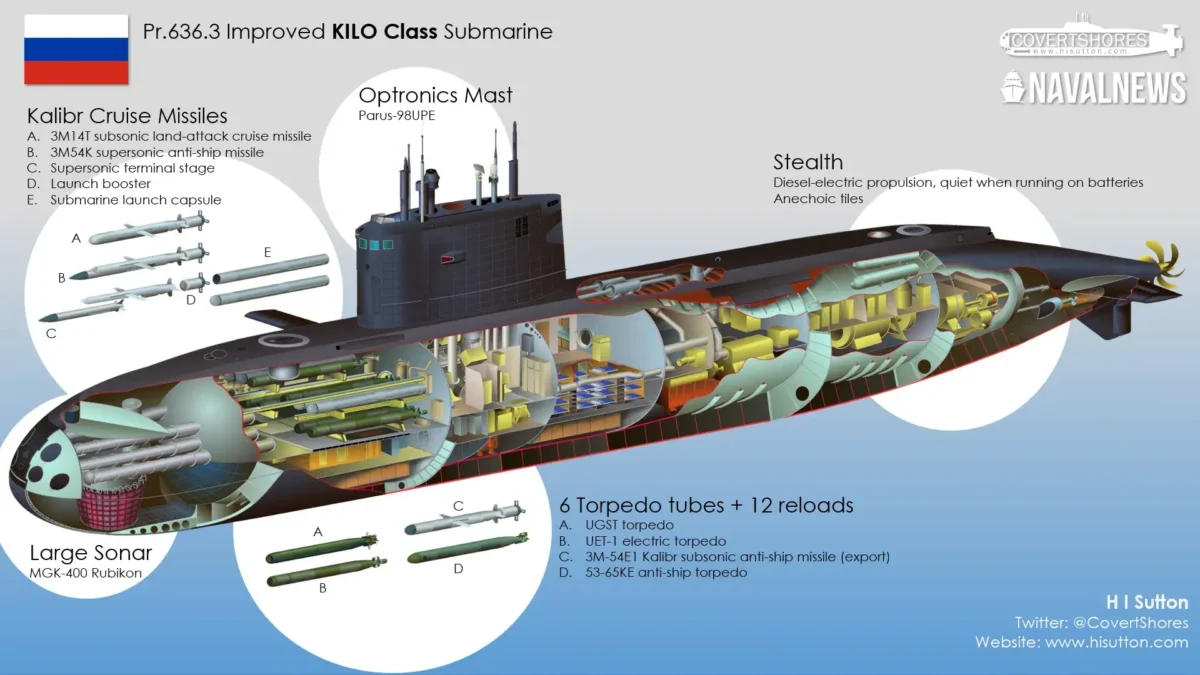
In plain terms: a submarine designed in the Cold War can strike targets far inland without surfacing. That’s not a footnote, that’s strategic leverage.
Sensors matter just as much.
The Kilo’s MGK-400 Rubikon sonar suite (and later upgrades) is optimized for passive detection. It listens more than it speaks.
In cluttered coastal waters, where civilian ships, marine life, and thermal layers confuse active sonar, that passive focus pays off. Many operators report detection ranges that exceed what surface ships expect from a diesel boat.
One subtle advantage? Crew training. Kilo-class submarines are often operated by navies that invest heavily in sonar operators, not automation. Human ears, trained well, still outperform algorithms in chaotic environments.
Weapons don’t make noise until they have to. And when a Kilo finally speaks, it’s usually too late to respond.
Most military hardware fades quietly into irrelevance. The kilo-class submarine did the opposite; it kept getting better without ever pretending to be something else. No radical redesign. No flashy rebranding. Just steady, almost stubborn evolution.
The original Project 877 Paltus, introduced in the late 1970s, laid the foundation. It was already quieter than many Western diesel submarines of its time, but it relied on fairly basic electronics and conventional torpedoes. Effective, yes, but limited by Cold War-era sensors.
Then came Project 636, often called the Improved Kilo. This wasn’t a cosmetic upgrade. Noise levels dropped further, some estimates suggest up to 10 decibels quieter than early 877 models, which is not incremental; it’s exponential in sonar terms. New fire-control systems allowed better target tracking, while export-focused customization made the class more attractive to foreign navies.
The real leap arrived with Project 636.3, sometimes referred to as Improved Kilo II. This variant integrated advanced sonar, modern combat management systems, and, most importantly, full compatibility with Kalibr cruise missiles.
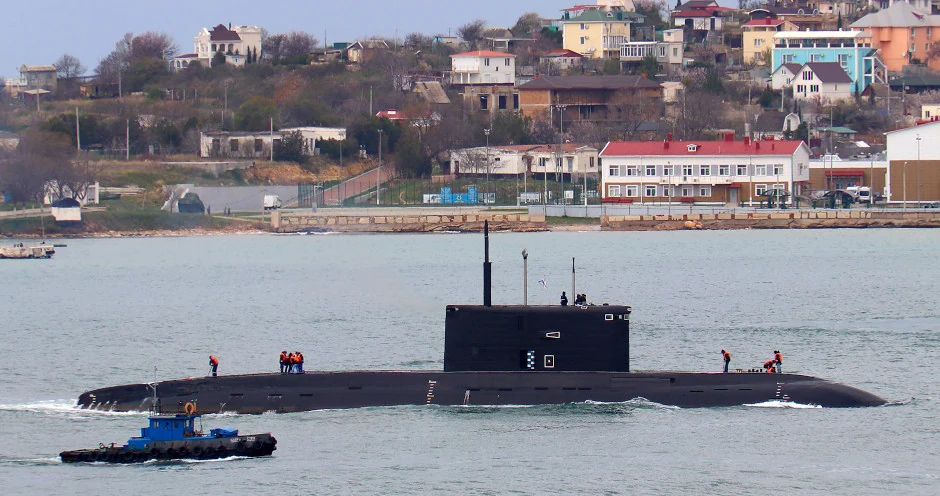
There’s also Project 636.6, tailored for specific export customers, with localized electronics and weapons packages. Same hull. Different brain.
What’s striking is what didn’t change. The hull shape remained familiar. The propulsion stayed diesel-electric. Designers resisted the temptation to chase trends like air-independent propulsion at the cost of reliability.
In a way, the Kilo evolved like a well-loved tool, modified, sharpened, reinforced, never replaced. And that may be why it’s still here, decades later, slipping quietly through modern seas.
The kilo-class submarine didn’t build its reputation in brochures. It earned it quietly, one patrol at a time, often in places where mistakes carry political consequences.
During the late Cold War, early Project 877 boats spent most of their lives training and shadowing NATO forces. Even then, Western navies noticed something unsettling: Kilos were harder to track than expected.
Exercises in the Baltic and Mediterranean routinely ended with after-action reports full of hedging language, probable contact, and uncertain classification. For submarine warfare, that’s a polite way of saying, we lost it.
Post–Cold War, the Kilo transitioned from theory to practice. Indian Kilo-class submarines conducted long-duration patrols in the Indian Ocean, refining tactics for warm, noisy waters where sonar behaves unpredictably.
Vietnam’s fleet, delivered in the 2010s, immediately reshaped regional naval planning. Neighboring states didn’t need confirmation of combat use; the mere existence of quiet submarines in contested waters was enough to force new defensive spending.
Russia, however, took things further. Improved Kilo submarines deployed to the Mediterranean and Black Sea conducted real combat missions, launching Kalibr cruise missiles against land targets during the Syrian conflict. These strikes weren’t symbolic. They demonstrated that a diesel-electric submarine—once considered short-legged and defensive—could deliver strategic effects hundreds of kilometers inland.
There have also been darker chapters. Accidents, most notably the loss of INS Sindhurakshak in 2013, highlighted the risks of operating aging submarines and the importance of maintenance discipline. Yet even after such events, operators chose modernization over retirement.
That decision speaks volumes. The Kilo isn’t perfect. But in real-world conditions, political pressure, tight budgets, and shallow seas, it keeps doing what it was designed to do: show up unannounced, stay unseen, and matter.
Here’s the uncomfortable question modern navies are wrestling with: can a kilo-class submarine stay relevant when the ocean itself is being watched? Satellites peer down.
Autonomous drones skim the surface. Unmanned underwater vehicles loiter where crewed subs once moved freely. It’s a noisier, more crowded battlespace.
And yet, the Kilo keeps showing up.
Recent years have pushed these submarines into the spotlight again, especially with reports of underwater drone attacks targeting docked or near-port Kilo-class boats.
What matters isn’t just whether those claims are fully verified; it’s what they reveal. The threat envelope has shifted closer to shore. Ports, maintenance areas, and predictable transit routes are now as dangerous as open water.
Ironically, this plays to the Kilo’s strengths. At sea, especially in cluttered littoral zones, modern sensors still struggle to separate a well-handled diesel-electric submarine from background noise. Battery-powered creep remains brutally effective. A Kilo running slow doesn’t light up networks the way a nuclear boat often does.
Upgrades continue quietly. Improved combat management systems, better electronic warfare suites, and integration with modern command networks have kept Project 636.3 boats operationally current. No, they aren’t cutting-edge. They don’t need to be. Their value lies in forcing opponents to over-invest, more patrols, more drones, more uncertainty.
Think of the Kilo as naval friction. It slows planning. Complicates assumptions. Adds cost. In military terms, that’s success.
As attention shifts toward autonomous warfare, the Kilo-class submarine occupies an odd, stubborn middle ground: old enough to be underestimated, quiet enough to punish that mistake. Next, we’ll compare it head-to-head with other conventional submarines and see why it still punches above its weight.