Follow Us:
Follow Us:

If you ask what the Kalibr missile is, the short answer is that it’s one of Russia’s go-to long-range cruise missiles. But the real story is more complicated. It has been fired from warships hundreds of kilometers away, sometimes surprising observers with just how far it can reach.
At the same time, there are reports that every new Kalibr that comes off the production line is fired straight away, meaning Russia doesn’t really build up a stockpile. And now, even icebreakers like the Ivan Papanin are being prepared to carry them.
Its long-range capability, especially in land-attack versions makes it in the same league as the American Tomahawk, which naturally invites comparisons.
Does it really hit with the same accuracy? How much damage can its payload do? And maybe the bigger question, is its reputation built more on its actual performance, or on the image Russia wants to project?
The Kalibr missile plays a role somewhat like the American Tomahawk. It isn’t identical, of course, but the idea is similar: a missile that can travel long distances, fly low to avoid radar, and hit a target with reasonable accuracy.
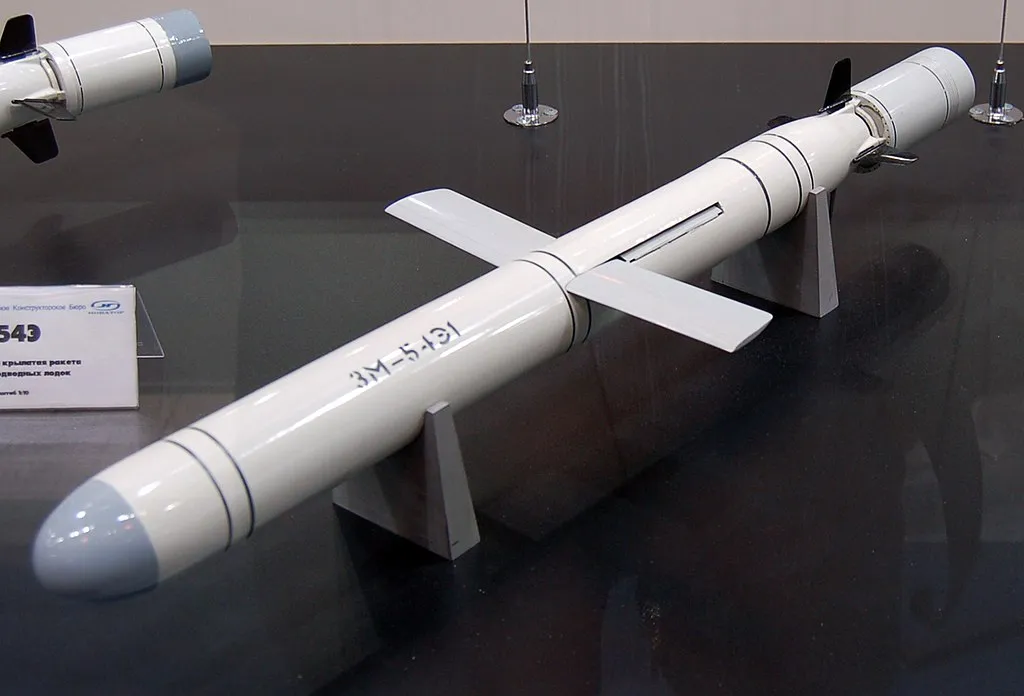
The story of how it came about goes back to the late Cold War. In the 1980s and 1990s, the Soviet Union (and later Russia), wanted a naval weapon that could strike far beyond the coast.
Western fleets already had cruise missiles that could be fired from ships or submarines, so Moscow set out to build something in the same class. Work dragged on for years, and the missile only became a common sight in the 2000s. Its first real test in around 2015, when Russia used it in Syria.
When people talk about the Kalibr, they often make it sound like a single weapon. In fact, it comes in several different versions. The 3M-14 is usually described as the land-attack version, the one designed to fly far inland and hit fixed targets. Then there’s the 3M-54, which is the anti-ship type.

That one has an unusual feature: the final stage of its flight can speed up to supersonic, which in theory makes it harder for defenses to stop. And then there’s the 91R, a submarine-launched variant that carries a small torpedo for use against other submarines.
So when people talk about the “Kalibr,” they might mean slightly different things, depending on the version.
In general, though, the missile family represents Russia’s effort to show that it can reach beyond its borders, striking from the sea with a tool that can be adjusted for different targets. Whether it always works as advertised is another question, but its place in modern conflicts has made it one of the most talked-about Russian weapons of recent years.
| Feature | Estimate / Reported Data* | Notes |
| Range | 1,500–2,500 km (land-attack 3M-14) | Some Western sources suggest shorter ranges in practice |
| Speed | Subsonic (~0.8 Mach), with supersonic sprint on 3M-54 | The supersonic phase only happens near the target |
| Payload | 400–500 kg warhead (HE or submunitions) | Can carry a nuclear option, though rarely discussed openly |
| Guidance | Inertial + satellite navigation (GLONASS) | Accuracy claims vary; Russia suggests 3–10 m CEP |
| Launch Platforms | Ships, submarines, and in some cases, coastal systems | Gives flexibility, but depends on available Navy assets |
*Numbers are based on open sources, so they may not always reflect actual battlefield performance.
When people look at the Kalibr missile, the first thing that often comes up is its range. On paper, being able to reach over 1,500 kilometers is impressive. It means a ship in the Black Sea could, in theory, hit targets almost across an entire region. That makes it look like a powerful tool for long-range strikes.
But it’s worth saying that these figures usually come from estimates, and in war conditions, the real usable range might be shorter. Also, firing such missiles in large numbers is costly and not always sustainable, which might explain why Russia doesn’t use them in endless waves.
The speed also draws attention. Most versions of the Kalibr cruise at subsonic speeds, not unlike the U.S. Tomahawk. The anti-ship 3M-54 does something different: as it nears its target, a final stage can suddenly dash at supersonic speed.
Read also: Tomahawk Missile: U.S. Navy’s Long-Range Precision Strike Weapon
On paper, that makes it harder for defenses to intercept. In practice, though, it’s not clear how often this has worked as intended in combat. Some analysts suggest that modern air defenses can still cope with such a trick if they are ready for it.
Then there’s the payload. With warheads of around 400–500 kilograms, the Kalibr can deliver a serious blow, whether through a high-explosive blast or submunitions.
Technically, Kalibr could be fitted with a nuclear warhead, but that’s mostly talked about as a political threat, not a battlefield move. More commonly it carries a big conventional warhead, which is big enough to do serious damage to infrastructure. Against hardened, well-built targets, though, one missile by itself might not be enough.
Finally, the guidance and accuracy. Russian officials often claim Kalibr lands within a few metres of the aim point, helped by inertial guidance and GLONASS. On paper, that sounds highly precise.
Yet battlefield reports have sometimes told a different story, with missiles hitting civilian areas or missing intended targets. That could be due to technical faults, electronic jamming, or even just the natural limits of using satellite navigation in contested environments.
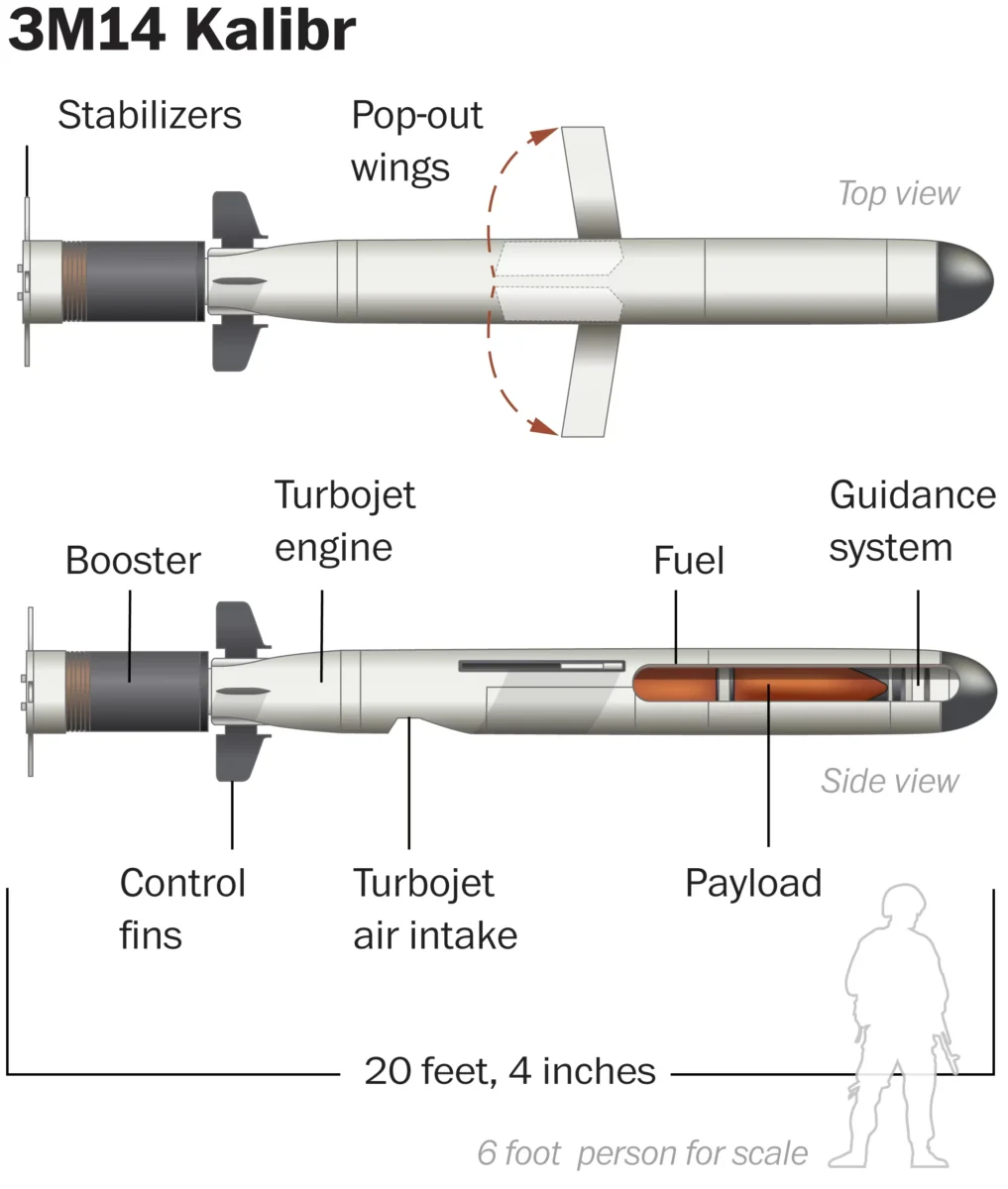
If you go back to late 2015, Russia used Kalibr missiles in Syria as an early public test. Ships in the Caspian Sea launched multiple Kalibrs, one often-quoted event is the 7 October launch of about 26 missiles, and the missiles flew very long distances across Iran and Iraq to strike targets in Syria.
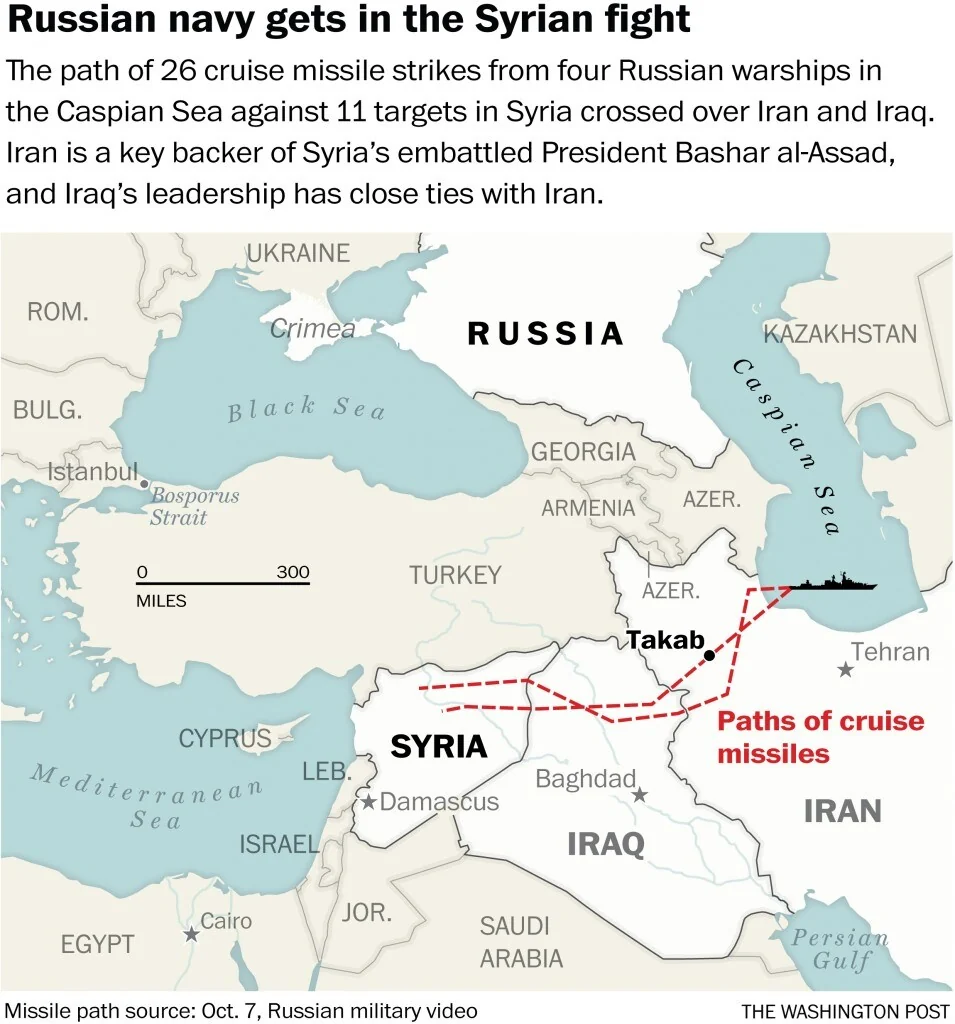
That operation was meant to show two things: that Russia’s navy could strike far inland from the sea, and that this family of missiles could be used for precision land attacks.
In effect, the strike acted more as a demonstration than only a tactical move; it told observers that Russia had a naval long-range strike option. This account comes from open reporting and defense analyses of the 2015 strikes.
Since Russia’s 2022 invasion of Ukraine, Kalibr missiles have been used often. They’ve been fired from Black Sea ships and from submarines to strike a mix of military and civilian infrastructure across Ukraine.
In some cases, for example the July 14, 2022 strike on Vinnytsia, Kalibrs (along with other cruise missiles) hit populated areas and caused many civilian deaths and injuries. Other strikes have targeted ports, industrial sites, air bases, and electrical infrastructure.
Over time, Kalibrs became one of the weapons Russia used in waves that mixed cruise missiles, ballistic missiles, and drones. Reporting and incident lists compiled since 2022 document these patterns and give concrete examples.
When looking at the Kalibr in real use, the picture isn’t black and white. The strikes in Syria back in 2015 did prove that Russia could fire from ships and still reach targets far inland. In Ukraine, the missile keeps showing up as one of the tools Moscow uses to hit deep into the country.
The design looks flexible enough—with different ranges, warheads, and guidance options—but that doesn’t always mean it performs the same way in combat.
Open-source records and field reporting suggest that performance has been uneven. Some Kalibr strikes have hit their intended targets, damaging infrastructure or military facilities. Others, however, have either missed or landed in civilian areas, raising questions about the missile’s real accuracy under combat conditions.
In other words, the neat specifications often cited in technical profiles look less clear when tested in actual war, where electronic interference, targeting information, and operational mistakes can complicate outcomes.
Air defense has also changed the picture. In the first months of the Ukraine war, Kalibrs often reached their targets with relatively little resistance. As time went on, though, Ukraine’s defenses became more layered and more capable, with Western systems helping raise interception rates.
Reports, including those from outlets such as The Guardian, have described waves of missile attacks in which a large share of incoming weapons were shot down. That does not mean Kalibr is obsolete, but the cost of sustaining such attacks is high, and Russia cannot always afford to expend missiles in unlimited numbers.
The human cost also cannot be ignored. Even if Russian planners intended Kalibrs to strike military or infrastructure targets, a number of documented incidents show heavy civilian casualties and damage to non-military sites. This non-trivial civilian impact shapes how the missile is judged outside of pure technical or military circles.
Politically and legally, the association with civilian harm weakens the narrative of Kalibr as a “precision” weapon, and instead places it in the ongoing debates about conduct in war and the limits of long-range strike campaigns.
If you ask, “how deadly is the Kalibr missile?” The short answer is: it can be quite destructive in the right circumstances, but it is not an unstoppable weapon. In practice its danger depends on what it’s aimed at, how many are fired, and whether defenses or electronic countermeasures are in play.
Kalibr is advertised as a precise weapon, using inertial navigation with help from GLONASS satellites. Russia’s claims suggest it can hit very small targets. But wars don’t play out that neatly. Reports from the field show cases where Kalibrs struck their mark and other cases where they missed or hit civilian areas instead.
This gap isn’t hard to explain. Sometimes the target data isn’t perfect. Signals from satellites can get jammed or fade. Hardware and software can also fail, and simple human error during mission planning. So while the guidance system looks solid in theory, the chaos of war often cuts into that.
In other words, Kalibr can be accurate in good conditions, but there are no guarantees once defenses and noise get in the way.
When it comes to raw destructive power, Kalibr warheads are no joke. They are big enough to do serious damage. The land-attack types usually carry a few hundred kilos of explosive (commonly said to be around 400–500 kg), which will wreck soft targets like warehouses, fuel depots, and simple buildings. But a single missile usually won’t crack a hardened bunker; several missiles or a special bunker-buster will be needed for that.
When a Kalibr lands in a built-up area, the harm often goes beyond the initial blast. Shrapnel and fires can ripple through streets and homes, and some variants even carry submunitions that spread destruction across a wider zone rather than delivering a focused blast.
Calling Kalibr Russia’s answer to the Tomahawk isn’t wrong, but it’s not a perfect match. Sure, both are long-range cruise missiles fired from ships and submarines.
The Tomahawk, however, has decades of service, a mature logistics system, and plenty of combat data to back up its accuracy claims. Kalibr entered the public eye later and has been used widely in recent conflicts, but its operational record is more mixed in open sources.
Read also: Kalibr vs Tomahawk: Which Cruise Missile is the Most Powerful?
Both missiles usually fly at subsonic speed, but one Kalibr type, the anti-ship 3M-54, can speed up right at the end and go supersonic for a short burst. That sprint is meant to make it harder to stop. Warhead size and claimed accuracy are in the same ballpark for both missiles, though sources give different numbers and often hedge those claims.
On logistics and production, Tomahawk benefits from decades of industrial scale and stockpiles among NATO partners; Kalibr appears more constrained by Russian production limits and the strain of repeated use in ongoing operations. Cost-wise both are expensive; which is cheaper depends on which baseline price you accept and which variant you compare.