Follow Us:
Follow Us:

When military analysts discuss the most decisive weapons of modern combat, the BGM-109 Tomahawk missile consistently tops the list. Known for its surgical precision and devastating payload, the Tomahawk cruise missile has become the go-to choice for long-range, high-stakes strikes by the United States and its allies.
Whether fired from the depths of a submarine or the deck of a destroyer, this missile brings unmatched reach and stealth to the battlefield.
But what is a Tomahawk missile, really? It’s more than just a projectile—it’s a highly advanced system capable of flying hundreds of miles, navigating enemy defenses with terrain-following radar, GPS guidance, and real-time targeting updates.
The Tomahawk missile range exceeds 1,000 miles in some variants, allowing it to strike far-off land and sea targets with impressive precision. With its low-altitude flight profile and small radar signature, enemy defenses often detect the missile only moments before impact, if at all.
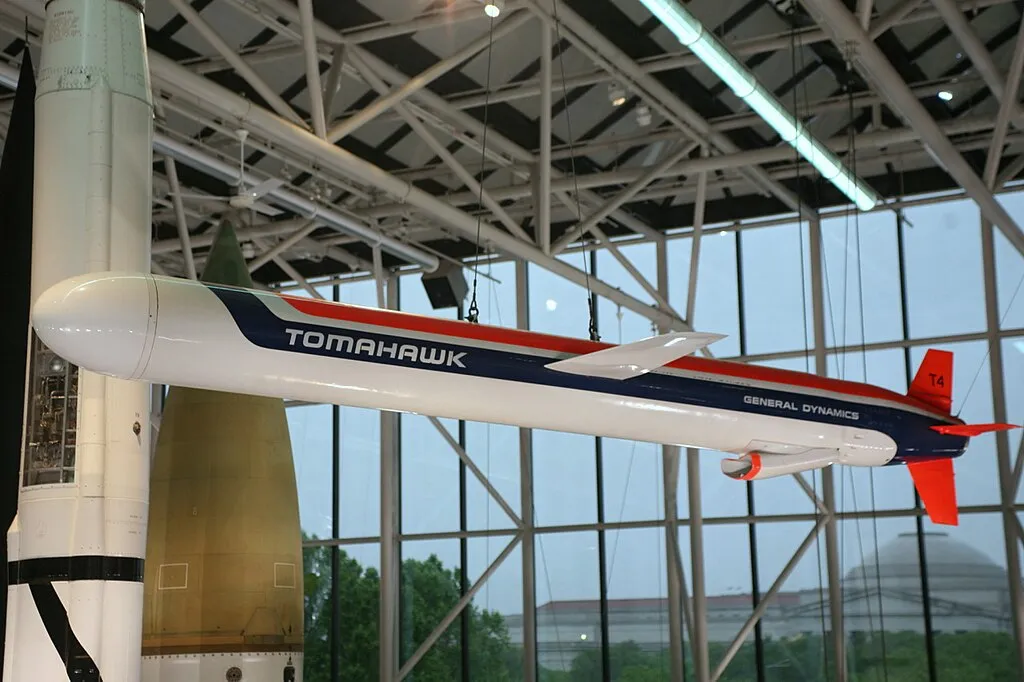
In this post, we’ll explore the Tomahawk cruise missile payload, design, speed, launch methods, and the evolution that keeps this iconic missile at the forefront of modern warfare.
The origins of the BGM-109 Tomahawk missile date back to the height of the Cold War in the 1970s, when the United States sought a reliable long-range cruise missile capable of launching from both ships and submarines.
Designed initially by General Dynamics and later refined by McDonnell Douglas, Hughes Aircraft, and ultimately Raytheon, the current Tomahawk missile manufacturer, the program was born from a pressing need to counter Soviet military superiority with a flexible, precision strike weapon that could operate from virtually anywhere.
What set the Tomahawk apart from earlier cruise missile designs was its unique blend of adaptability and survivability. Unlike ballistic missiles, the Tomahawk cruise missile could fly low over land and sea, guided by TERCOM (Terrain Contour Matching) and later enhanced by GPS systems for greater Tomahawk missile accuracy.
This gave commanders the ability to strike deeply into enemy territory without risking manned aircraft or broadcasting their intent.
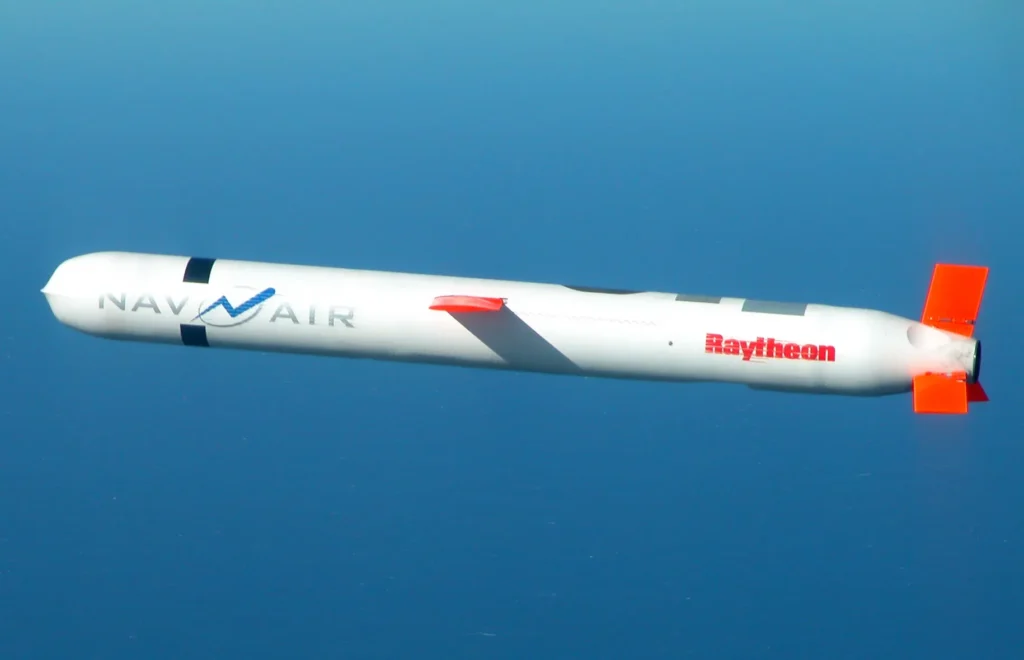
The Tomahawk’s first major operational use came during Operation Desert Storm in 1991, when hundreds of missiles rained down on Iraqi targets with unprecedented accuracy, solidifying its reputation.
Over the decades, the missile has been upgraded through various blocks, Block II, III, IV, and the latest Block V, each improving range, target flexibility, and warhead options.
Read also: Russian Kalibr Missile: How Deadly Is It Really?
These upgrades have expanded the Tomahawk cruise missile range to between 900 and 1,500 miles, depending on the variant, and have introduced new features like in-flight retargeting and real-time damage assessment.
The BGM-109 Tomahawk missile is a marvel of modern engineering, designed to deliver lethal payloads across vast distances while maintaining stealth and survivability.
One of its standout features is its sleek, aerodynamic body optimized for low-level flight. This enables the missile to follow the contours of the earth—hugging hills, valleys, and sea surfaces to avoid radar detection.
When it comes to the Tomahawk cruise missile dimension, the missile measures approximately 20.6 feet (6.25 meters) in length with a wingspan of 8.9 feet (2.67 meters) when its wings are deployed.
This compact yet powerful design allows it to be launched from a variety of platforms, including vertical launch systems aboard ships and 21-inch torpedo tubes on submarines.

In terms of propulsion, the Tomahawk uses a solid-fuel booster for its initial launch phase, followed by a Williams International F107 turbofan engine that sustains it during cruise flight.
The engine gives the Tomahawk cruise missile speed of approximately 550 miles per hour (Mach 0.74), which is intentionally subsonic to help maintain stability and fuel efficiency over long distances.
The Tomahawk missile range varies by block and purpose, but modern Block IV and V versions can reach targets more than 1,000 miles (1,600 kilometers) away, giving naval commanders the ability to strike distant land targets without exposing ships or submarines to enemy defenses.
Read also: Kalibr vs Tomahawk: Which Cruise Missile is the Most Powerful?
When examining the Tomahawk cruise missile payload, versatility becomes immediately evident. The missile can carry either a unitary high-explosive warhead weighing around 1,000 pounds or cluster munitions designed for widespread damage over area targets.
The warhead options are tailored to mission needs, be it bunker-busting strikes, air defense suppression, or anti-ship attacks in the Block V Maritime Strike Tomahawk.
Despite its payload, the missile maintains an excellent record of precision thanks to its advanced guidance systems.
This guidance suite includes inertial navigation, GPS updates, and DSMAC (Digital Scene Matching Area Correlation), all of which contribute to the accuracy, often measured at a Circular Error Probable (CEP) of less than 10 meters. Its stealthy approach, combined with this accuracy and a potent warhead, ensures that the Tomahawk cruise missile remains one of the most feared and respected weapons in the naval arsenal.
A key factor behind the enduring success of the BGM-109 Tomahawk missile lies in its sophisticated guidance and seeker technologies, which allow the missile to navigate complex terrain and reach targets with exceptional precision.
In modern warfare, accuracy is everything, and the Tomahawk delivers this in spades. The missile is equipped with a suite of redundant and layered guidance systems that ensure its target is hit even if one system fails or is disrupted.
Initially, the Tomahawk cruise missile relied on TERCOM (Terrain Contour Matching), which compared stored digital maps of the terrain to the actual landscape the missile flew over.
This method allowed the missile to fly at extremely low altitudes, following the Earth’s contours and avoiding enemy radar, an essential feature for penetrating heavily defended airspace.
Later improvements added DSMAC (Digital Scene Matching Area Correlation), which uses onboard cameras to match real-time images of the ground with stored reference photos. This visual-based correction system significantly improved Tomahawk missile accuracy, reducing the risk of deviation from the intended target.
Modern versions, including the Block IV Tactical Tomahawk and the latest Block V, have taken guidance to the next level by integrating GPS and a two-way datalink. This allows operators to adjust the missile’s course in real time or redirect it to new targets mid-flight, a game-changing feature in dynamic combat environments.
These improvements ensure that the missile not only maintains its impressive range but also retains precision throughout its journey, regardless of shifting battlefield conditions.
The datalink system can even transmit post-strike battle damage assessments, providing immediate feedback to commanders, a rare and valuable feature among cruise missiles globally.
The BGM-109 Tomahawk missile has seen numerous upgrades and variant developments since its introduction, each tailored for specific operational needs.
These variants reflect the missile’s adaptability to diverse combat scenarios, ensuring it remains a cornerstone of modern naval and land-attack strategies. Below is an overview of the major Tomahawk variants and their distinctive features.
The BGM-109A, also known as TLAM-N, was the nuclear-armed version of the Tomahawk cruise missile. Designed to deliver a W80 nuclear warhead, this variant provided a strategic deterrent option for U.S. and NATO forces. Due to arms reduction treaties and the shift away from tactical nuclear weapons, this variant was retired from active service by the early 2010s.
The BGM-109B/E, referred to as TASM (Tomahawk Anti-Ship Missile), was developed to target enemy vessels at sea. Fitted with an active radar seeker, this variant was designed for open-ocean engagements but was eventually withdrawn in favor of more advanced and specialized anti-ship systems.
However, the recent Block V upgrades aim to restore and modernize the Tomahawk’s anti-ship role.

The BGM-109C (TLAM-C) is the standard land-attack variant equipped with a 1,000-pound unitary high-explosive warhead.
This model specializes in precision strikes against hardened, high-value targets such as bunkers, command centers, and critical infrastructure. Its impressive Tomahawk missile accuracy has made it the primary version for precision land strikes.
The BGM-109D (TLAM-D) variant was armed with cluster munitions designed to spread submunitions over large target areas, ideal for attacking airfields or troop concentrations. Due to concerns about the long-term dangers of unexploded ordnance, this version has been phased out of operational service.
The BGM-109G Gryphon was a ground-launched version of the missile, deployed in Europe during the Cold War to counter Soviet threats. With a nuclear payload and similar guidance systems to its seaborne counterparts, the Gryphon played a significant role in NATO’s deterrence strategy until it was eliminated under the 1987 INF Treaty.
Introduced in the early 2000s, the Block IV Tactical Tomahawk brought transformational improvements, including in-flight retargeting via two-way datalink, loitering capability over targets, and a reduced cost of Tomahawk missile production and maintenance. Its operational flexibility and range of up to 1,000 miles made it a mainstay of U.S. naval strike operations.
The latest upgrade, the Block V Maritime Strike Tomahawk, enhances the missile’s role with a modernized seeker that enables effective targeting of moving ships at sea. This rejuvenates the missile’s anti-ship capability, filling a critical gap left by the retirement of earlier TASM variants.
The Block V also includes enhancements to increase survivability, range, and effectiveness in both land-attack and maritime strike missions.
A standout feature of the BGM-109 Tomahawk missile is its remarkable versatility in launch platforms, allowing it to be fired from both surface ships and submarines with ease.
This adaptability gives military commanders unparalleled strategic options, as the missile can be deployed from various points across the globe, whether from open waters or beneath the ocean’s surface.
This flexibility ensures that U.S. and allied naval forces can respond quickly to threats without needing to position specialized, limited-use launchers.
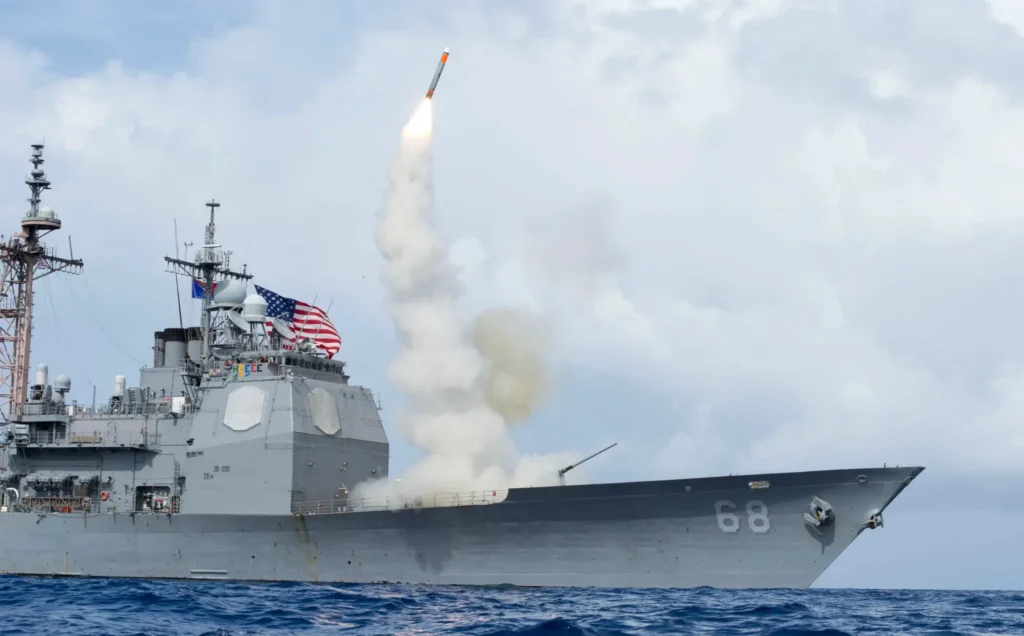
On the surface, the Tomahawk cruise missile is launched primarily from U.S. Navy destroyers and cruisers equipped with the Mk 41 Vertical Launching System (VLS). Each VLS cell can house a Tomahawk, allowing ships to carry and fire multiple missiles in rapid succession.
During conflicts such as the Gulf War and Operation Iraqi Freedom, these warships unleashed waves of Tomahawks, showcasing the system’s ability to strike distant, heavily defended targets while staying well outside enemy weapons range.
Submarines also play a crucial role in Tomahawk missile launch operations. Nuclear-powered attack subs like the Virginia-class and converted Ohio-class platforms can fire Tomahawks from standard 21-inch torpedo tubes or vertical launch systems, providing a stealthy and unpredictable strike capability.
This underwater launch option greatly enhances the Tomahawk cruise missile’s strategic value by allowing attacks from concealed positions close to enemy shores, making the missile a constant and silent threat in global military theaters.
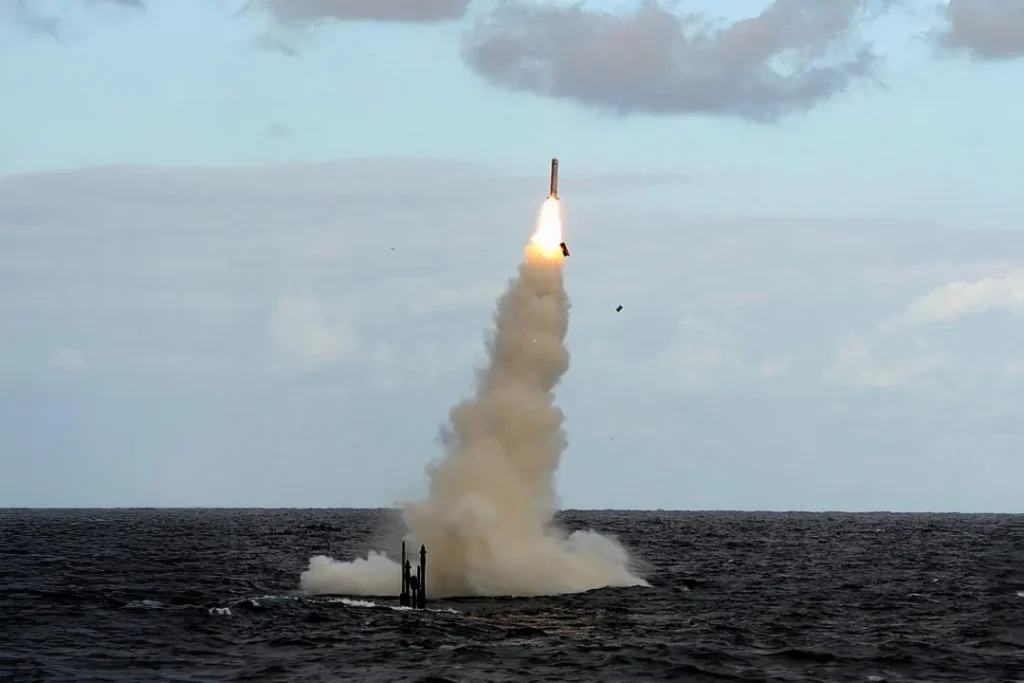
The BGM-109 Tomahawk missile has built an impressive combat record over the past four decades, earning its reputation as one of the most reliable and effective long-range strike weapons in the world.
First used in combat during Operation Desert Storm in 1991, over 280 Tomahawks were launched against Iraqi targets, marking the missile’s combat debut with extraordinary success.
These early strikes showcased the Tomahawk missile accuracy, as the missiles flew hundreds of miles into heavily defended airspace and hit key military and infrastructure targets with devastating precision.
Since then, the Tomahawk cruise missile has seen action in nearly every major U.S. and allied military operation. In 1999, Tomahawks were used against Serbian targets during the NATO-led intervention in Kosovo.
More recently, during the conflicts in Afghanistan, Iraq, Libya, and Syria, the missile’s long range and precision guidance enabled forces to strike high-value targets, such as terrorist training camps, command bunkers, and air defense systems, without risking manned aircraft.
The Tomahawk missile range has proven critical in these operations, allowing ships and submarines to stay safely out of reach of enemy forces while delivering their lethal payloads.
One notable use occurred in April 2017, when U.S. Navy destroyers launched 59 Tomahawks against a Syrian airbase in response to chemical weapons attacks.
This strike demonstrated the missile’s enduring relevance in modern conflict, as well as the justification for its high cost of a Tomahawk missile, then estimated at around $1.5 million per unit.
Despite the price, military planners continue to favor the Tomahawk because of its low risk to human life, operational flexibility, and proven reliability across diverse combat environments.
The missile’s combat history underscores why it remains a cornerstone of Western strike capabilities even as new weapons systems are introduced.
The BGM-109 Tomahawk missile stands as one of the most successful and enduring precision strike weapons in modern military history.
Its unmatched versatility, from launching off both ships and submarines to striking targets at ranges exceeding 1,000 miles, has made it the preferred choice for operations where accuracy, reliability, and standoff range are essential.
The missile’s proven combat record across diverse theaters, from the deserts of Iraq to the contested waters near Iran, underscores why it remains the backbone of Western naval strike capabilities.
Despite the high cost of Tomahawk missile units, defense planners continue to invest in its future because of its long list of operational advantages: exceptional Tomahawk missile accuracy, adaptable Tomahawk cruise missile payload, and continuous upgrades that keep it relevant against evolving threats.
With enhancements like the Maritime Strike Tomahawk and possible future improvements in speed and networking, the missile is set to serve the U.S. and its allies for decades to come.