Follow Us:
Follow Us:

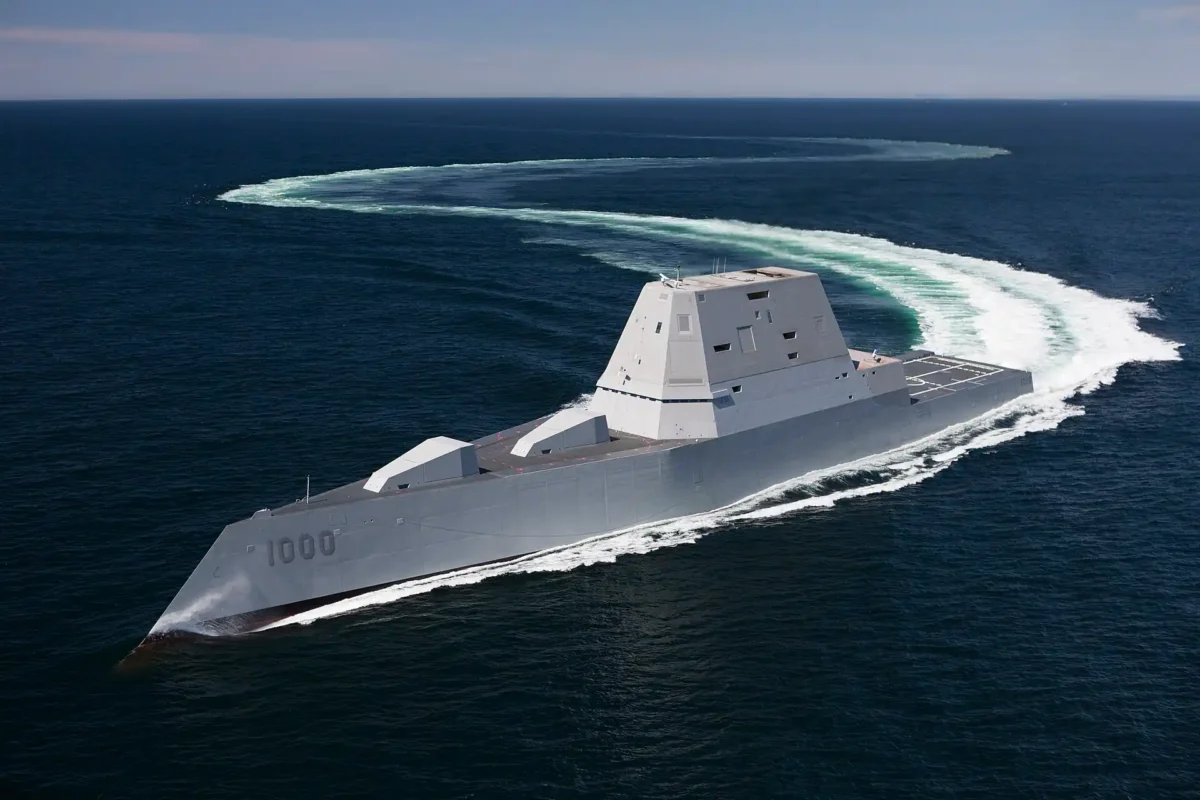
The Zumwalt-class destroyer has always stood out in the U.S. Navy lineup. It doesn’t look or feel like any destroyer before it; all sharp angles, a sloping hull, and technology that once sounded closer to science fiction than shipbuilding.
Its unusual “tumblehome” shape was meant to deflect radar waves and make the ship harder to spot, while its electric drive and automation cut down the crew size and boosted efficiency. On paper, it promised a quieter, smarter, and more lethal warship.
In May 2024, one of the Zumwalt’s big 155 mm gun turrets was taken off at Ingalls Shipbuilding, which was seen as a pretty clear sign that the ship’s old land-attack role was being left behind. The Navy had sent it there months earlier, back in August 2023, to get ready for something completely different: a fit-out to carry twelve hypersonic missiles under the Conventional Prompt Strike program.
By December 2024, the USS Zumwalt was floating again after a long stretch of modifications. If everything goes to plan, and that’s a big if, the first live-fire tests might happen around 2027.
Yet, despite all these innovations, the Zumwalt is also expensive and complicated. Each upgrade pushes the ship further into experimental territory, and the cost keeps climbing.
Some systems have struggled to meet expectations, and others, like the Advanced Gun System, never quite found a purpose. That’s why the question keeps coming back: is the Zumwalt really showing us the future of naval warfare, or is it a billion-dollar experiment that’s trying to justify its own existence?
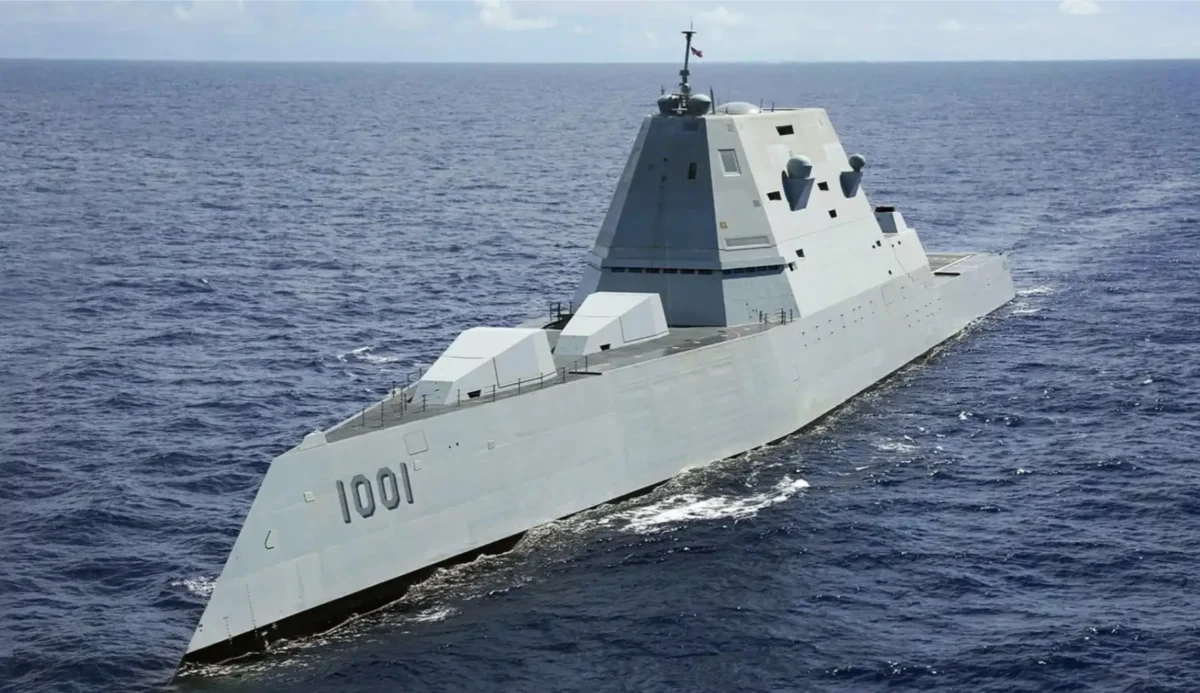
When the Zumwalt-class destroyer first showed up, people weren’t sure what to make of it. It didn’t look like any destroyer anyone had seen before, more like something borrowed from a sci-fi movie than a Navy ship. The hull sloped inward instead of outward, a style called a “tumblehome” design.
Read also: What Makes Zumwalt Tumblehome Hull So Special?
Engineers thought that the shape would scatter radar signals and make the ship look much smaller on enemy screens, maybe even as small as a fishing boat. On paper, that meant a 15,000-ton warship could get a lot closer to shore before anyone even knew it was there.

In practice, the stealth story may be more complicated. While the Zumwalt’s shape and radar-absorbent materials almost certainly reduce its signature compared to older destroyers, it’s unlikely to be truly invisible.
Sea conditions, radar frequencies, and even the ship’s own heat and electronic emissions could still give it away. In other words, it might be “harder to see,” not “impossible to find.” But even that smaller signature could make a big difference in a modern naval fight, where detection often decides survival.
Then there’s the ship’s power system, which might be its most forward-looking feature. Unlike older destroyers that split propulsion and electrical systems, the Zumwalt runs on what’s known as an Integrated Power System, or IPS.
Basically, it produces a massive pool of electricity, around 78 megawatts, that can be directed wherever it’s needed, whether that’s to the engines, sensors, or weapons. The idea is that this setup could someday make it easier to run energy-hungry systems like railguns or lasers.
Some people even describe the ship as a “floating power plant.” Of course, that flexibility also means more complexity, and the Navy reportedly faced challenges fine-tuning the system early on. Even so, the IPS might end up shaping how future warships handle power.
The ship’s weapons tell another interesting story. At first, the Zumwalt’s big selling point was its Advanced Gun System, or AGS, a pair of large-caliber guns meant to hit targets more than 100 kilometers away.
The plan was for them to provide long-range fire support for troops on shore. But when the specialized ammunition turned out to be too expensive, reportedly up to $800,000 per round, the Navy shelved the idea. For a while, the ship was left with two enormous guns it couldn’t really use.
That might have been the turning point. Rather than abandon the ships, the Navy began to reimagine their role. Now, with the AGS removed, the Zumwalt-class is being refitted to carry Conventional Prompt Strike (CPS) hypersonic missiles.
If the upgrade works as planned, it could give the U.S. Navy one of the fastest, longest-range weapons ever deployed at sea. But again, “if” is the key word. Integrating hypersonic systems into an existing hull is no simple task, and it remains to be seen whether the Zumwalt can fully deliver on that new promise.

When you step back and look at the whole story, the Zumwalt-class destroyer feels like a mix of ambition and adjustment. It didn’t hit every goal, but the ideas behind it, stealth, flexibility, and raw electrical power, still hint at where future fleets might be heading.
So, if you ask, “What makes the Zumwalt-class revolutionary?” The answer probably depends on how you define progress. It’s not revolutionary because everything went right; it’s revolutionary because it dared to do things differently. Even with all the stumbles, the Zumwalt might be the moment the Navy started thinking past tradition, toward ships built for problems we haven’t even seen yet.
The Zumwalt-class destroyer was meant to show what an efficient, forward-looking warship could be. Back in the early 2000s, the Navy planned to build 32 of them, each supposedly costing around $1.3 billion (it’s not cheap, but manageable for something that advanced). Then the design kept changing. New technologies were added, systems got more complex, and the price tag started climbing fast.
By the time the first ship, the USS Zumwalt (DDG-1000), finally joined the fleet, the real cost, including all the research and development, had shot past $7 billion per ship, which’s more than five times the original estimate, and on a per-ton basis, it’s actually pricier than some aircraft carriers.
A big part of the problem was that the Zumwalt tried to do too much at once. Nothing about it was standard. Every major component (e.g., the radar, the guns, the power system) had to be designed from scratch. There were no off-the-shelf parts to fall back on, so every step took longer, cost more, and came with its own set of growing pains.
As one naval analyst put it, “the Navy tried to leap a generation ahead instead of taking one step at a time.” When costs kept climbing, the Navy eventually cut the planned fleet from 32 ships to just three, turning what was once a large-scale production program into a kind of experimental prototype series.
Compared to the Arleigh Burke-class destroyers, the difference is striking. An Arleigh Burke Flight III costs roughly $2.2 billion. That’s still expensive, but far more predictable. Those ships use proven systems, mature radar, and a long supply chain that spreads out costs.
In contrast, every Zumwalt component came with its own learning curve. The result, some critics argue, is that the Navy ended up with three of the most advanced ships ever built, but also three of the least cost-effective.
Congress noticed. Over the past decade, several reports from the Government Accountability Office (GAO) have raised questions about whether the Zumwalt program delivered enough value for its price.
In a 2023 update, for example, the GAO noted that the Navy still lacked full operational testing data to show the ship could perform all its intended missions. Lawmakers have also pointed out that many of the ship’s original goals, like providing long-range land attack, were quietly abandoned after the gun system failed to deliver affordable ammunition. Some members of Congress have since called the program a “lesson in overreach,” warning that innovation without a clear mission can quickly become a budget trap.
Still, it might be unfair to call the Zumwalt a total loss. Much of the money poured into the program has gone into technologies that could shape future designs. The Integrated Power System, stealth hull form, and automation features developed for the Zumwalt could all inform the Navy’s next generation of destroyers, particularly the upcoming DDG(X) program, which will likely borrow many of these ideas but apply them more cautiously.
So, can all that innovation really make up for the price? It depends on what you’re looking for. If you measure success by what the ship can do right now in battle, the Zumwalt might seem like a very expensive experiment that never quite paid off.
But if you see it as a bridge or a way to test ideas and tech the Navy could depend on later, then maybe the investment isn’t wasted after all. The catch is, people don’t usually think in decades, and budgets don’t wait that long either.
Since it joined the fleet, the Zumwalt hasn’t spent much time out on real missions. Most of its days have been taken up by testing, upgrades, and short exercises rather than long deployments. The USS Zumwalt has done a few runs across the Pacific and some integration trials, but nothing close to actual combat. That’s pretty common for a new ship class, but it also hints that the Navy’s still working out what, exactly, to do with it.
A lot of that uncertainty goes back to the ship’s original purpose. The Zumwalt was built around its Advanced Gun System for land attacks. This was a good idea on paper, until the special ammunition turned out to be far too expensive to produce. Once that happened, the Navy had to rethink the whole concept.
These days, the focus has shifted to fitting the ship with hypersonic missiles and giving it a surface-strike role instead. Whether this new role will work in practice remains uncertain, especially given the ship’s small fleet size and complex maintenance needs. A warship that powerful but rare might struggle to fit neatly into the Navy’s larger, more standardized operations.
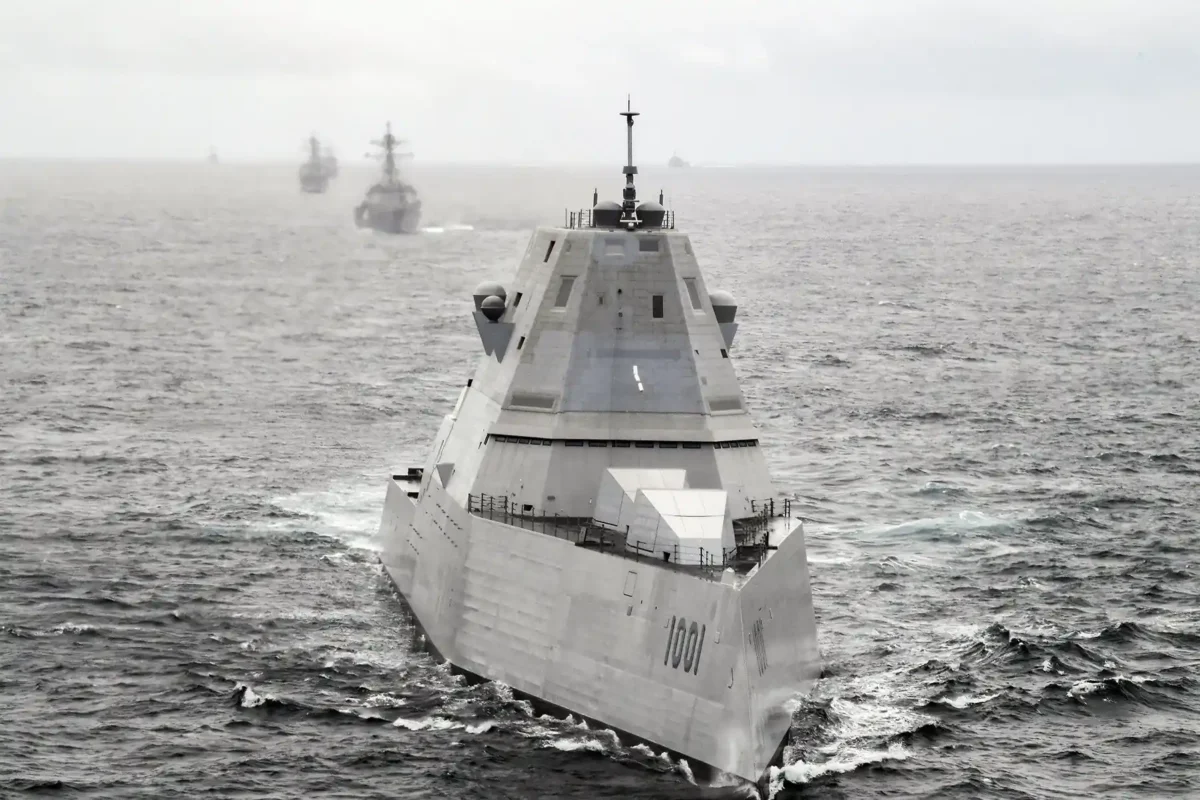
Some experts have doubts about how ready the Zumwalt really is for regular duty. A few naval analysts have mentioned that its unusual design might not handle rough seas as well as traditional destroyers, and that could limit how far it can operate from support bases. There’s also the issue of logistics.
The Navy’s training and supply systems were built around the Arleigh Burke class, not the Zumwalt. So in practice, it can feel a bit like an outsider in its own fleet. That doesn’t mean it’s a failure, but it does suggest its main value might be in testing new ideas rather than fighting day to day.
So, does it work in practice? The honest answer might be “not yet.” The Zumwalt seems to be in a long testing phase; part warship, part laboratory. If the hypersonic missile upgrade succeeds, it could finally find its place as a strike platform for the next era of naval warfare. But for now, it still feels like a ship that’s learning what it wants to be.
That’s the question people keep coming back to. For all its bold ideas, the Zumwalt still feels like a ship that’s trying to find its place. It was meant to support land attacks with those massive guns, but now it’s being reimagined for something else entirely.
The Navy seems to have accepted that shift, turning the class into a kind of experimental platform, a place to test new weapons, new sensors, and maybe even new ways of fighting at sea.
The next big step is the hypersonic upgrade. The plan is to equip the Zumwalt with Conventional Prompt Strike (CPS) missiles that could hit targets thousands of miles away in minutes. If it works, the ship could become the first surface vessel with that kind of reach.
But that’s still uncertain. Integrating such advanced weapons on a ship that already pushes engineering limits might take longer and cost more than expected. The Navy’s track record on that kind of integration isn’t exactly spotless.
Still, the Zumwalt might prove its worth in a quieter way. Many of its systems (e.g., the electric drive, stealth shaping, and automated controls), are already influencing the Navy’s next big project like the DDG(X) destroyer. So even if the Zumwalt never lives up to its original hype, the ideas it tested are shaping what comes after. Maybe that’s its real job, not to lead the fleet, but to show where the future might go.
At this point, it’s hard to call the Zumwalt either a total success or a total failure. It sits somewhere awkwardly in between. Some analysts say the Navy had to build it to see what was possible, that without the Zumwalt, we wouldn’t have the tech foundation for the next generation of ships. Others think it was a warning shot about what happens when defense programs get too ambitious for their own good.
The media has mostly treated it as both a marvel and a punchline. The “stealth destroyer that couldn’t afford its own ammo” became an easy target, especially when each ship ended up costing over $7 billion. But that number doesn’t tell the whole story.
The Navy has been quietly reusing much of its technology, the electric drive, automation systems, and radar shaping, in upcoming designs. So maybe it wasn’t money thrown away, just money spent ahead of its time.
If you ask people inside the Navy, you’ll hear mixed feelings. Some crews love how quiet and stable it is at sea. Others say it’s still too experimental and hard to maintain. It might never be the fleet’s backbone, but it’s changing how the Navy thinks about ships; fewer sailors, more automation, bigger power capacity for future weapons.