Follow Us:

Follow Us:

If you’ve ever watched a clip of a railgun test, you probably felt that same mix of wait… that can’t be real and okay, that’s actually kind of incredible. The idea of flinging a chunk of metal at extreme speeds using nothing but electricity sounds almost sci-fi, but railguns are not just a futuristic dream anymore; they’re re-emerging in very real defense programs right now.
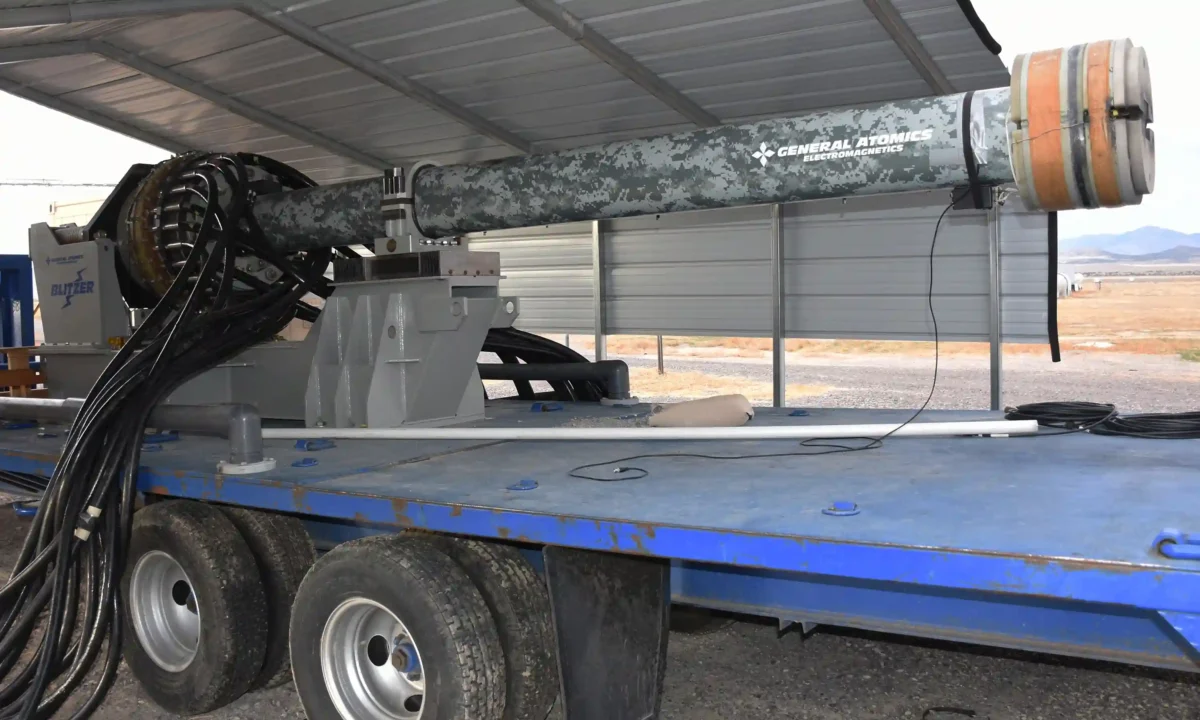
Despite being widely believed “cancelled” in the U.S., companies like General Atomics are quietly pitching a next-gen railgun system for air and missile defense. Their new design, showcased just this year, claims muzzle velocities up to Mach 6 and aims to intercept cruise and ballistic missiles.
At the same time, Japan is making bold moves. Its JMSDF test ship JS Asuka now carries a railgun, and recent images released by the Japanese Ministry of Defense suggest the system is much more mature than early prototypes. What’s even more surprising is that they’ve reportedly already hit a target at sea in tests.
And if that feels like déjà vu, because the U.S. dropped its railgun program a few years ago, that’s kind of the point. According to insiders, many of the old technical hurdles (like barrel wear) are now being solved. But how powerful is a new railgun?
If you strip the idea down to its basics, a railgun is really just a machine that uses electricity instead of gunpowder to push a metal projectile forward. That’s it. No big fireball, no chemical explosion, just raw electromagnetic force doing the heavy lifting.
And this matters because, at least in theory, electricity can accelerate a projectile way faster than burning propellant ever could.
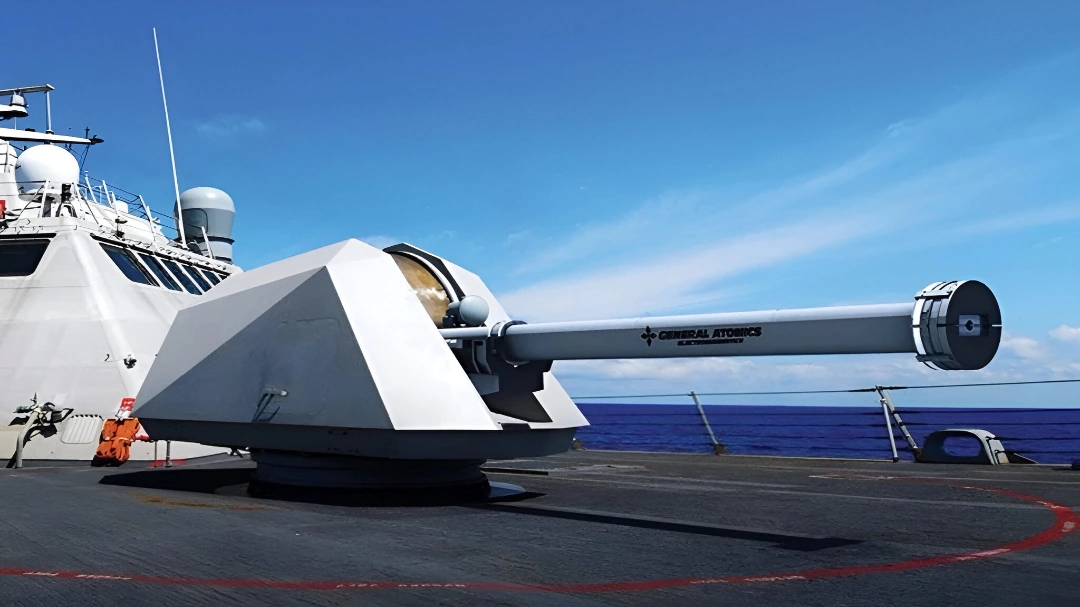
So we’re talking about speeds that might reach several times the speed of sound, plus the bonus of not having to store explosive ammo onboard a ship. From a safety and logistics angle, that’s kind of a big deal.
But the real story isn’t just the “cool factor.” It’s the idea that a weapon could fire long-range, ultra-fast, low-cost rounds without relying on missiles. If you’re responsible for defending a ship from incoming threats, the possibility of shooting cheap metal slugs instead of million-dollar interceptors probably sounds appealing, even if the technology isn’t fully there yet.
When you stack a railgun next to a traditional naval gun, the differences feel pretty stark:
In theory, this setup could push the projectile far faster and farther than a conventional shell. But that same “electricity instead of explosives” idea is also the source of railguns’ problems. They need huge bursts of power, their rails wear out insanely fast, and the amount of heat involved is… not gentle.
So, the railgun sounds like the future, but the conventional gun still wins in reliability, at least for now. The tension between those two ideas is partly why railguns keep bouncing between “breakthrough of the decade” and “too messy to field.”
| Component | What It Actually Does | Why It Matters |
| Rails | Two conductive metal bars running parallel. The electrical current travels down one rail, through the armature, and back along the other. | They create the electromagnetic force that launches the projectile, but they also wear out quickly, which is one of the biggest engineering headaches. |
| Armature | The piece that connects the rails electrically. Could be a solid block or a conductive sabot. | It’s basically the “shuttle” that gets shoved forward by the magnetic field. No armature, no launch. |
| Power Supply | A huge energy storage system that releases a massive pulse of electricity in a split second. | Railguns need a short, intense burst of power, far more than a normal ship grid can provide, which is why power systems are such a limiting factor. |
| Projectile | Usually just a solid metal slug with no explosives inside. | The destructive power comes from sheer speed, which is appealing for safety, cost, and logistics. |
Most explanations of railguns tend to dive into equations and lose people immediately, but the core idea is surprisingly straightforward: a railgun turns electricity into a pushing force.
If we slow things down and look at it piece by piece, the process goes something like this:
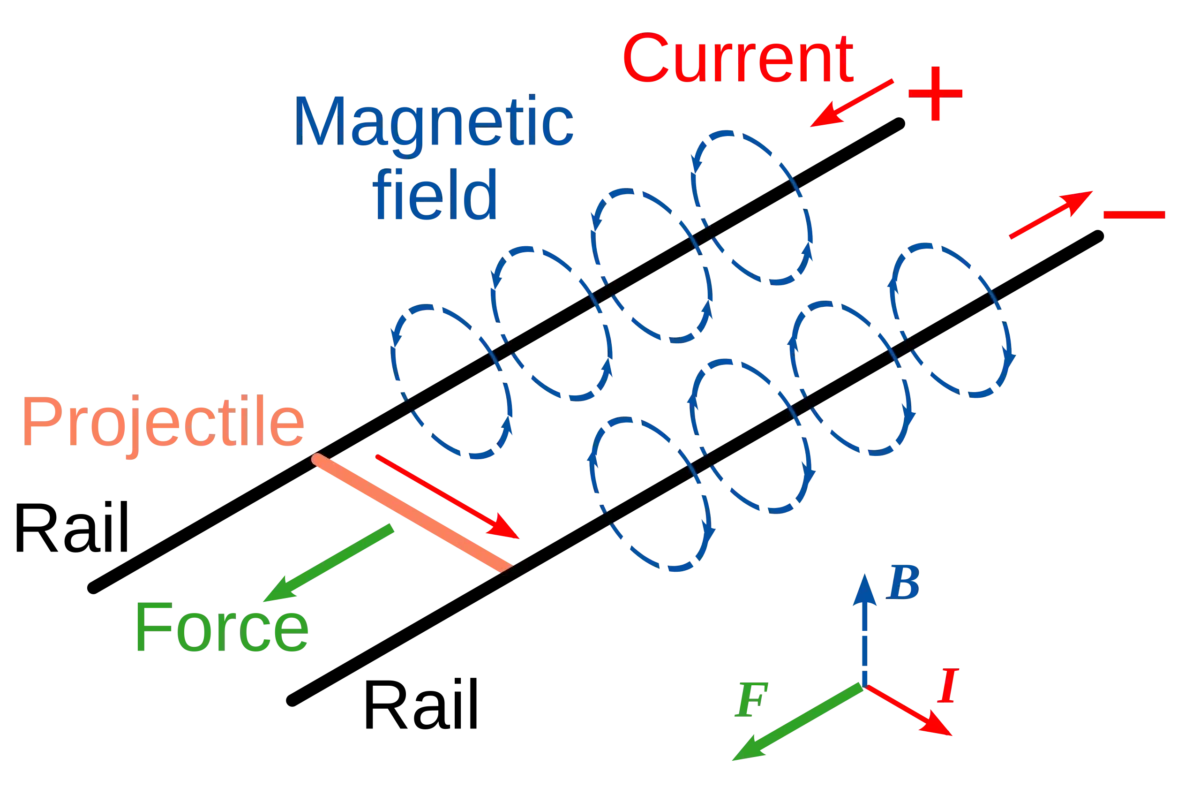
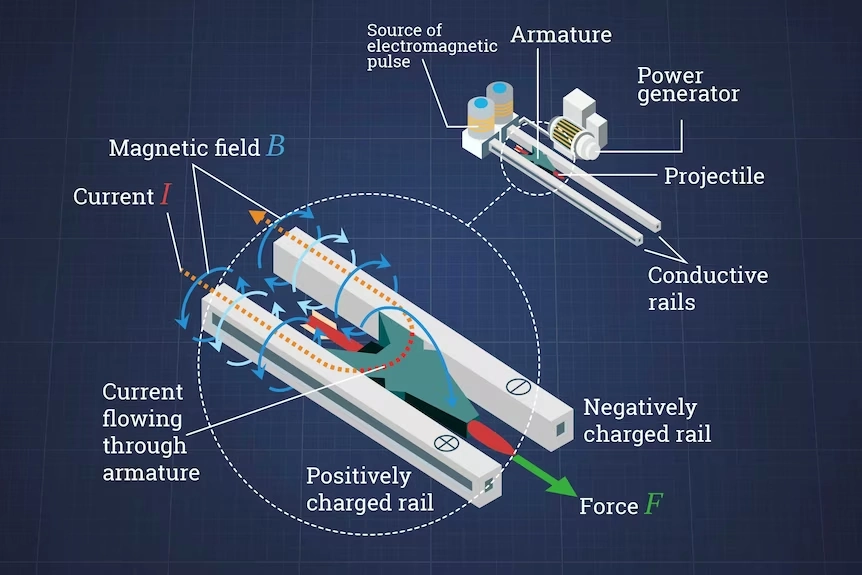
When people first hear that a railgun uses electricity to fire a projectile, it sounds almost too simple or maybe too futuristic to be real. But the heart of the system is basically just a clever way of turning electrical energy into a powerful shove. Instead of relying on gunpowder or an explosion, a railgun channels an enormous current through two metal rails and the armature connecting them.
As that current flows, it creates magnetic fields around the rails, and those magnetic fields interact with the current in the armature. That interaction produces what physicists call the Lorentz force, which is really just a fancy label for a push strong enough to accelerate the projectile down the barrel at blistering speed. It all happens so quickly that the projectile is already experiencing high-speed aerodynamic drag almost the moment it exits the rails.
What makes this approach interesting is that it reframes how we think about launching something. Instead of carefully timing a chemical explosion, engineers are trying to choreograph a burst of electricity and let physics take over.
The idea is elegant, but the reality is a bit more stubborn. The same forces that make a railgun so powerful are also rough on the hardware. Rails heat up rapidly, they wear down after just a few shots, and the electrical load is more like a controlled lightning strike than anything a normal weapons system deals with. So while the underlying science is surprisingly straightforward, making it work reliably is anything but.
The part that often gets overlooked is the power system behind all this. A railgun doesn’t just need a lot of electricity; it needs it in one huge, instantaneous pulse. That’s why most test platforms rely on massive banks of capacitors.
They charge up slowly, almost like giant energy buckets, and then dump everything in a single blink when the gun fires. Delivering that pulse is a whole specialty of its own, known as pulsed power, and it involves heavy-duty switching systems, thick conductive paths, and cooling setups that can survive the electrical chaos.
And this is where the real engineering challenges start to stack up. The rails get incredibly hot, the repeated electrical surges erode the metal, and the power equipment takes up a surprising amount of space.
On top of that, most ships or ground platforms weren’t designed to feed a weapon that wants more power in a split second than the rest of the system uses in minutes.
So even though the physics behind railguns has been understood for a long time, building a practical weapon means wrestling with heat, materials limits, size, weight, and energy demand all at once.
One of the reasons railguns keep popping up in headlines is their potential for sheer speed. A well-designed system can, at least in testing, push a projectile to several times the speed of sound.
People often throw around numbers like Mach 6 or Mach 7, and while those figures come from controlled trials, they do show what the technology might be capable of when everything works just right.
What makes that speed meaningful is the kinetic energy behind it, even a small, non-explosive metal slug hits with enormous force simply because it’s moving so fast. In a way, the projectile doesn’t need a warhead; the velocity does the damage for it.
That said, the actual speed a railgun can reach isn’t fixed. It depends heavily on how much electrical power the system can deliver in that split second between “ready” and “fire.” More power generally means more acceleration, but only up to the point where the hardware can handle it.
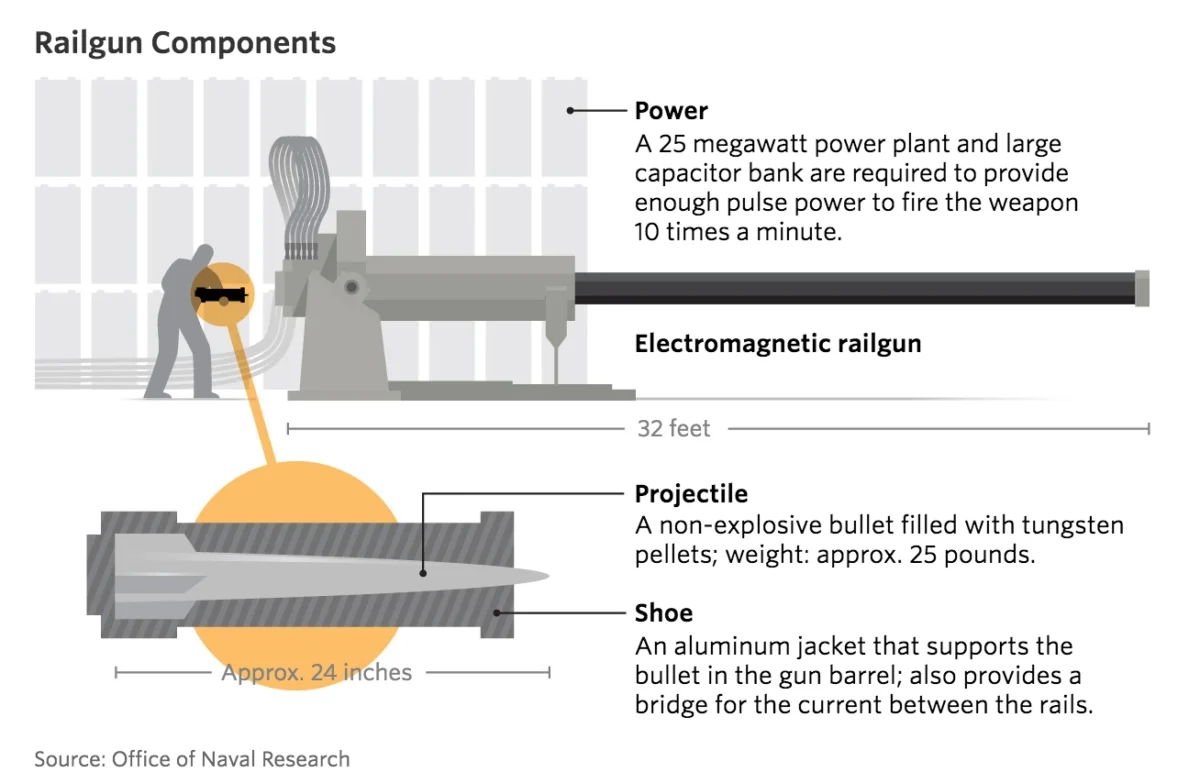
Barrel length matters too. A longer set of rails gives the projectile more distance to accelerate before it leaves the launcher. Engineers also have to think about the materials used for the rails themselves. If they heat up too fast or degrade too quickly, the system can’t sustain those higher speeds for long.
Heat management, in particular, becomes a kind of hidden limiter. Even if the power system could push the projectile faster, the rails might not survive the launch cycle.
So while railguns can reach incredible velocities, the speeds you actually see in practice tend to be a balance between ambition and what the materials, cooling systems, and power architecture can realistically support.
In other words, the headline numbers are exciting, but the real story is about how far engineers can push things before physics pushes back.
When people talk about railguns being “powerful,” they’re usually referring to two things: how far they might shoot, and how much damage a high-speed slug can actually do. And honestly, the answers depend a bit on whether we’re talking about real-world tests or more optimistic projections.
In practical trials, railgun projectiles tend to stay effective somewhere in the 50–110 km range. That’s already impressive for a gun firing a solid piece of metal. But on paper, if you had perfect materials and all the power you could ever want, the range could stretch several hundred kilometers. That’s the theoretical side, and most engineers would admit we’re not quite there yet.
For now, missiles still outrange railguns by a wide margin, and conventional naval artillery is more reliable, even if it’s slower.
The interesting twist is that a railgun doesn’t rely on explosives at all. Its destructive power comes almost entirely from kinetic energy, basically the brutal combination of mass and extreme speed. When a metal slug is traveling at multiple times the speed of sound, it hits with a kind of force that armor has a hard time dealing with. The impact can punch through metal, generate intense heat, and cause internal damage simply through shock.
In a way, the velocity becomes the warhead. This does mean the projectile needs to stay fast all the way to the target, which is its own challenge, but when the conditions line up, that speed can make even a small, simple slug surprisingly lethal.
Railguns get a lot of attention because, on paper, they offer a few genuinely appealing advantages. The big one is speed. A railgun can launch a projectile far faster than most traditional guns, which opens the door to quicker reaction times and potentially longer engagement ranges.
There’s also the fact that the ammunition doesn’t rely on explosives. From a safety and logistics standpoint, carrying solid metal slugs instead of shells or missiles is a lot simpler and arguably safer. And if the technology ever matures, each shot could be relatively cheap compared to missile interceptors, which is part of why militaries keep circling back to the idea.
But the limitations are just as real, and they’re mostly tied to the physics of pushing that much current through a weapon. The most painful issue is rail erosion, every shot scrapes and heats the rails to the point where they wear out quickly, sometimes after only a handful of firings.
On top of that, railguns demand enormous bursts of power, the kind most ships or platforms can’t deliver without major redesigns. And even if you solve those two problems, you still have heat management, which becomes a constant battle. The rails and surrounding components get so hot that you can’t fire rapidly without risking damage.
If railguns are ever going to move from test ranges to real deployments, a few big hurdles need to be cleared. The first is durability.
Right now, the rails simply don’t last long enough. Each shot dumps so much heat and current into the system that the metal wears down fast. Until engineers can create a launcher that survives dozens or ideally hundreds of rounds without major repairs, it’s hard to call the technology practical.
The second issue is power generation. A railgun doesn’t sip electricity; it gulps it. You need a ship or platform that can deliver massive, instant bursts of power without shutting everything else down.
Some newer ships might be able to support that someday, but most existing platforms weren’t built with this kind of electrical demand in mind. So unless power systems get lighter, more efficient, and far more responsive, railguns will stay stuck in the “great idea, tricky execution” phase.
And finally, there’s materials science, which might be the quiet hero of the whole story. Better conductors, tougher rail materials, improved cooling systems, these are the kinds of breakthroughs that could actually push railguns into the real world. Even modest gains here could reduce erosion, handle heat more gracefully, and make the launch cycle less destructive.
If those pieces come together and there are signs the industry is inching in that direction, railguns could eventually shift from “sci-fi curiosity” to something much more practical.