Follow Us:

Follow Us:

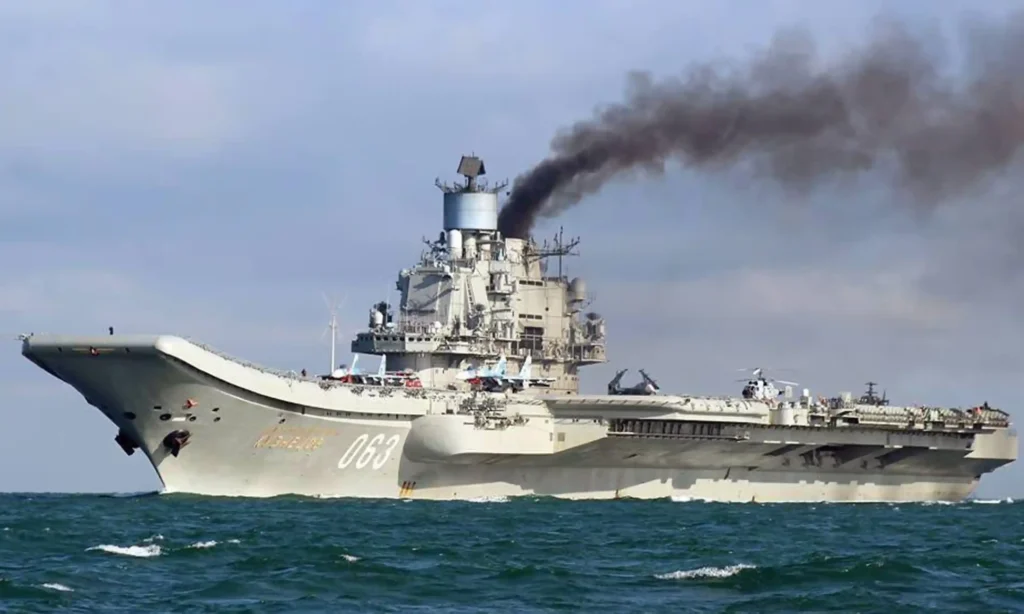
When you think of powerful naval fleets, sleek nuclear supercarriers probably come to mind, bristling with aircraft, cutting through the sea without a hitch. But then there’s the Admiral Kuznetsov aircraft carrier, Russia’s one and only carrier, famous not just for its military role but for the smoke it belches and the drama it brings.
Let’s be honest, this isn’t your typical aircraft carrier. Officially called a heavy aircraft-carrying cruiser, the Russian aircraft carrier Admiral Kuznetsov is a mix of old Soviet ambition and modern-day setbacks. And it’s seen it all, from Cold War posturing to real combat missions over Syria. Yet despite being plagued by engine problems, fires, and constant delays, this ship keeps coming back.
So, what makes the Kuznetsov-class aircraft carrier such a big deal?
First, it’s Russia’s only shot at global naval projection. With a flight deck packed with Su-33 and MiG-29K fighter jets, plus missile systems onboard, the Kuznetsov carrier is both a launch platform and a fighting machine. Even if it doesn’t run as smoothly as its Western counterparts, it still sends a message when it sails into contested waters.
But there’s more to this story than steel and smoke.
This ship has become a symbol, of national pride, military resilience, and sometimes, of how tough it is to modernize a navy in today’s world. Whether you’re a military enthusiast, a geopolitical observer, or just someone curious about one of the most infamous warships afloat, the Admiral Kuznetsov is worth a closer look.
In this post, we’ll explore the carrier’s backstory, tech specs, missions, and why it’s still hanging on, despite every reason not to.
So strap in. We’re setting sail on one of Russia’s most talked-about military vessels.
The story of the Admiral Kuznetsov aircraft carrier begins during the final chapter of the Soviet Union. Laid down in 1983 at the Nikolayev South Shipyard in Ukraine (then part of the USSR), the ship was intended to be the Soviet Navy’s answer to the U.S. supercarriers dominating the seas.
Originally named Riga, it was later renamed Leonid Brezhnev, and then Tbilisi, before finally becoming Admiral Flota Sovetskogo Soyuza Kuznetsov in honor of a legendary Soviet naval officer.
Its development marked a significant shift in Soviet naval doctrine. Up until that point, the USSR’s surface fleet relied heavily on submarines and missile cruisers for defense.
But with growing recognition of the strategic value of naval aviation, Soviet designers crafted a new hybrid concept: a Kuznetsov-class aircraft carrier that not only launched fighter jets but also carried powerful long-range anti-ship missiles, something Western carriers didn’t do.
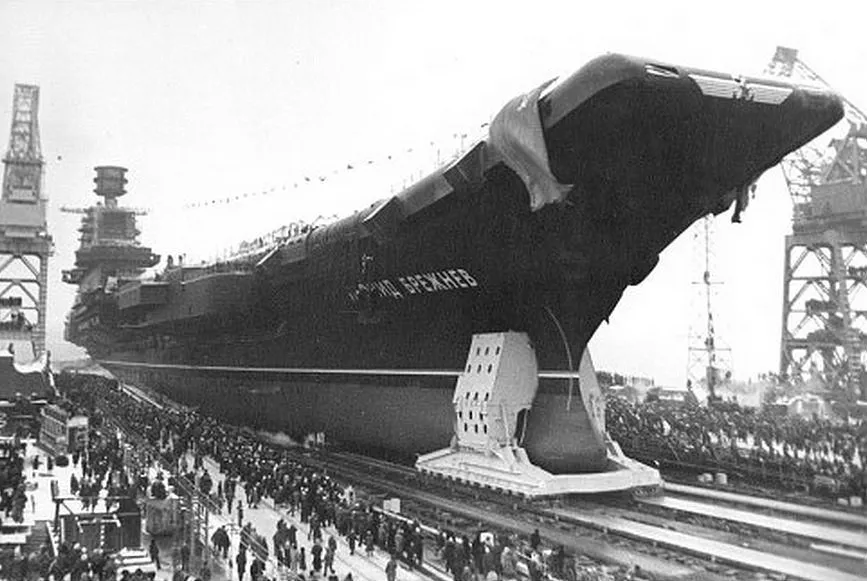
This dual-role design, combining carrier aviation with cruiser firepower, allowed Moscow to classify the ship as a “heavy aircraft-carrying cruiser.” That classification wasn’t just for semantics.
Under the 1936 Montreux Convention, aircraft carriers are restricted from passing through the Turkish Straits. But cruisers? They’re allowed. So by calling the Kuznetsov carrier a cruiser, the Soviets found a legal loophole to deploy the ship from the Black Sea to the Mediterranean.
Commissioned in 1990, just months before the Soviet Union collapsed, the ship entered service under the newly formed Russian Navy.
However, without the full industrial and financial support of the USSR, its post-commissioning years were rocky. Operational readiness dropped, and several planned sister ships were canceled. Its first few years were marked by low activity, poor maintenance, and logistical issues.
Despite this rough start, the Russian aircraft carrier Admiral Kuznetsov became a symbol of Moscow’s naval persistence. It wasn’t perfect, far from it, but it was what Russia had. And for a country aiming to maintain global influence, having a carrier, even one with issues, was better than having none at all.
At first glance, the Admiral Kuznetsov aircraft carrier looks every bit the part of a formidable warship, massive, angular, and built to project power. But beneath its imposing exterior lies a unique blend of Soviet-era engineering and compromises that have both defined and hampered its operational life.
The ship stretches nearly 305 meters (1,001 feet) long, with a full-load displacement of around 58,600 tons. That puts it just behind the U.S. Navy’s Nimitz-class carriers in size. But unlike its American counterparts, the Kuznetsov-class aircraft carrier doesn’t use nuclear propulsion.
Instead, it relies on eight conventional boilers feeding steam turbines, powered by heavy mazut fuel, which is notoriously dirty. That’s the reason for those thick black plumes often seen billowing from its smokestacks. It’s not a design flaw, it’s just old-school Soviet engineering, and it’s become one of the ship’s most ridiculed features.

Propulsion aside, the carrier uses a STOBAR (Short Take-Off But Arrested Recovery) configuration for launching and recovering aircraft.
This system combines a ski-jump ramp with arrestor cables but lacks catapults. It’s a simpler, lighter alternative, but it limits the types and weights of aircraft that can operate effectively from the deck. That means the Kuznetsov carrier can’t launch fully loaded fixed-wing aircraft the way U.S. carriers can.
Read also: The Reason why the Russian Aircraft Carrier has a Ramp
The air wing typically includes a mix of Su-33 “Flanker-D” fighters, MiG-29K multirole fighters, and Kamov Ka-27 or Ka-31 helicopters for anti-submarine and early warning roles.
At full capacity, the ship can carry up to 40 aircraft, though in practice it often operates fewer due to maintenance issues and limited deck space.
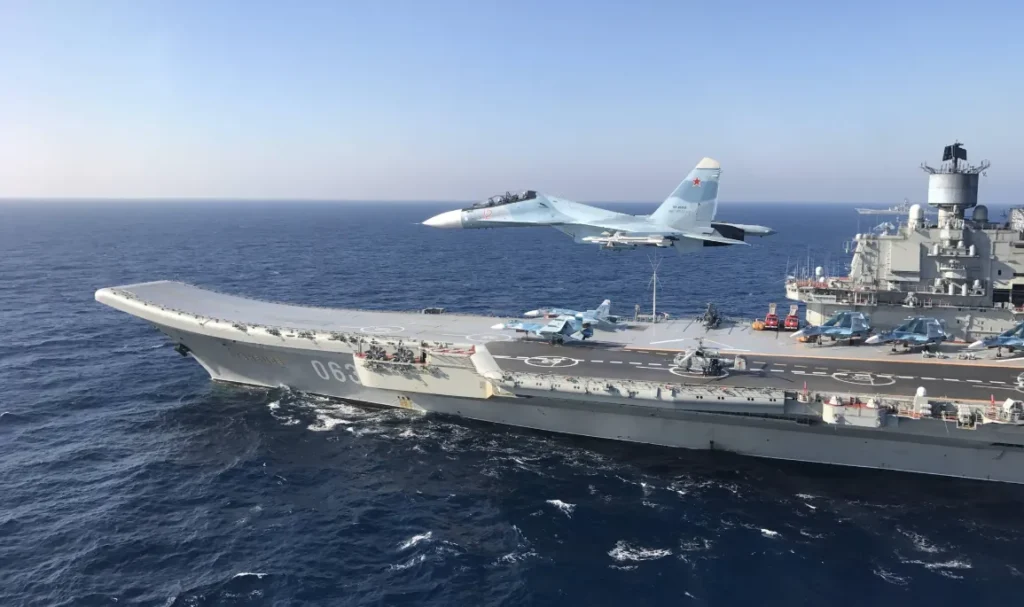
What makes the Russian aircraft carrier Admiral Kuznetsov stand out is its missile armament. Unlike Western carriers, which rely on escorts for ship-to-ship or land attack capabilities, the Kuznetsov is armed with P-700 Granit anti-ship missiles, vertical-launch surface-to-air missiles (SA-N-9 Gauntlet), and close-in weapon systems like the Kashtan CIWS. This cruiser-like weapon load was designed to allow the ship to defend itself independently in hostile environments.
In theory, it’s a floating fortress. In practice, many of these systems have aged poorly, and ongoing modernization efforts aim to address that, though not without setbacks, delays, and more than a few budget overruns.
Unlike most Western aircraft carriers, the Admiral Kuznetsov aircraft carrier was designed to be more than just a floating airfield. It’s a hybrid warship, part carrier, part cruiser, with a significant arsenal of offensive and defensive weapons. This dual-role design reflects the Soviet Navy’s belief that a carrier should be able to defend itself and strike targets independently, without relying heavily on escorts.
Let’s start with the aircraft. The Kuznetsov-class aircraft carrier operates a fixed-wing air wing composed primarily of Sukhoi Su-33 fighters and MiG-29K multirole jets.
The Su-33s are naval variants of the Su-27, equipped with reinforced landing gear, folding wings, and tailhooks for carrier operations. While formidable in a dogfight, their capabilities are limited compared to modern fifth-generation fighters. The MiG-29K, though newer and more versatile, has faced reliability issues during deployments.
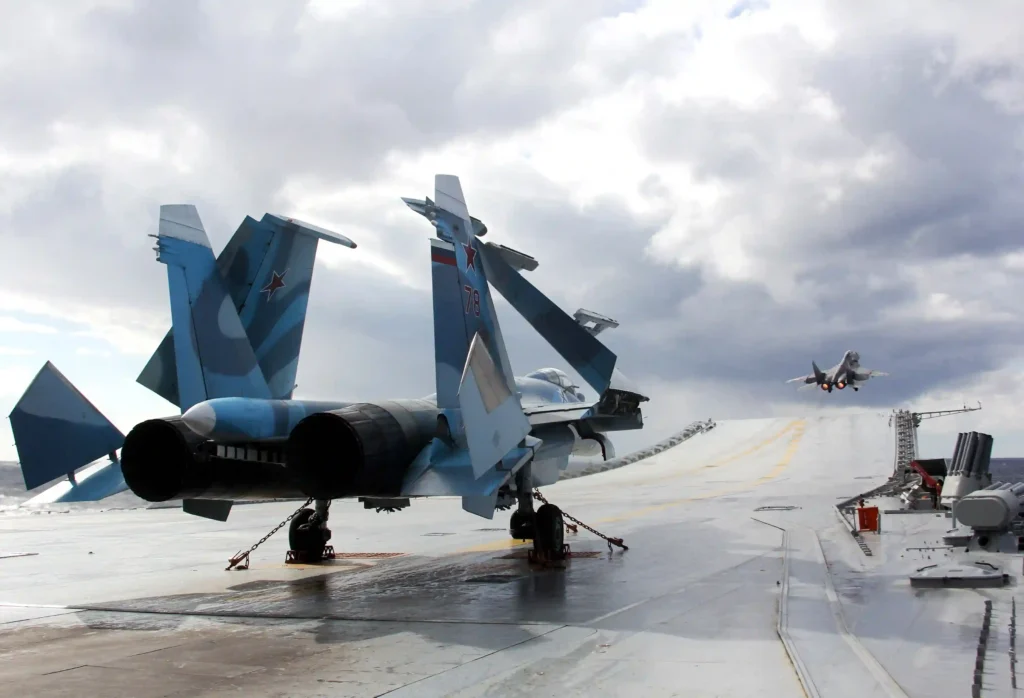
The carrier also supports Kamov Ka-27 and Ka-31 helicopters, which are primarily used for anti-submarine warfare (ASW) and airborne early warning (AEW). These rotary-wing aircraft extend the ship’s defensive bubble and give it greater situational awareness at sea.
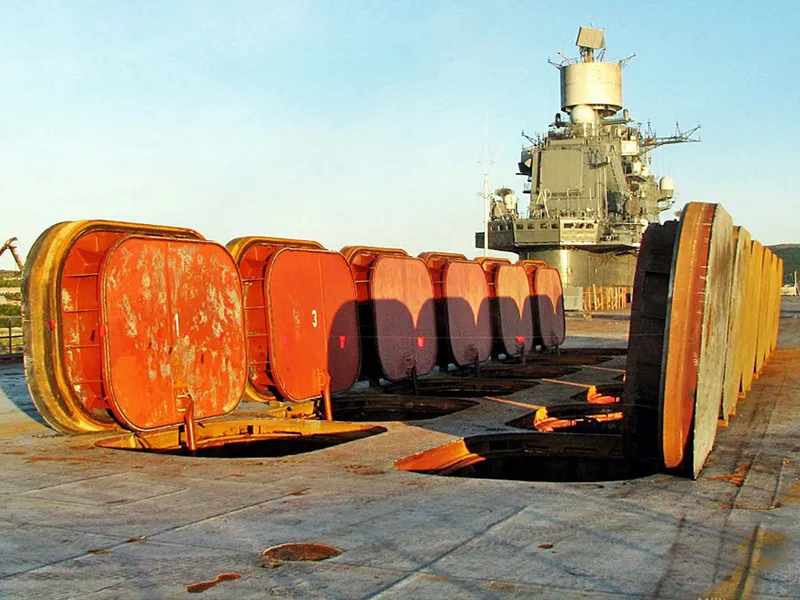
However, the Russian aircraft carrier Admiral Kuznetsov doesn’t stop at aircraft. What truly sets it apart from NATO carriers is its onboard missile systems. Beneath the forward deck, it houses 12 P-700 Granit (SS-N-19 Shipwreck) anti-ship missiles.
These massive supersonic cruise missiles were designed to punch through U.S. carrier strike groups, flying in coordinated salvos and adjusting their trajectory mid-flight. It’s an intimidating feature, even if these systems are now considered dated.
For air defense, the ship fields a combination of SA-N-9 Gauntlet surface-to-air missiles and Kashtan close-in weapon systems (CIWS), which use a twin rotary cannon and missile combination to intercept incoming threats.
The Kuznetsov carrier also includes traditional naval guns and electronic warfare systems, though many of these have suffered from aging equipment and maintenance issues.
Despite the firepower, integrating these systems with modern technology has been a constant struggle. Some weaponry is no longer in production, and replacements are slow to arrive.
That said, during its 2016 deployment to Syria, the ship’s Su-33s and MiG-29Ks flew dozens of combat sorties, proving that it could still function, albeit not without incident.
The operational history of the Admiral Kuznetsov aircraft carrier is as eventful as it is troubled. Since entering service with the Russian Navy in 1991, the ship has spent more time in repair docks or undergoing maintenance than at sea.
Yet, despite this rocky track record, it has played a role in nearly every major Russian naval deployment of the past three decades.
One of the carrier’s earliest significant voyages occurred in 1995 when it sailed to the Mediterranean Sea. This mission marked its debut on the world stage, intended to demonstrate that post-Soviet Russia still had blue-water naval capability.
But the mission was plagued by mechanical issues, limited aircraft availability, and poor coordination, problems that would become recurring themes in the Kuznetsov carrier’s service life.
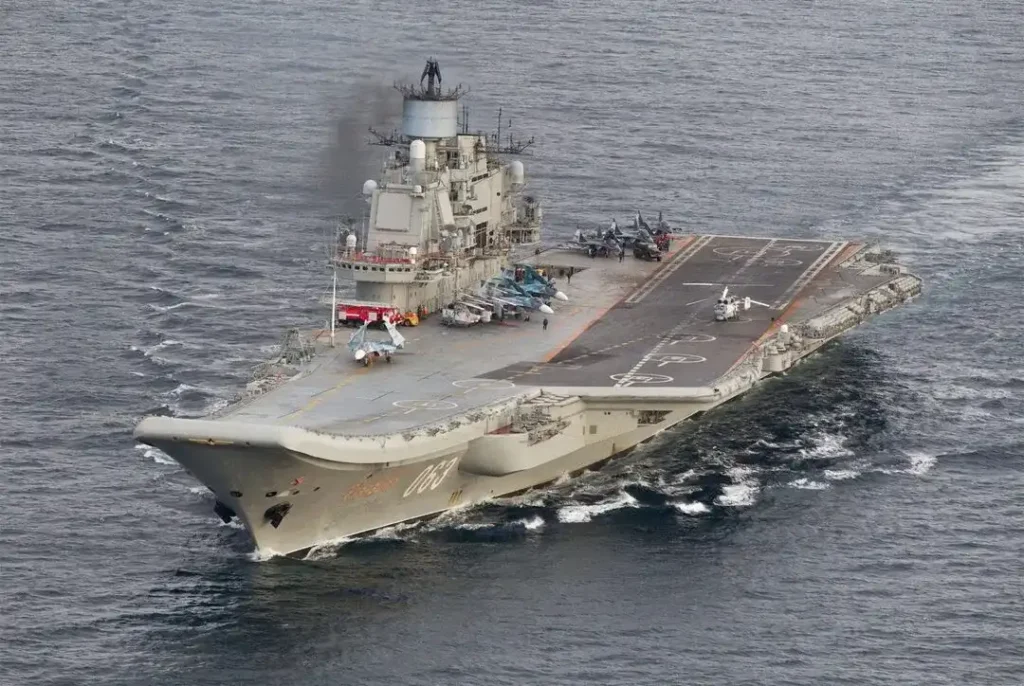
Its most high-profile deployment came in 2016, during Russia’s military intervention in Syria. The carrier was dispatched to the Eastern Mediterranean to support combat operations near Aleppo. It was the first time in Russian history that a fixed-wing aircraft launched from a Russian aircraft carrier had conducted real-world strike missions.
Over the course of two months, the ship’s Su-33 and MiG-29K jets flew more than 400 combat sorties targeting Syrian rebel positions.
But the mission didn’t go smoothly. Within weeks of deployment, the carrier lost two aircraft, one MiG-29K crashed into the sea due to a mechanical failure during approach, and a Su-33 was lost after a cable snapped during landing.
These incidents highlighted the operational risks tied to aging equipment and undertrained deck crews. Critics also questioned the effectiveness of the air wing, especially compared to more sophisticated U.S. Navy carrier operations in the same region.

Back home, the Kuznetsov-class aircraft carrier has suffered a string of accidents. In 2009, an electrical fire killed a sailor.
In 2018, it was damaged when a 70-ton crane collapsed onto the deck after its floating dry dock sank. Then in 2019, a major onboard fire killed two and injured more than a dozen workers. And in 2022, another fire broke out during repairs at the Sevmorput shipyard in Murmansk.
Still, despite the setbacks, Russia continues to keep the Russian aircraft carrier Admiral Kuznetsov in service, symbolically and strategically. Whether as a training platform, a tool of deterrence, or simply a legacy asset too expensive to replace.
The long-troubled modernization of the Admiral Kuznetsov aircraft carrier has officially hit a breaking point. After nearly eight years of delays, accidents, and spiraling costs, recent reports out of Russia confirm that the overhaul of the Kuznetsov-class aircraft carrier is now suspended, with scrapping actively under consideration.
Initially launched in 2017, the refit was designed to keep the Russian aircraft carrier Admiral Kuznetsov operational well into the 2030s. The plan included upgrading its aging steam boilers, overhauling radar and electronic systems, installing the modern Pantsir-M air defense system, and reinforcing the flight deck. But those ambitions quickly unraveled.
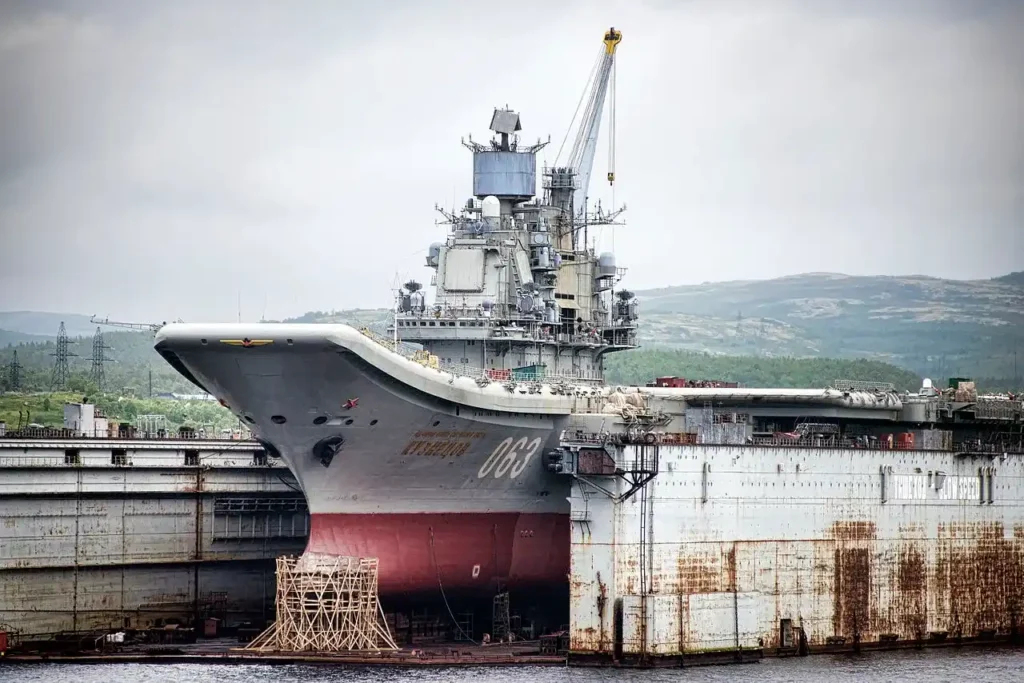
In 2018, the PD-50 floating dry dock, the only one in Russia capable of holding the carrier, sank during a power outage. A 70-ton crane collapsed onto the flight deck, causing major structural damage. This incident delayed the project by over a year and left the Russian Navy scrambling for a replacement dry dock.
Then came the fires. A blaze in December 2019 killed two workers and destroyed several internal compartments.
Another fire broke out in 2022, during welding operations, raising fresh doubts about the safety of continued work. By 2024, the ship had been in dock longer than it had ever been at sea. Timelines were pushed again and again, from 2021 to 2023, then into 2025.
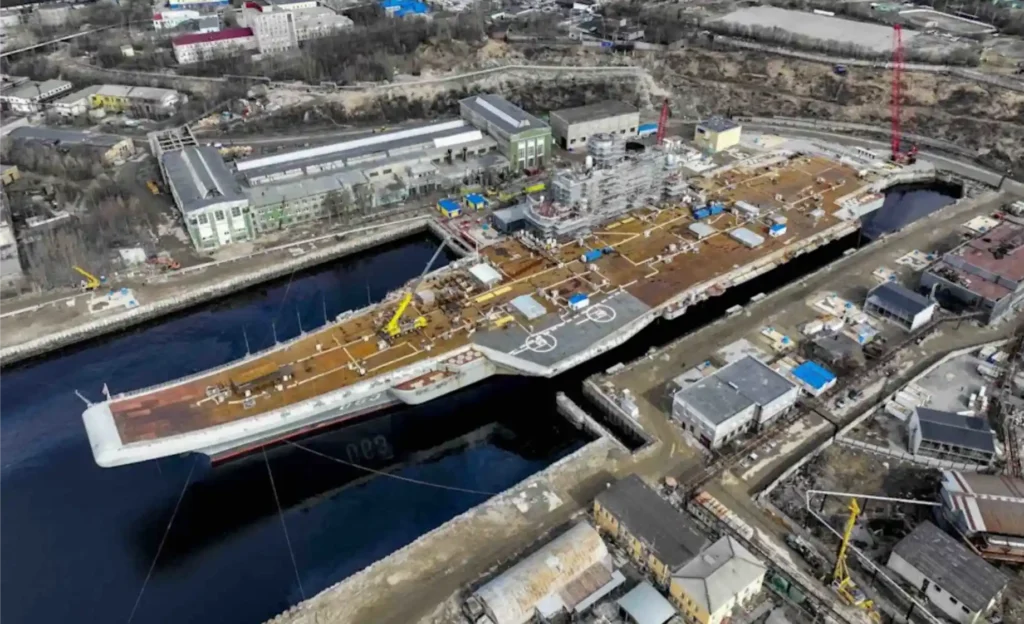
Now, in mid-2025, both Russian state media and independent defense analysts are reporting that the overhaul has been paused indefinitely. According to Izvestia, the Kremlin is weighing whether it’s worth continuing repairs, or whether to decommission the ship altogether.
At the same time, Admiral Sergei Avakyants, former commander of Russia’s Pacific Fleet, publicly declared that traditional aircraft carriers are outdated and inefficient for modern warfare. He urged the Ministry of Defense to shift focus toward unmanned systems and precision-strike capabilities.
As of July, roughly 1,500 of the ship’s crew have been reassigned to land units, many reportedly sent to reinforce Russian ground operations in Ukraine. With the workforce dispersed and repair contracts stalled, it’s clear the Kuznetsov carrier is on borrowed time.
Once envisioned as the pride of Russia’s naval revival, the Russian aircraft carrier Admiral Kuznetsov may soon end its career not with a triumphant return to sea, but in pieces, hauled off for scrap.
The story of the Admiral Kuznetsov aircraft carrier is one of ambition, adversity, and ultimately, hard choices. Born from the final years of the Soviet Union, this Russian aircraft carrier was meant to signal that Moscow could compete with the world’s greatest naval powers.
For a time, it did, barely. But over the decades, the Kuznetsov-class aircraft carrier has become more symbol than asset, burdened by accidents, budget overruns, and a changing military landscape that may no longer have room for it.
Now, with its modernization suspended and scrapping on the table, the Kuznetsov carrier faces what may be its final chapter. Whether it sails again or is quietly broken up at dock, its legacy will outlive its steel. It served as Russia’s only platform for carrier-based aviation, a tool for projecting power even if imperfectly, and a reminder of what it takes to build and maintain a true blue-water navy.
As the world’s navies shift toward lighter, faster, and unmanned systems, traditional carriers like the Russian aircraft carrier Admiral Kuznetsov may slowly become relics. But for now, the ship remains a floating metaphor for Russia’s place between past glories and future uncertainty.