Follow Us:
Follow Us:

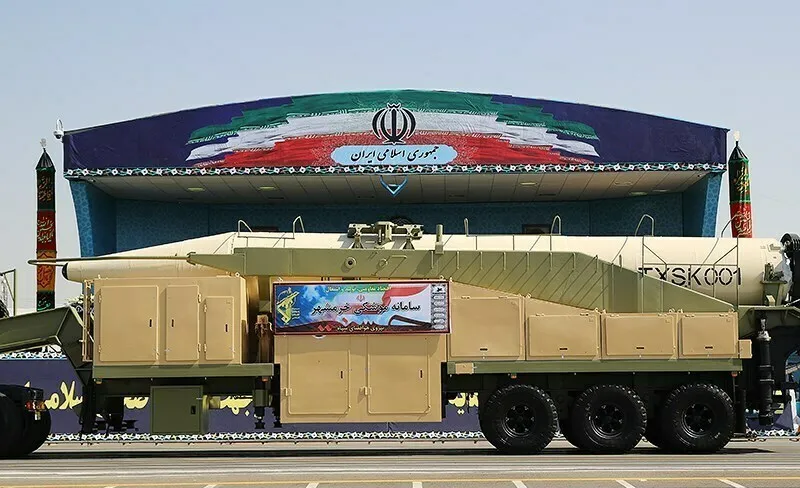
In a region where missile capability defines strategic leverage, Iran has unveiled what could be one of its most advanced weapons to date—the Khorramshahr-4 missile. This ballistic missile, also referred to as Khorramshahr IV, marks a significant leap in Iran’s defense technology, boasting longer range, improved accuracy, and greater payload potential. For analysts and adversaries alike, its emergence signals a clear message: Iran is not just upgrading its arsenal, it’s redefining its deterrence strategy.
Part of a broader push to enhance Tehran’s missile force, the Khorramshahr-4 is the latest evolution in the Khorramshahr missile line, which has been steadily advancing since its first public reveal in 2017. With a claimed range exceeding 2,000 kilometers and the ability to carry a warhead of up to 1,500 kilograms, it presents a credible threat to U.S. bases in the Gulf, Israeli strategic assets, and potentially parts of Eastern Europe. Iranian defense officials suggest this version features a new reentry vehicle designed for increased precision, although independent verification remains limited.
More than just hardware, the Khorramshahr-4 reflects a deliberate shift in Iranian military doctrine—away from conventional warfare and toward a posture centered on missile deterrence and strategic ambiguity. This post explores the missile’s origins, capabilities, and potential role in future conflicts, placing the Khorramshahr-4 in context with both regional security dynamics and global nonproliferation concerns.
The Khorramshahr-4 missile did not emerge in isolation—it is the result of years of incremental development within Iran’s ballistic missile program, one of the most advanced in the Middle East. The Khorramshahr missile lineage can be traced back to Iran’s adaptation of North Korea’s Musudan missile, also known by its NATO designation BM-25. Iran began testing early iterations of this platform under the name Khorramshahr-1 around 2016, gradually refining range, payload, and accuracy through successive versions.
The initial version, Khorramshahr-1, reportedly had a range of about 2,000 kilometers and carried a single warhead. It raised eyebrows when displayed in a military parade due to its sheer size and unconventional design. Following international backlash and tightened sanctions, Tehran doubled down on indigenous development.
The Khorramshahr-2 introduced some enhancements in flight stability and targeting, though details remained classified. The third variant, rarely discussed publicly, likely served as a prototype or transitional phase toward the fully operational Khorramshahr-4.
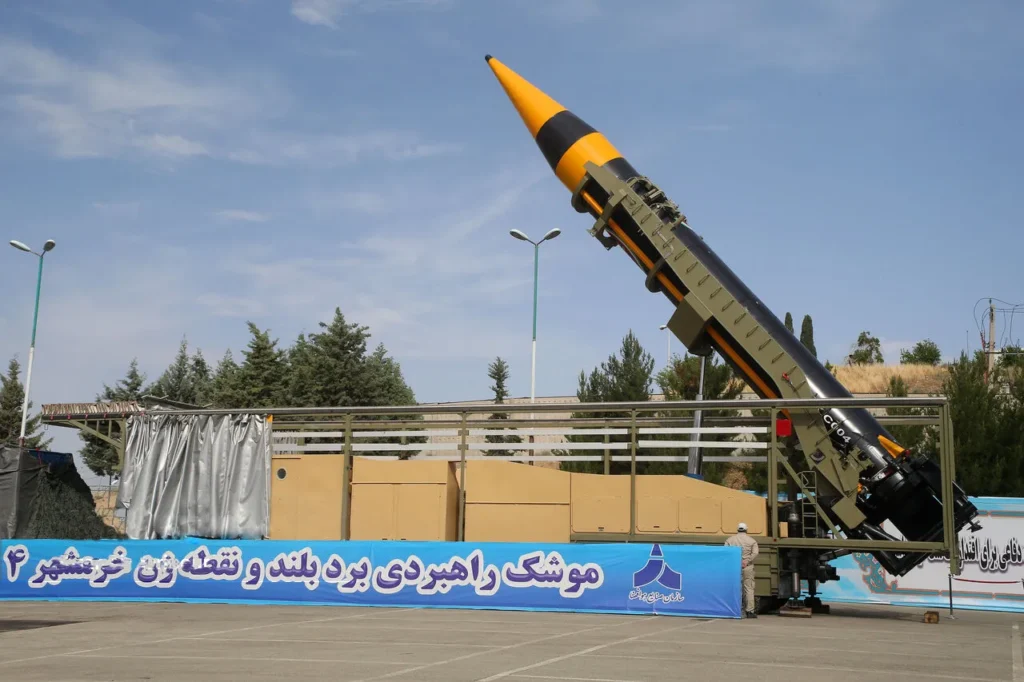
By the time the Khorramshahr-4 was announced, Iranian military engineers had seemingly overcome earlier technical hurdles. State media claims the missile includes a more advanced liquid-fueled engine and a new detachable reentry vehicle capable of evasive maneuvers during descent—features that, if true, would complicate missile defense interception.
The Aerospace Industries Organization led development under the Ministry of Defense and Armed Forces Logistics (MODAFL), which has spearheaded most of Iran’s recent breakthroughs in ballistic technology. While Western analysts remain skeptical about some of the more ambitious specifications, few dispute that the Khorramshahr missile represents a marked evolution in Iran’s ability to threaten targets across the Middle East and beyond.
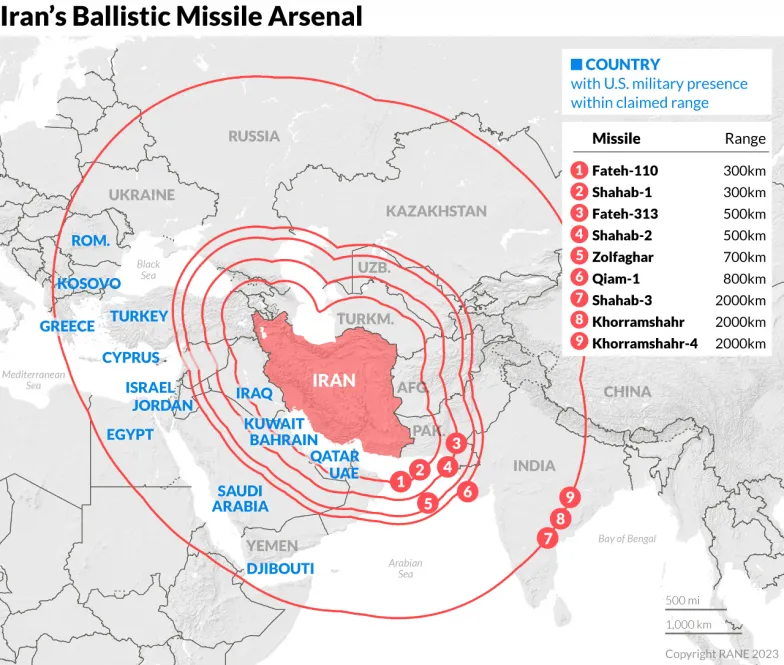
The Khorramshahr-4 missile stands out among Iran’s ballistic arsenal not only for its range but also for the claimed sophistication of its onboard systems. According to official statements from Iran’s Ministry of Defense, the missile has a reported range of 2,000 kilometers (approximately 1,242 miles), putting it firmly in the category of medium-range ballistic missiles (MRBM). This distance gives it the capacity to strike targets across the Arabian Peninsula, Israel, parts of Eastern Europe, and U.S. military bases scattered throughout the region.
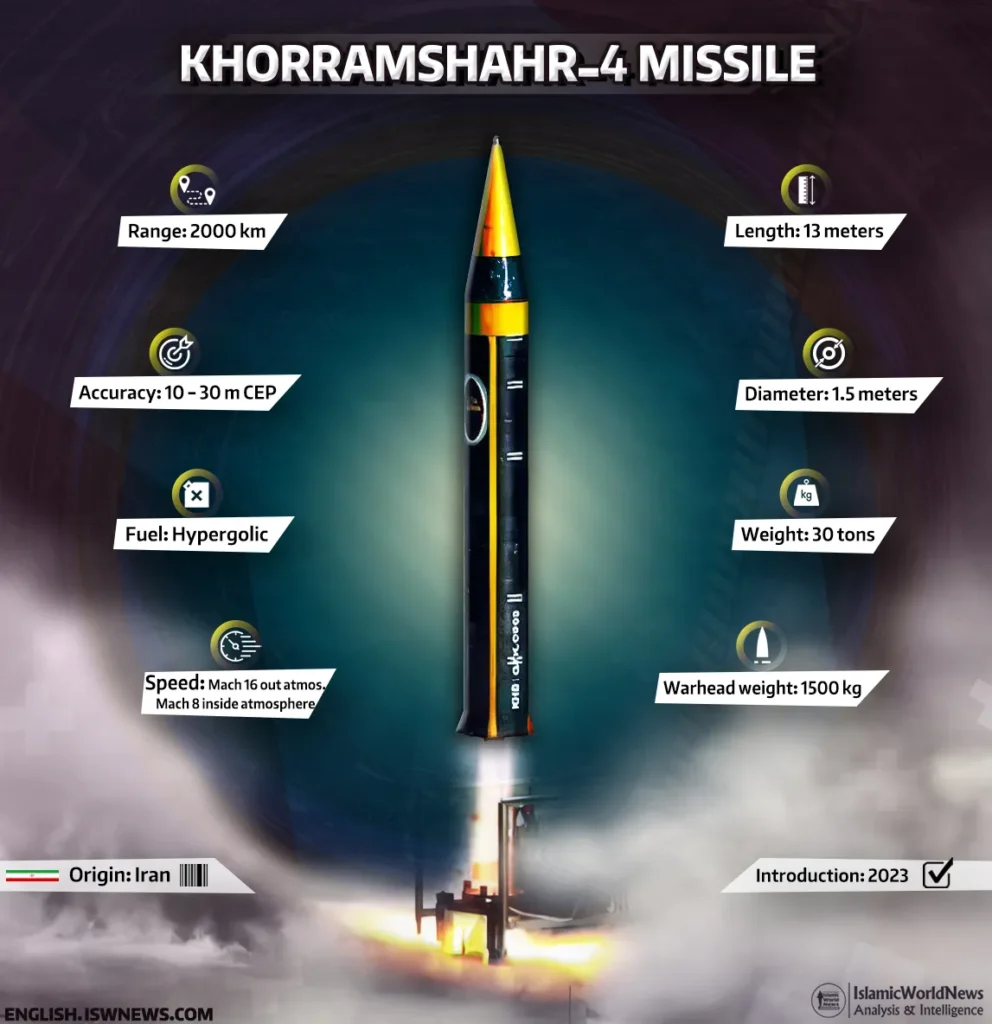
One of the most noteworthy upgrades in the Khorramshahr-4 is its detachable reentry vehicle (RV). Iranian defense officials claim the RV is equipped with maneuvering capabilities designed to complicate missile defense interception efforts.
In practical terms, this could allow the warhead to shift trajectory during the terminal phase, evading radar-guided interceptors like Israel’s Arrow system or U.S.-deployed THAAD batteries. Additionally, the RV is reportedly capable of carrying a 1,500 kg conventional or unconventional payload, making it one of the heaviest warhead capacities in Iran’s inventory.
Technologically, the missile uses a liquid-fueled engine, which is both a strength and a limitation. While liquid fuel can provide greater thrust and allow for heavier payloads, it also means the missile must be fueled prior to launch, making it more vulnerable to preemptive strikes. Iranian sources suggest the Khorramshahr-4 can be launched from road-mobile transporter-erector-launchers (TELs), which improve survivability by increasing mobility.
While much of the interior avionics and guidance architecture remain classified, satellite imagery and leaked documents hint at the use of an inertial navigation system (INS) possibly augmented by satellite data, allowing for a circular error probable (CEP) of under 150 meters, though independent verification remains limited. These specs, if accurate, place the Khorramshahr IV among the most capable non-nuclear missiles in Iran’s current lineup.
The Khorramshahr-4 missile is more than a piece of military hardware—it’s a cornerstone of Iran’s evolving strategic doctrine. In a region where air superiority is often dominated by technologically superior adversaries like Israel and Gulf Arab states, Iran has leaned heavily on missile capabilities as a force equalizer. The Khorramshahr-4, with its increased range, warhead capacity, and maneuverable reentry vehicle, is tailored to operate as both a deterrent and an offensive tool in Iran’s asymmetric warfare strategy.
Tehran’s defense posture emphasizes what it calls a “forward defense” or “active deterrence” model. In this framework, the Khorramshahr-4 serves as a direct response to perceived threats from U.S. military installations in the Gulf, Israeli missile defense systems, and NATO-aligned forces near Iran’s periphery. Its potential to hit high-value strategic targets with limited warning time gives Iran a credible second-strike capability.
The missile’s mobility—enabled by road-mobile TELs—also enhances its survivability, making it more difficult for adversaries to neutralize in a first strike. This adds a layer of unpredictability to Iran’s military calculus that is designed to complicate preemptive planning by rival powers.
Furthermore, the Khorramshahr-4 supports Iran’s broader geopolitical narrative. It allows the regime to project strength domestically, affirming its technological self-sufficiency and resilience in the face of sanctions. Internationally, it gives Iran leverage in diplomatic negotiations, particularly around issues like the Joint Comprehensive Plan of Action (JCPOA) and broader regional security pacts.
While the missile is conventionally armed, its specifications suggest that it could theoretically be adapted for non-conventional payloads, a concern that continues to raise alarms in nonproliferation circles. Ultimately, the Khorramshahr IV is not just about firepower—it’s about signaling, deterrence, and reshaping the strategic landscape in the Middle East.
Public information on the Khorramshahr-4 missile’s testing and operational history is limited, largely due to the secrecy that surrounds Iran’s ballistic missile program. However, official Iranian sources and satellite imagery provide glimpses into its developmental milestones and potential operational readiness.
The missile was reportedly unveiled in May 2023 during a ceremony attended by high-ranking officials from Iran’s Ministry of Defense. During the same event, it was announced that a successful test launch had taken place, though exact details such as launch site coordinates, flight path, and impact accuracy were withheld.
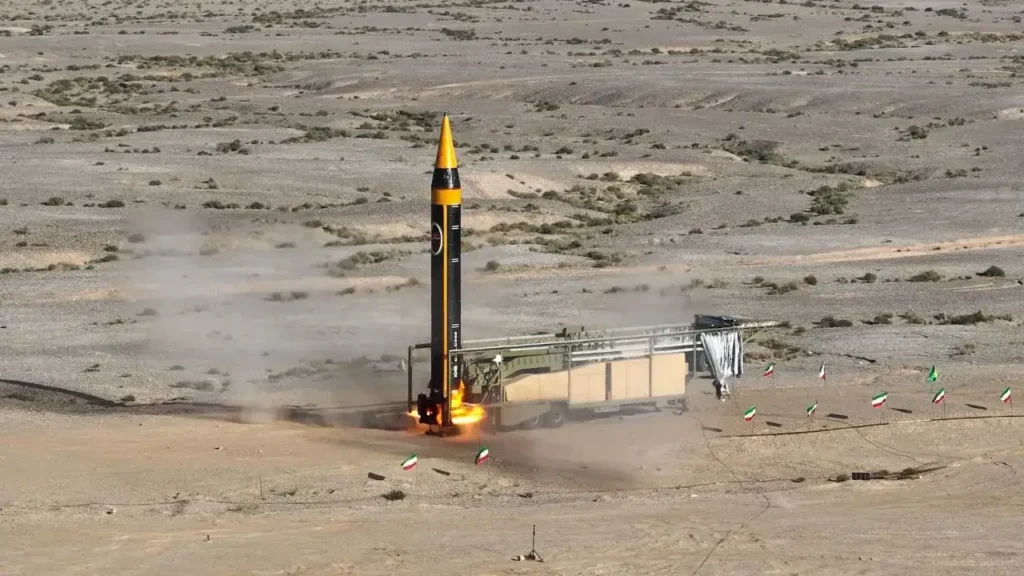
State-run media released carefully edited footage of what they claimed was the first successful launch of the Khorramshahr-4. In the video, a missile believed to be the Khorramshahr IV is seen lifting off from a desert location—possibly the Imam Khomeini Space Center in Semnan Province, which has hosted prior missile trials.
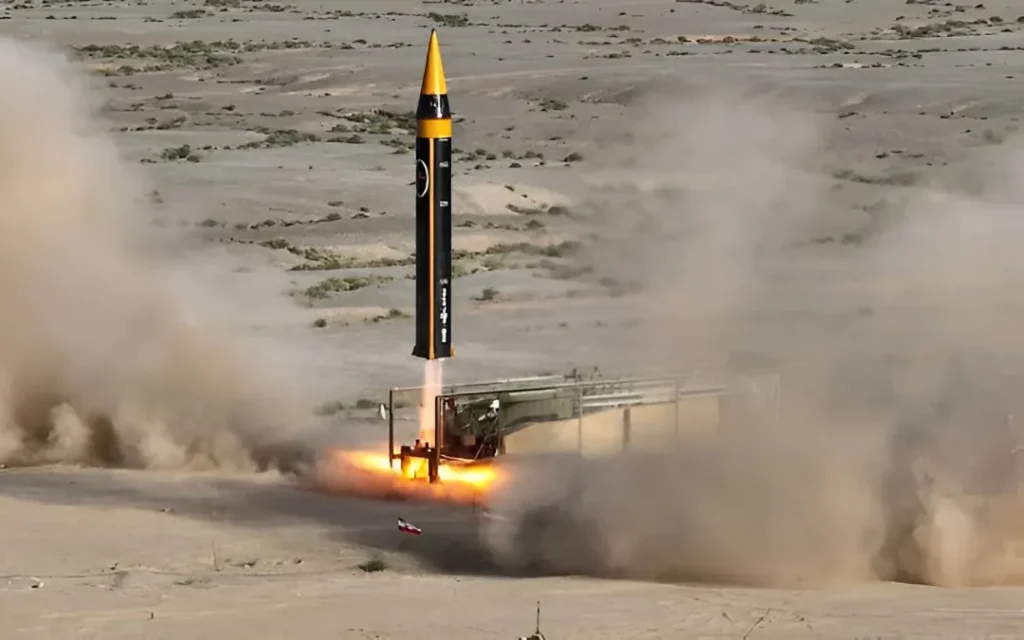
Analysts noted several upgrades compared to previous iterations: a redesigned nose cone suggesting a new reentry vehicle, different plume signatures indicating changes in the propulsion system, and improved vertical launch capability. Despite the propaganda-like nature of the footage, open-source intelligence analysts were able to verify that a test did occur, though independent assessments of the missile’s performance remain inconclusive.
Operational deployment of the Khorramshahr-4 is less transparent. As of early 2025, there are no confirmed reports of the missile being stationed with frontline units, but it is widely believed that Iran has begun integrating it into its strategic missile brigades under the Islamic Revolutionary Guard Corps Aerospace Force (IRGC-AF). Its presence in military parades and continued mention in Iranian state broadcasts suggest that Tehran views it not only as a viable weapon system but also as a political tool aimed at external audiences. If future launches are conducted—or if the missile is used in a live-fire scenario during escalating regional conflicts—it will provide clearer data on the Khorramshahr-4’s real-world capabilities and strategic intent.
When evaluating the Khorramshahr-4 missile, it’s essential to place it within the broader context of regional and international missile systems. Among Iran’s own arsenal, the Khorramshahr-4 is most often compared to the Fateh-110, Zolfaghar, and earlier Khorramshahr variants. While missiles like the Fateh-110 and Zolfaghar are solid-fueled and tactically oriented, the Khorramshahr series—particularly the fourth generation—leans into strategic depth with its larger range and payload.
The Khorramshahr-4, with its reported 2,000 km range and 1,500 kg payload, clearly occupies the upper tier of Iran’s medium-range ballistic capabilities, positioning it as a deterrent aimed at distant, high-value targets rather than battlefield use.
Compared to Khorramshahr-1, which was first publicly revealed in 2017 and speculated to be based on North Korea’s Musudan (BM-25), Khorramshahr-4 demonstrates significant advancements in payload capacity, flight stability, and precision. It also addresses criticisms about the lack of terminal guidance in earlier models by reportedly integrating a maneuverable reentry vehicle. This places it closer in concept—though not necessarily in capability—to advanced systems like Russia’s Iskander or China’s DF-21, which use post-boost maneuvering to evade missile defense systems.
Internationally, the Khorramshahr-4 finds rough parallels in missiles such as India’s Agni-II and Pakistan’s Shaheen-II, both of which have comparable ranges and strategic missions. However, those systems benefit from more advanced guidance technology and have undergone rigorous, publicly documented testing programs.
Iran, in contrast, often shrouds its missile development in secrecy and political theater, making direct performance comparisons difficult. Nonetheless, if Iran’s claims hold even partial accuracy, the Khorramshahr missile could represent a cost-effective and strategically viable option within the MRBM category, capable of challenging regional adversaries and undermining the perceived reliability of Western missile defense systems.
The Khorramshahr-4 missile marks a significant evolution in Iran’s ballistic missile program, signaling a shift toward more sophisticated, long-range deterrent capabilities. With its reported 2,000 km range, large payload, and maneuverable reentry vehicle, the missile strengthens Iran’s strategic posture across the region. While some of its performance claims remain unverified, its existence alone challenges regional missile defense systems and reinforces Iran’s reliance on asymmetric power projection in lieu of conventional military parity.
Beyond its technical specifications, the Khorramshahr-4 carries weight as a geopolitical tool. It sends a clear message that Iran intends to continue advancing its missile capabilities despite sanctions or diplomatic isolation. As the region grows increasingly tense and arms control mechanisms erode, the missile adds complexity to regional security dynamics and international negotiations. Whether as a deterrent or a bargaining chip, the Khorramshahr missile is now a pivotal piece of Iran’s strategic playbook.