Follow Us:
Follow Us:

Something unusual is happening beneath the surface—literally.
Australia is preparing to operate nuclear-powered submarines. Not in some distant future, but potentially within the next decade. And it’s all happening under the framework of AUKUS—a quietly transformative defense pact between the US, UK, and Australia.
On paper, AUKUS is about technology sharing and joint defense. But many suspect it’s also about something bigger: sending a message to China, rebalancing power in the Indo-Pacific, and reshaping how military alliances work in the 21st century.
Still, not everything is going smoothly. Just last week, the Pentagon reportedly launched a review of the submarine deal—raising quiet doubts about timelines, readiness, and whether the U.S. can afford to part with its own submarines. So, is AUKUS a bold leap forward? Or a strategic gamble still figuring itself out?
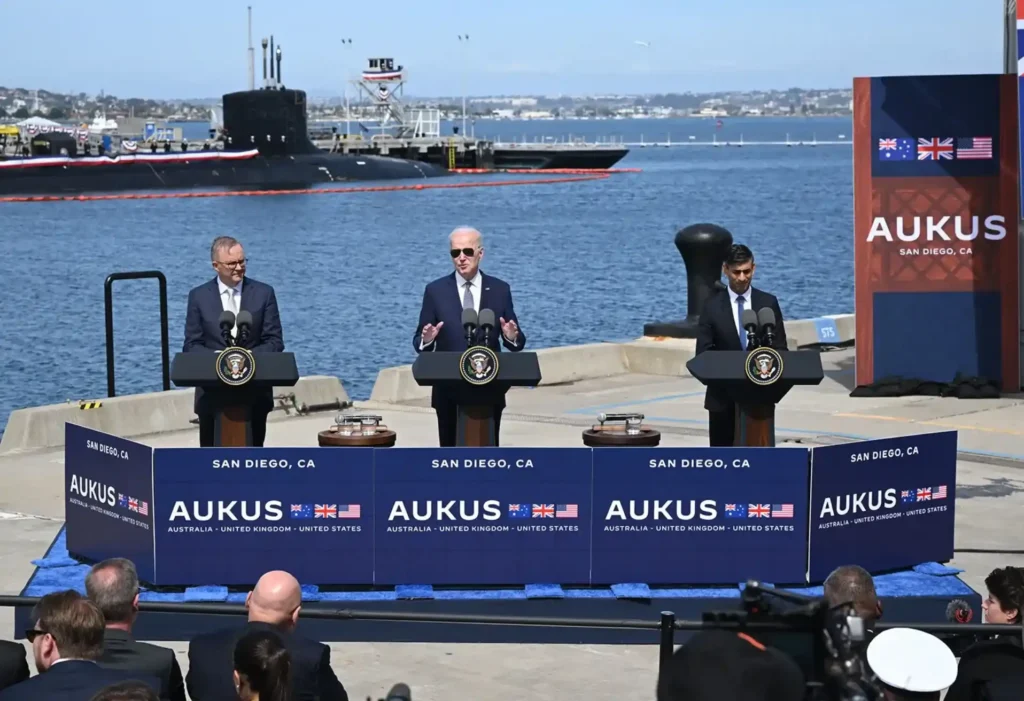
To understand AUKUS, it helps to go back to a very specific moment—September 15, 2021. That’s when three leaders—U.S. President Joe Biden, UK Prime Minister Boris Johnson, and Australian Prime Minister Scott Morrison—appeared together in a split-screen announcement. It was a virtual press conference, but the message was anything but routine.
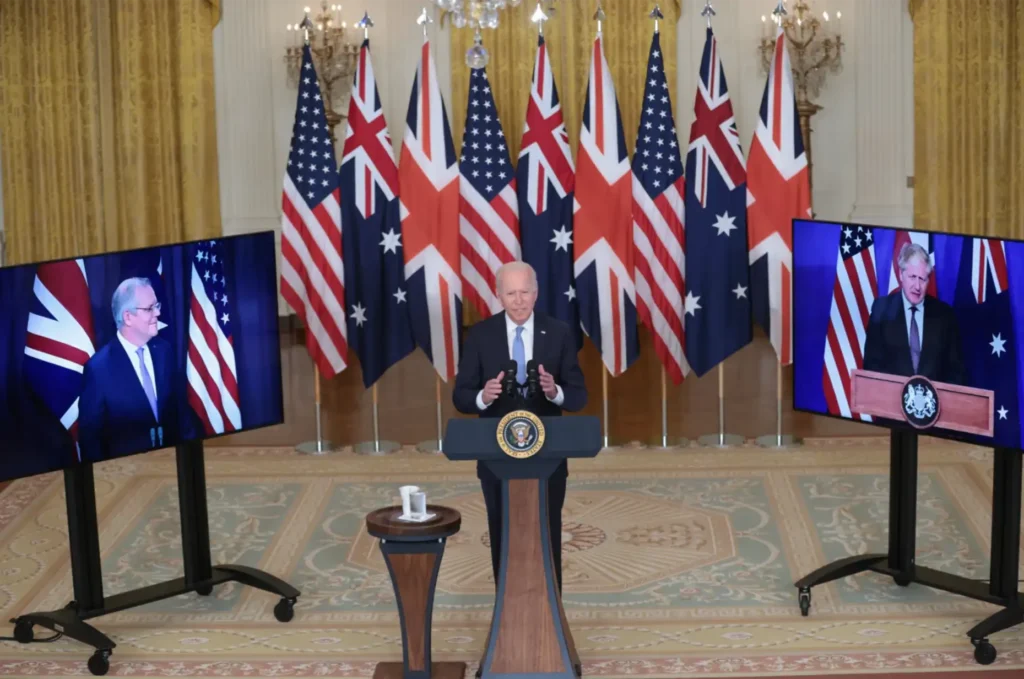
The three nations were unveiling what would soon become known as the AUKUS alliance—a new military pact aimed at promoting long-term security and stability in the Indo-Pacific. At the heart of the agreement was a major surprise: the United States and the United Kingdom would help Australia acquire a fleet of nuclear-powered submarines. Not armed with nuclear weapons, they were quick to clarify—but powered by nuclear propulsion. This would mark the first time either country had shared such sensitive technology with anyone other than the other.
So why did this happen?
There’s a strong case to be made that AUKUS was shaped by rising geopolitical tensions, especially with China’s growing influence across the Indo-Pacific. Many analysts argue that Beijing’s increasingly assertive behavior in the South China Sea, its military modernization, and its pressure on Taiwan all played a role in galvanizing the U.S. and its allies to act more decisively. Still, it’s worth noting that the leaders themselves framed the pact in more neutral terms—highlighting technological cooperation, shared values, and a “free and open Indo-Pacific” as the primary motivations.
Historically, all three countries had been long-time defense partners through the Five Eyes intelligence alliance and other multilateral frameworks. But AUKUS went a step further—it formalized a trilateral military alliance with a sharper edge. It was also symbolic: Biden, Morrison, and Johnson represented a renewed effort among Western democracies to collaborate on high-end defense capabilities, including cyber, artificial intelligence, quantum technologies, and of course, submarine development.
Read also: Is China Preparing to Invade Taiwan?
Still, the announcement wasn’t without fallout. Perhaps most notably, it led to a serious diplomatic rift with France. Before AUKUS, Australia had been in a multi-billion-dollar deal with the French to purchase conventional submarines. That contract was scrapped overnight in favor of the AUKUS nuclear submarine deal—something that Paris called a “stab in the back.” The episode highlighted how disruptive AUKUS could be, even among allies.
Since then, the alliance has evolved slowly but deliberately. Some see it as a cornerstone of a broader Indo-Pacific security alliance architecture, while others remain skeptical about its long-term feasibility—especially given the cost, complexity, and political risk tied to nuclear-powered submarine programs.
When leaders from the U.S., the UK, and Australia announced AUKUS back in September 2021, the spotlight immediately landed on submarines. And while that part of the deal—the promise to provide nuclear-powered submarines for Australia—is undoubtedly significant, it’s just one piece of a much broader, more ambitious puzzle.
Read also: Exercise Talisman Sabre 2025: What to Expect?
At its core, AUKUS is about military cooperation, yes—but also about future-proofing that cooperation. It’s arguably an attempt to prepare the three countries for the kinds of challenges that could define the next 30 or 40 years.
First and foremost, AUKUS is a strategic move to deepen defense and security ties among three already close allies. Australia, the U.S., and the UK have long cooperated under frameworks like Five Eyes and joint training exercises, but AUKUS takes that to a new level by formalizing their collaboration around some of the most sensitive and advanced military technologies available. It’s about increasing interoperability between their forces and aligning their defense planning more closely.
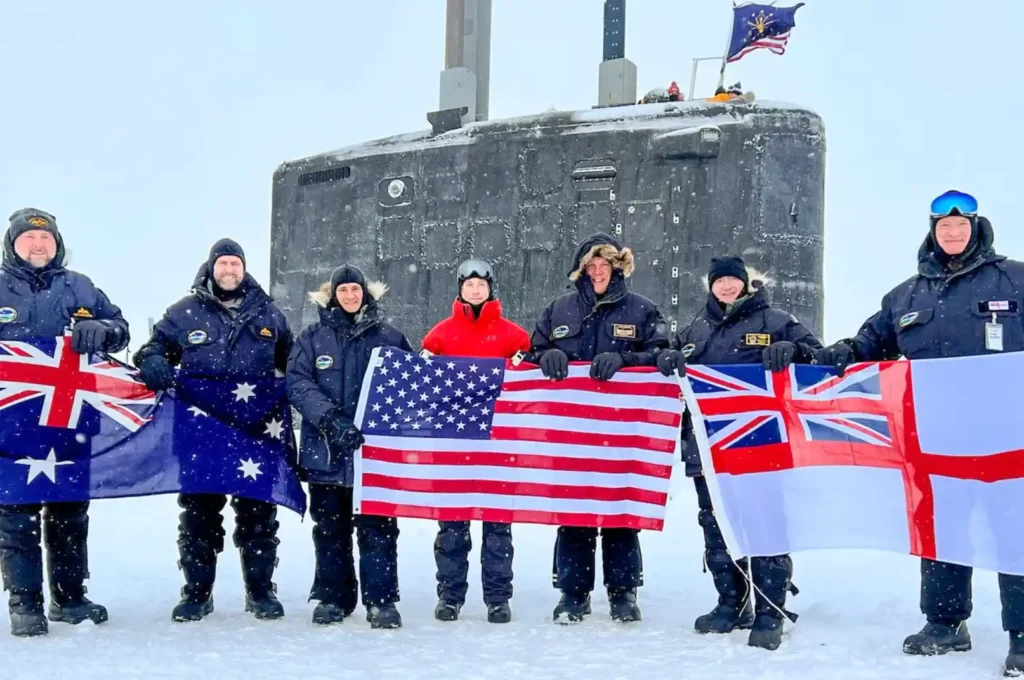
This becomes especially important in the context of a more contested Indo-Pacific, where China’s growing military footprint has raised alarms—not just in Washington, but in Canberra and London too. The AUKUS defense pact could be seen as a kind of deterrent signal, though officials are often careful not to name Beijing directly.
Read also: How Strong Is China’s Military
The centerpiece of AUKUS, at least publicly, is the submarine deal. Under what’s now referred to as the SSN-AUKUS program, Australia is expected to acquire at least eight nuclear-powered submarines over the coming decades, with the first deliveries projected in the late 2030s. These subs will offer far greater range, speed, and stealth than Australia’s current diesel-electric fleet—potentially allowing Canberra to project power deeper into the Indo-Pacific and beyond.
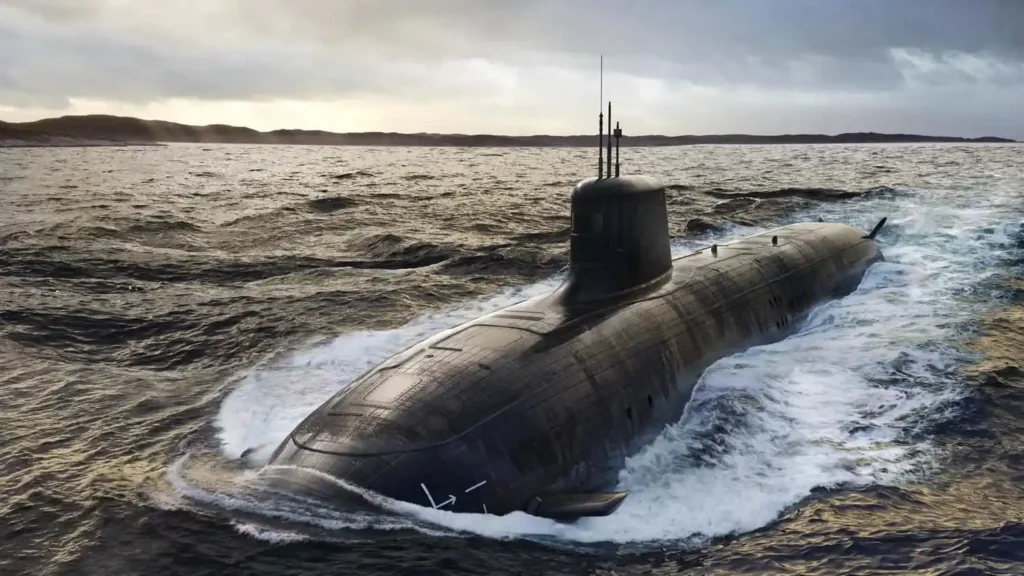
The U.S. and UK, in the meantime, plan to rotate their own submarines through HMAS Stirling, a naval base in Western Australia, starting as early as 2027, in a phase known as “Submarine Rotational Force-West.” This not only boosts Australia’s capabilities, but also strengthens the region’s broader deterrence strategy—at least in theory.
Still, it’s not without challenges. Questions have emerged about whether the U.S. Navy can spare the Virginia-class submarines it promised, and whether Australia is prepared—both technically and politically—for the complexities of operating nuclear-powered vessels. The latest reports from July 2025 suggest the Pentagon is reviewing the plan, which could hint at internal concerns, though officials say the alliance remains committed.
Another pillar of AUKUS is the sharing of cutting-edge defense technology. This includes not only submarine propulsion systems, but also emerging areas like cybersecurity, artificial intelligence (AI), quantum technologies, and hypersonic weapons.
In April 2023, the three partners formally expanded AUKUS to focus on these “Pillar Two” capabilities. This part of the agreement may not get as many headlines as the submarines, but it could be just as important—if not more so. After all, the next major conflict might not start in the sea or air, but in the cyber domain, or through AI-enabled decision warfare.
Quantum computing, for instance, could eventually allow militaries to break encryption or run advanced simulations in real time. AI, meanwhile, might be used to manage drone swarms or optimize battlefield logistics. By working together, AUKUS nations hope to stay ahead of rivals who are also investing heavily in these areas—China, most notably.
Zooming out, the broader objective of AUKUS seems to be ensuring a stable balance of power in the Indo-Pacific. This isn’t necessarily about preparing for war, but about creating enough deterrent strength to discourage one from breaking out in the first place.
The logic goes: if Australia has nuclear-powered submarines, if the three nations integrate their cyber and AI capabilities, and if their forces can operate jointly and flexibly, then potential adversaries might think twice before acting aggressively.
Of course, some critics argue this approach could further fuel geopolitical tensions—especially with China, which has repeatedly condemned AUKUS as provocative and destabilizing. Others question whether such long-term plans can survive political changes in any of the three countries.
If there’s one part of AUKUS that’s gotten the most global attention—and perhaps stirred the most controversy—it’s the nuclear submarine deal. And understandably so. For a country like Australia, which has no civilian nuclear program, acquiring nuclear-powered submarines marks a massive strategic leap. But it’s also a move layered with complexity, risk, and long timelines.
Announced as part of the broader AUKUS defense pact in September 2021, the submarine deal is aimed at giving Australia a fleet of at least eight nuclear-powered attack submarines. These won’t be armed with nuclear weapons—something all three countries have emphasized repeatedly—but they will be powered by highly enriched uranium, enabling them to operate longer, dive deeper, and stay stealthier than their diesel-electric counterparts.
This isn’t just a purchase—it’s a generational commitment. The plan is broken into multiple phases, starting with training and infrastructure upgrades, followed by interim U.S. and UK submarine deployments to Australia, and eventually, the construction of an entirely new class of submarines known as SSN-AUKUS.
Read also: 5 Main Options For Australia’s AUKUS Nuclear Submarine Deal
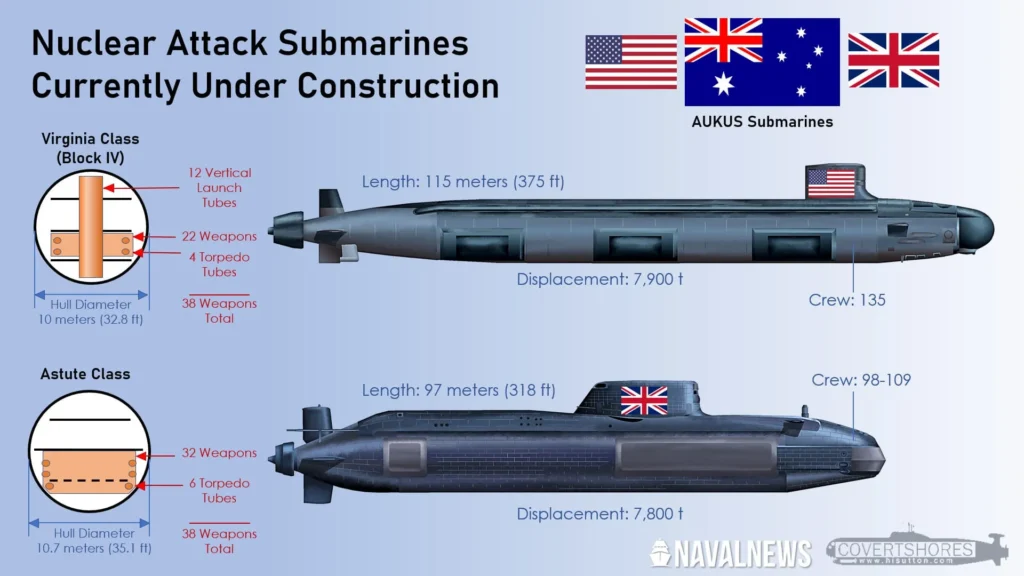
For Australia, the benefits are significant—at least in theory. Nuclear-powered submarines could allow the Royal Australian Navy (RAN) to operate far beyond its coastline, perhaps even in contested zones like the South China Sea, where geopolitical tensions are rising. The subs are expected to be quieter, faster, and more survivable than conventional ones—key traits in modern naval warfare.
But there’s more at stake than just hardware. This deal puts Australia into an exclusive club, signaling a strategic shift in its defense identity. It may no longer be viewed solely as a regional player, but as a central actor in the Indo-Pacific security alliance framework.
Still, there are caveats. Australia faces major challenges: building domestic nuclear infrastructure, developing specialized crews, and navigating political debates about sovereignty, costs, and public safety. A recent Pentagon review in July 2025—though not openly critical—has reportedly raised questions about Australia’s long-term readiness and whether diverting U.S. subs to Australia could strain American naval capabilities.
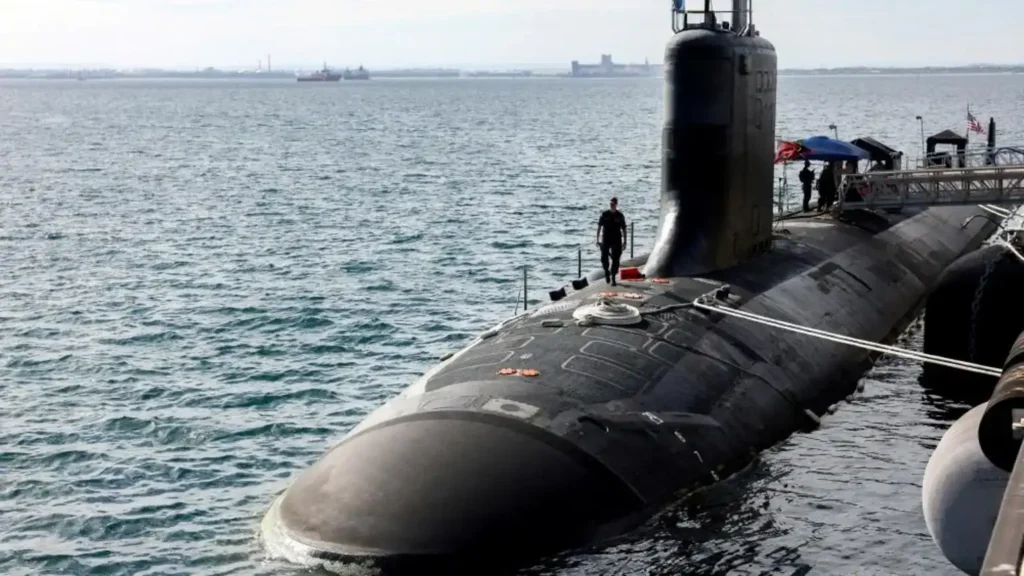
The United States plays a foundational role here. It’s expected to supply Virginia-class submarines to Australia as a stopgap solution while the SSN-AUKUS class is being developed. U.S. personnel will also train Australian crews and help build a nuclear submarine industrial base in the country.
Meanwhile, the United Kingdom is contributing more than just moral support. British shipyards and engineers will co-develop the SSN-AUKUS platform, which will be based on the UK’s next-generation submarine design but incorporate U.S. combat systems and propulsion technology. This trilateral production model is ambitious—and unprecedented.
Some observers have suggested that this cooperation represents a new level of technology sharing—arguably the deepest since the original U.S.-UK nuclear submarine cooperation agreement signed back in the 1950s.
This is not a short-term acquisition. According to the AUKUS roadmap unveiled in March 2023, the timeline spans decades:
That’s assuming everything stays on track—which, in a program this complex, is never guaranteed.
So why all the effort?
The submarine deal is often framed as a deterrence strategy—a way to complicate military planning for any potential adversary, particularly China. Nuclear-powered submarines could offer Australia the ability to patrol key chokepoints, monitor maritime activity, and contribute to broader allied naval operations.
From Washington’s perspective, it could help share the burden in an era of stretched U.S. naval resources. From London’s view, it deepens the UK’s long-term relevance in the Indo-Pacific and showcases British shipbuilding and defense innovation.
So, is the AUKUS nuclear submarine deal a masterstroke of defense planning? Or an overextended gamble still trying to find its sea legs? Perhaps it’s a bit of both. What’s clear, though, is that the deal is about more than submarines—it’s about shaping the future of power projection, alliance-building, and strategic trust in a region where all three are in flux.
The creation of AUKUS has triggered a ripple of geopolitical implications, many of which are still playing out. One of the most immediate and vocal responses came from China, which has framed the pact as a provocative move that could destabilize the region. While the AUKUS members argue that the nuclear-powered submarine deal is purely defensive and complies with non-proliferation norms, Beijing sees it—perhaps understandably—as part of a broader deterrence strategy aimed squarely at containing its rise in the Indo-Pacific. Chinese officials have warned of an arms race and hinted that AUKUS might undermine regional trust.
Elsewhere in the region, reactions have been mixed. Several ASEAN members have expressed quiet unease, particularly Indonesia and Malaysia, who worry that AUKUS could spark greater militarization in already tense waters. These concerns may not be uniform across Southeast Asia, but they do suggest that the pact is viewed with a degree of caution, even among countries that are not aligned with China.
Interestingly, AUKUS has also created friction with allies—France, in particular. When Australia scrapped its $90 billion conventional submarine contract with Paris in favor of the AUKUS deal, the diplomatic fallout was swift and intense. France recalled its ambassadors and accused Australia and the U.S. of acting in bad faith. Although relations have since cooled, the episode highlighted how AUKUS could disrupt not only adversaries but also existing alliances—particularly among EU and NATO partners.
That tension has sparked comparisons between AUKUS and QUAD—another key Indo-Pacific security alliance involving the U.S., Australia, India, and Japan. While QUAD emphasizes diplomatic and economic cooperation, AUKUS is much more narrowly focused on military capability and technology sharing. Some analysts argue that the two can be complementary, but others worry that overlapping security structures might confuse strategic objectives or lead to competing visions in the region.