Follow Us:
Follow Us:


Defense Feeds – US Navy Unveils Armed Modular Drones in a decisive response to mounting naval challenges posed by China and other global powers.
On July 28, 2025, the US Navy kickstarted a game-changing modernization initiative known as the Modular Attack Surface Craft (MASC) program.
Announced by the Program Executive Office Unmanned and Small Combatants (PEO USC), the program marks a significant shift in how the Navy envisions, builds, and deploys uncrewed surface vessels (USVs).
Breaking away from traditional, size-based classifications of naval drones into medium and large categories, the MASC program—through which the US Navy unveils armed modular drones— brings these efforts under one unified, highly modular architecture.
At the heart of this transformation is the innovative use of ISO-standard shipping containers as interchangeable mission payloads.
Instead of designing each vessel for a single dedicated role, the Navy now aims to deploy a new fleet of autonomous surface drones that can be quickly outfitted with weapon systems, sensors, or communication equipment as operational needs shift.
The Navy’s official solicitation, posted on NAVSEA’s website, further emphasizes this initiative where the US Navy unveils armed modular drones by inviting industry partners to submit white papers and technical proposals by August 11.
This strategic push for industry collaboration is intended to accelerate the deployment of new technologies by leveraging commercial solutions and bypassing the lengthy procedures of traditional military procurement through streamlined “Other Transaction Agreements.”
At the heart of the new strategy is versatility. The proposed MASC fleet will come in three sizes: a standard version that hauls two 40-foot ISO containers, a larger vessel carrying four, and a nimble craft sized for a single 20-foot container.
Each payload bay can be rapidly swapped or reconfigured, accommodating equipment weighing up to 36.3 metric tons (24 tons for the compact version) and requiring up to 75 kilowatts of power.
This setup is tailored for everything from advanced radar and jamming suites to high-powered weaponry like lasers or missile launchers.
Performance specifications highlight a minimum speed of 25 knots and an operating range of 2,500 nautical miles.
The drones are expected to operate reliably through moderately rough seas (Sea State 4), with more robust variants tackling even harsher conditions (Sea State 5). Critically, full autonomy is required; these USVs must navigate and execute missions with no human input, even when communications are jammed or absent and radio silence must be observed.
Compliance with international maritime rules ensures safe operations even in crowded or contested waters.
Tactically, the standardized, “containerized” payloads introduce a valuable element of ambiguity.
Adversaries won’t easily know whether a drone ship is packing missiles, surveillance equipment, or even if it’s running empty, making it much harder to predict or counter US Navy movements.
This operational “fog of war” increases survivability and complicates enemy planning, as every vessel could present a different threat on each mission.
A major focus of the MASC program is speed. Navy planners want these ships to be built within just 18 months and repaired quickly using commercial shipyard standards.
This rapid-cycle approach is vital to keep up with evolving technologies and shifting threats, preventing potential adversaries from outpacing US capabilities.
Extended maintenance intervals, the ability to operate with or without minimal crew, and potential exportability to US allies are all baked into the Navy’s requirements, ensuring these vessels can fill a variety of roles across the globe.
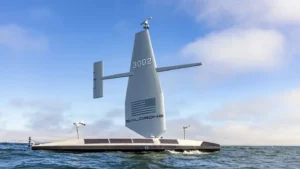
Current prototypes like the Ranger, Mariner, Sea Hunter, and Defiant USVs have all contributed to MASC’s evolving blueprint.
The Defiant, developed under the DARPA NOMARS program, already aligns with most baseline MASC specs.
A larger derivative, called Dauntless, is being created to carry more firepower, including vertical launch missile systems that have already proven compatible with the Navy’s SM-6 and Tomahawk missiles.
The Navy’s Fiscal Year 2026 budget plans reveal that a rapid prototyping phase—with help from the Defense Innovation Unit—will soon begin.
By combining private-sector agility, off-the-shelf technology, and knowledge gained from previous unmanned programs, the Navy aims to field a working fleet without delay.
Ultimately, the MASC program could become a mainstay of future US maritime operations, providing an agile, cost-effective answer to rising peer threats and shrinking shipbuilding budgets.
The US Navy’s bold move away from slow-moving, expensive, crewed ships toward modular, uncrewed, and rapidly adaptable platforms signals not just a technological leap but a major shift in military thinking.
By prioritizing dispersion, adaptability, and operational unpredictability, the United States is taking concrete steps to maintain its naval edge in an era of great power competition.
Whether these new drones can turn the tide of maritime rivalry remains to be seen, but the shift is already making waves throughout defense circles worldwide.