Follow Us:
Follow Us:

Defense Feeds – US Navy eyes rapid deployment of modular unmanned surface vessels with containerized payloads to boost fleet flexibility and mission readiness.
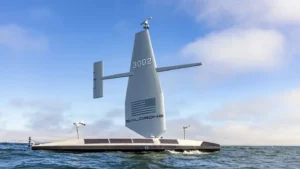
US Navy Eyes a new era in naval warfare as it ramps up efforts to develop and deploy modular unmanned surface vessels (USVs) capable of carrying heavy, containerized payloads.

In a strategic shift toward faster more scalable naval innovation, the Navy’s unmanned maritime systems program office has officially invited defense contractors to submit white papers for a next-generation prototype known as the Modular Attack Surface Craft (MASC).
This move follows a well-attended industry day earlier this summer, where senior naval leaders outlined their vision for autonomous, low-cost vessels to operate independently or alongside traditional Navy fleets.
As the US Navy eyes greater flexibility and cost-efficiency, these new vessels are designed to be mass-produced using commercial shipbuilding standards, simplifying production and maintenance while delivering mission-critical payloads over long distances.
Documents released by the Navy highlight a clear intent to move fast.
Leveraging Other Transaction Authority (OTA) agreements—often used to accelerate prototyping—the US Navy eyes the ability to begin fielding these prototype vessels within just 18 months of awarding the contract.
Unlike previous programs that aimed to develop expensive, highly customized unmanned vessels, the Navy is now emphasizing practicality and speed.
The MASC concept focuses on non-exquisite vessel designs that can be produced using widely available commercial shipbuilding standards.
According to the official solicitation, the vessel should be “capable of embarking containerized payloads” and must either operate independently or seamlessly integrate with existing Navy surface fleets.
Scalability is a critical element, with the service seeking designs that can be mass-produced at multiple U.S. shipyards, minimizing dependency on a single facility or contractor.
This change in philosophy marks a sharp departure from the Navy’s earlier push for Medium and Large Unmanned Surface Vessels (MUSVs and LUSVs)—platforms that were more complex and took longer to field.
Rear Adm. William Daly echoed the urgency earlier this year, saying, “We can build this craft in numbers at many shipyards. Designs already exist. We must not over-spec this.”
The Navy’s solicitation outlines three different vessel configurations but highlights one model in particular as the most aligned with operational requirements.
This preferred version must carry two 40-foot containerized payloads, each weighing up to 36.3 metric tons and consuming up to 75 kilowatts of power.
Moreover, while carrying 25 metric tons on the main payload deck, the vessel should achieve a minimum range of 2,500 nautical miles and sustain speeds of at least 25 knots—even in challenging NATO Sea State 4 conditions, which represent moderate waves and wind.
The push for modular unmanned surface vessels reflects a broader trend within the Pentagon: investing in flexible, cost-effective, and scalable platforms capable of meeting the demands of modern naval warfare. As tensions rise across multiple maritime theaters—including the South China Sea and the Arctic—the Navy recognizes the need for a distributed force structure that doesn’t rely entirely on large, crewed warships.
Containerized payloads also open the door for multi-mission versatility, allowing the same hull design to support different roles such as surveillance, electronic warfare, anti-submarine operations, or even logistical support.
By shifting payloads instead of entire vessels, the Navy can adapt quickly to different operational needs without waiting years for new ships to be constructed.
This shift aligns with the Department of Defense’s growing interest in modular open systems architecture (MOSA), which promotes interoperability, upgrades, and cost control by decoupling hardware from software and payload-specific systems.
The use of commercial shipbuilding techniques is another strategic benefit.
By adhering to widely accepted marine standards, the Navy can tap into the U.S. commercial shipbuilding base—spreading economic benefit while accelerating production timelines and repair capabilities.
In the event of conflict, such redundancy ensures the Navy can maintain fleet readiness without being hindered by limited dockyard capacity.
Proposals from industry partners are due by August 11, and while no specific contract award date has been announced, the Navy’s language signals a clear intent to move quickly.
The use of OTA contracts means selected vendors could receive funding and direction far faster than under traditional procurement processes.
As defense manufacturers prepare their submissions, many are expected to leverage existing commercial and military hull designs, modifying them to meet the Navy’s weight, power, and endurance requirements.
The race is now on to deliver a working prototype that balances speed, capability, and cost-effectiveness.
If successful, the MASC program could reshape how the Navy approaches unmanned maritime operations—offering a blueprint for future vessels that are simpler, smarter, and built for the realities of modern conflict.
By focusing on flexibility and mass production, the Navy isn’t just seeking new ships—it’s building a fleet for tomorrow’s battlefield, today.