Follow Us:
Follow Us:


Defense Feeds – US Navy Deploys USS Abraham Lincoln to the Gulf of Alaska as the lead warship in Northern Edge 2025, a large-scale joint exercise with Canadian forces.
The drill, which began in mid-August, unites over 6,400 U.S. service members, nearly 100 aircraft and seven naval vessels from both nations.
The deployment underscores cooperation, interoperability and readiness in one of the world’s most strategically important regions.
The Department of Defense noted that Northern Edge 2025 carries higher strategic value than ordinary drills.
This year, Northern Edge is running alongside Arctic Edge, effectively combining two of the largest military training events the U.S. and its partners have undertaken in the Arctic areas of North America.
The combined scope creates a rare opportunity for simultaneous training on homeland defense and Indo-Pacific contingency operations.
The USS Abraham Lincoln, a Nimitz-class aircraft carrier, serves as the centerpiece of Carrier Strike Group 3, providing command and control for both American and Canadian naval forces.
The strike group is reinforced by Destroyer Squadron 21 and three Arleigh Burke-class destroyers — the USS O’Kane, USS Michael Murphy and USS Frank E. Petersen Jr.
Canada has deployed the Halifax-class frigate HMCS Regina and an Airbus CC-150 Polaris aerial refueling tanker, underscoring Ottawa’s military commitment to operating alongside the U.S. in northern waters.
A photo released by the U.S. Navy on August 22 showcased the intensity of flight operations, featuring an MH-60S Sea Hawk from squadron HSC-14 touching down on the flight deck of the USS Abraham Lincoln.
At the same time, Carrier Air Wing 9 is operating a diverse mix of fourth- and fifth-generation aircraft, including F/A-18 Super Hornets and F-35C Lightning II stealth fighters.
One of the defining elements of Northern Edge 2025 is its role in testing and integrating next-generation weapons into fleet operations.
The USS Abraham Lincoln operated as a testing platform for the AIM-174B, an extended-range air-launched missile modified from the Navy’s SM-6.
By launching it from carrier-based aircraft, the Navy is broadening its air defense umbrella and extending the reach of patrol missions across vast maritime spaces.
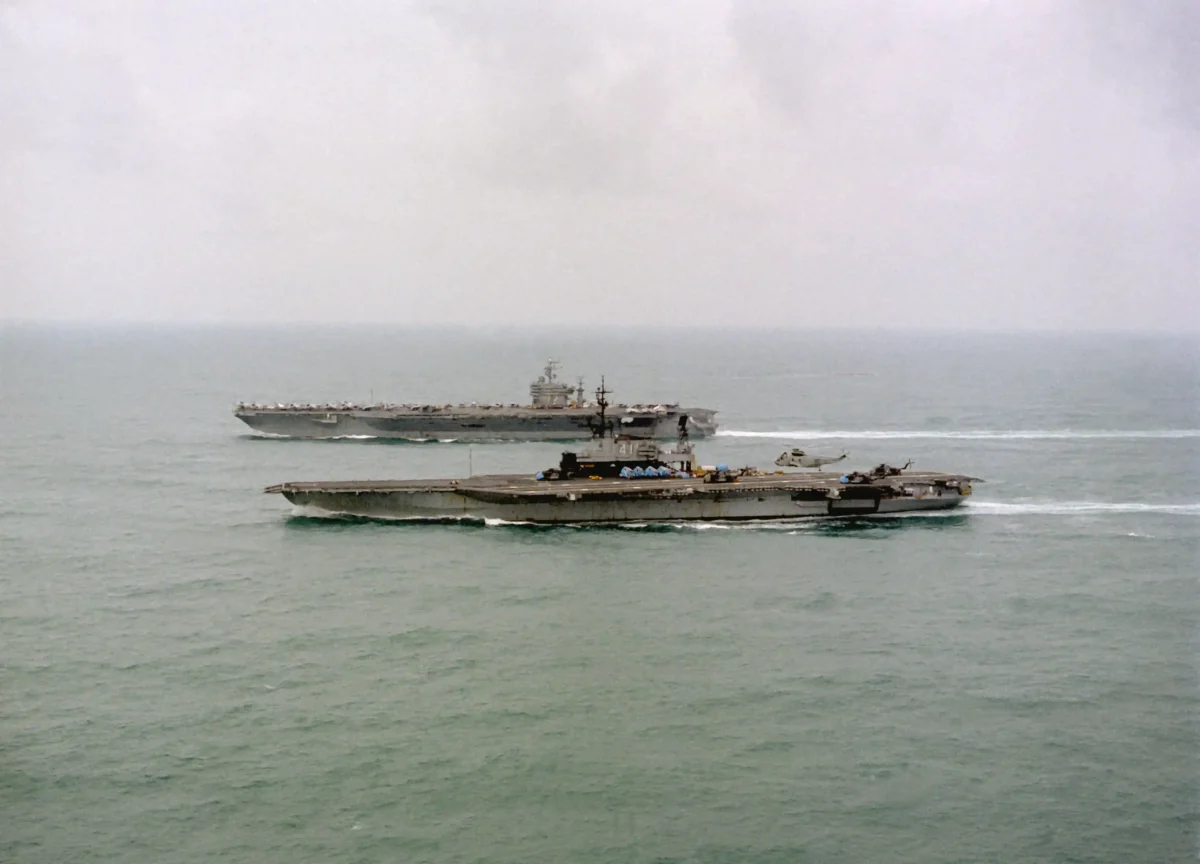
Since its commissioning on November 11, 1989, the USS Abraham Lincoln has embodied the multi-mission capability of U.S. Navy aircraft carriers.
In 1991, it executed Operation Fiery Vigil, evacuating thousands of civilians from the Philippines after Mount Pinatubo erupted.
It later played a central role in Operation Iraqi Freedom in 2003, where the carrier’s flight deck became the stage for President George W. Bush’s iconic “Mission Accomplished” address.
In humanitarian operations, the ship led Operation Unified Assistance in response to the 2004 Indian Ocean tsunami, delivering tons of relief supplies and conducting thousands of helicopter sorties to remote regions of Indonesia.
The Lincoln reinforced U.S. naval deterrence in 2012, navigating the Strait of Hormuz at a time of heightened friction with Iran.
After undergoing a Refueling and Complex Overhaul (RCOH) between 2013 and 2017, the carrier returned to service with upgraded nuclear reactors, advanced combat systems and modernized command technology.
Its 2019 deployment stretched for 295 days across multiple combatant command regions, marking the longest carrier deployment of the post-Cold War era.
The ship continues to adapt to new warfare demands. In 2021 and 2022, its air wing showcased the Navy’s “Air Wing of the Future” concept by integrating Marine F-35C stealth jets alongside electronic warfare aircraft like the EA-18G Growler.
In 2024, it launched the first combat missions by the F-35C, targeting Houthi missile sites in Yemen while simultaneously testing the AIM-174B missile.
The USS Abraham Lincoln embodies the engineering might of the U.S. Navy. The massive carrier, measuring 333 meters in length and 76.8 meters wide, displaces nearly 100,000 tons at full load.
It is powered by two Westinghouse A4W nuclear reactors, giving it effectively unlimited range with refueling intervals of two decades or more.
Its four-acre flight deck is equipped with four catapults and four arresting wires, enabling rapid cycles of aircraft launch and recovery.
At full capacity, the carrier can operate up to 90 aircraft, ranging from F-35Cs and Super Hornets to E-2D Hawkeyes and MH-60 Seahawk helicopters.
Defensively, the ship is outfitted with Sea Sparrow launchers, Rolling Airframe Missiles and the Phalanx Close-In Weapon System (CIWS).
For electronic warfare, the AN/SLQ-32 suite, Nulka decoys and anti-torpedo countermeasure systems add layers of protection, ensuring survivability in contested seas.
The importance of the Lincoln to U.S. strategy was underscored in July 2025 when the Navy accelerated its deployment by urgently loading nearly 2 million gallons of aviation fuel to surge it into the Pacific ahead of schedule.
Within weeks, it was positioned off Alaska for Northern Edge 2025, now serving as a floating command hub coordinating air, sea and land operations across the theater.
Looking ahead, the USS Abraham Lincoln is expected to remain a linchpin of American naval power projection until the late 2030s.
Its ongoing role in high-profile multinational drills such as RIMPAC, Talisman Sabre and now Northern Edge illustrates how it not only strengthens U.S. deterrence but also deepens military cooperation with allied partners worldwide.