Follow Us:
Follow Us:


Defense Feeds – Ukraine Enhances ‘Sea Baby’ Drone as the Security Service (SBU) unveils new advanced variants of its renowned unmanned surface vessels, signaling another leap in the country’s maritime warfare innovation.
Recently tested in the Black Sea, these upgraded Sea Baby models reflect Ukraine’s continued effort to merge endurance and offensive capabilities within its naval drone fleet to challenge Russia’s control at sea.
The new Sea Baby drones, developed for both reconnaissance and strike missions, are engineered to endure high-intensity operations and deliver accurate hits on coastal and maritime targets.
As Ukraine Enhances ‘Sea Baby’ Drone technology, the platform has become a central component of the nation’s asymmetric warfare approach, playing a crucial role in targeting Russian naval assets and supply lines across the Black Sea.
According to the SBU’s technical briefing, two distinct combat variants have been developed.
The first is armed with a gyro-stabilized automatic machine gun capable of tracking and engaging moving targets autonomously.
The second model is fitted with a small multiple rocket launcher capable of firing ten 122mm Grad rounds, greatly boosting the drone’s striking power.
This dual configuration allows Ukrainian forces to adapt their unmanned tactics: one platform focuses on providing suppressive fire or direct ship engagement, while the other can be used for shoreline attacks or coordinated barrages alongside manned units.
Sources familiar with the trials suggested that these modifications were inspired by lessons learned from previous successful Sea Baby operations against Russian naval vessels near Crimea.
Engineers have enhanced the Sea Baby’s propulsion and endurance, allowing the latest model to cover over 1,500 kilometers while hauling up to 2,000 kilograms of equipment.
This expanded range means they can potentially reach targets deep within the occupied Black Sea zones or along the Russian coastline without external support.
The SBU confirmed that both models now feature reinforced engines, upgraded composite hulls resistant to small-caliber fire, and an advanced navigation suite integrating satellite guidance with terrain-following algorithms.
This modernization not only enhances operational reliability but also makes the drone fleet more resilient in electronic warfare environments where GPS disruption is common.
Ukraine’s growing expertise in naval unmanned systems has caught international attention, with defense analysts noting the Sea Baby as one of the first combat-capable surface drones to demonstrate both precision fire and long-range strike abilities in actual combat conditions.
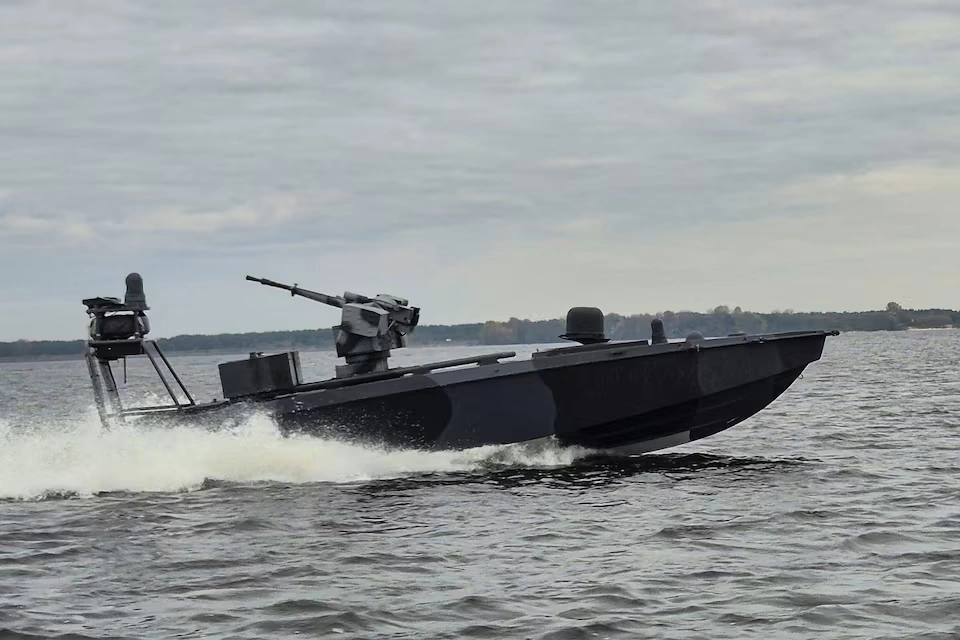
The Sea Baby’s evolution underlines Ukraine’s emphasis on technological adaptation amid ongoing maritime challenges.
Since the early days of the war, Kyiv’s engineers have transformed commercial marine technology into combat-ready drones capable of breaching Russian defenses and striking major naval assets like the Black Sea Fleet’s flagship targets.
With this new generation of armed Sea Babies, Ukrainian forces gain a more flexible choice of tactics.
They can perform remote-controlled raids, suppress enemy coastal batteries, or engage hostile ships from stand-off distances.
These unmanned operations also reduce risk to personnel while maintaining offensive pressure on Russian fleet positions.
Military experts view the Sea Baby program as a cornerstone of Ukraine’s wider move toward AI-assisted, autonomous warfare.
As the conflict pushes further into contested waters, drones like the Sea Baby could redefine naval security dynamics not only in the Black Sea but potentially in future conflicts where unmanned vessels play front-line roles.