Follow Us:
Follow Us:

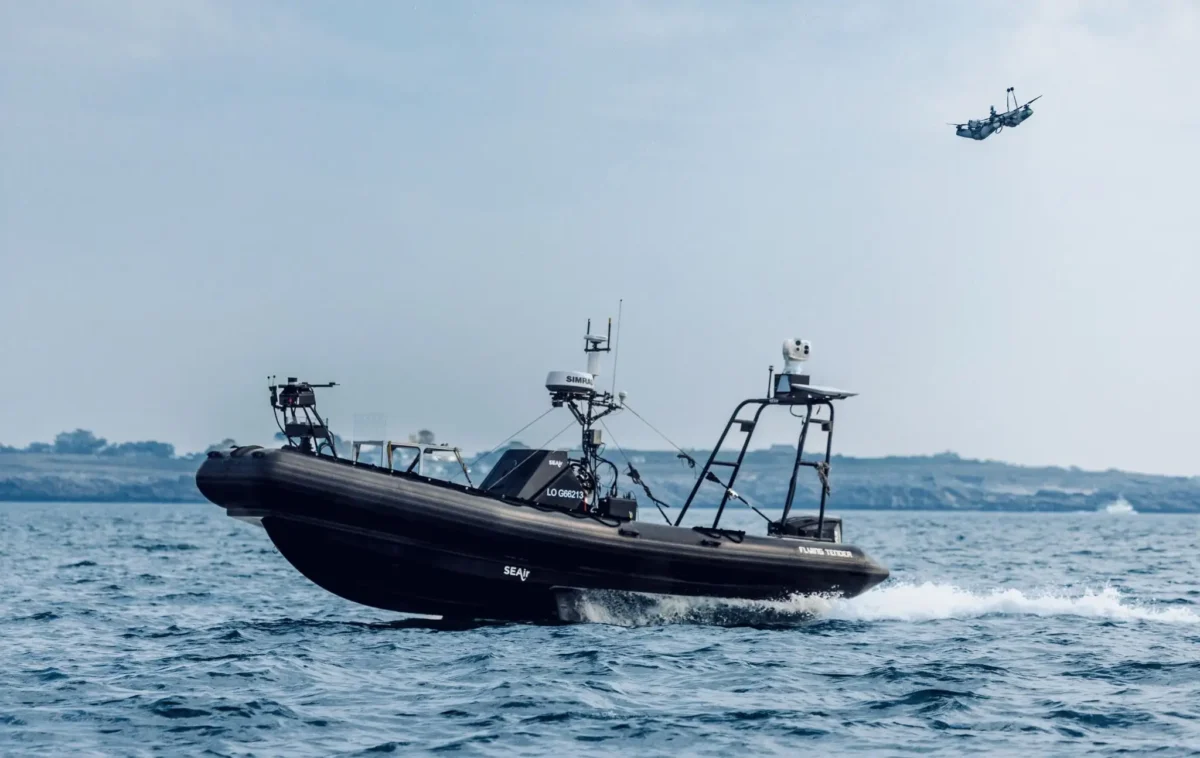
Defense Feeds – SEAir Unveils ARROW, a fully autonomous uncrewed surface vessel (USV), marking a major step toward enhancing Europe’s maritime defense capabilities.
The French company introduced the advanced naval drone in Brussels as part of a European Defence Fund (EDF)-backed initiative.
The ARROW project represents a significant leap in the European Union’s efforts to secure its vast coastline and key maritime routes using faster, smarter, and more fuel-efficient technology.
Backed by a 7.5 million euro ($8.6 million) grant, SEAir’s ARROW is expected to be operational by 2028.
The vessel is being developed through a consortium of 10 organizations across eight EU member states and associated countries, with SEAir leading the effort.
SEAir Unveils ARROW, a fully autonomous uncrewed surface vessel (USV), marking a major step toward enhancing Europe’s maritime defense capabilities.
The French company introduced the advanced naval drone in Brussels as part of a European Defence Fund (EDF)-backed initiative.
The ARROW project represents a significant leap in the European Union’s efforts to secure its vast coastline and key maritime routes using faster, smarter, and more fuel-efficient technology.
Backed by a 7.5 million euro ($8.6 million) grant, SEAir’s ARROW is expected to be operational by 2028.
The vessel is being developed through a consortium of 10 organizations across eight EU member states and associated countries, with SEAir leading the effort.
The ARROW vessel is not just another addition to the fleet—it is a next-generation system combining speed, stealth, and sustainability.
Measuring 12 meters (39 feet) in length, it can operate either autonomously or with a minimal crew, offering flexible deployment depending on mission requirements.
One of the standout features of ARROW is its hydrofoil design, allowing it to ‘fly’ above water at high speeds.
This advanced engineering enables the vessel to reach up to 45 knots (52 mph or 83 kph), far surpassing the speed of many conventional patrol boats.
Its operational range sits at an impressive 400 nautical miles (740 km or 460 miles), making it suitable for extended missions across vast maritime zones.
Fuel efficiency is another core strength. The hydrofoil design is not only about speed—it also reduces fuel consumption by up to 50%, cutting down operational costs and carbon footprint.
The vessel also creates minimal wake, a feature that enhances its stealth in surveillance and defense missions. Low visibility and acoustic signatures make ARROW ideal for reconnaissance, patrol, and border security tasks in sensitive or contested waters.
SEAir stated that Europe, with over 90,000 kilometers of coastline and critical sea lanes, faces evolving maritime threats.
From illegal trafficking and piracy to territorial intrusions and hybrid warfare, the need for agile and autonomous naval platforms is becoming urgent. ARROW is positioned as a direct response to these challenges.
SEAir is leading a diverse group of partners in the ARROW project, most of whom are small and medium-sized enterprises (SMEs), supported by top technical and academic institutions.
The consortium includes C&V Defence, D3 Applied Technologies, Knierim Yachtbau, and Maritime Robotics—each bringing specialized knowledge in marine engineering, robotics, and defense systems.
The academic side is just as strong, with involvement from Riga Technical University, Tallinn University of Technology, and others like Sierra Tango, Maxwell Applied Tech, and EU3STAR, focusing on applied research and systems integration.
This collaborative model reflects the European Defence Fund’s goal: to create a unified and self-sufficient defense ecosystem across the EU.
By drawing on expertise from various sectors and regions, the EDF aims to strengthen the bloc’s capacity to innovate and reduce reliance on foreign technologies.
The ARROW initiative aligns with the broader strategy of enhancing European defense industrial capabilities through shared resources, regional synergies, and technology sharing—ensuring that future military tools are built in Europe, for Europe.
The ARROW project is just one of many initiatives gaining traction under the European Defence Fund.
In May, the European Commission announced a sweeping investment package worth 910 million euros ($1.02 billion) aimed at improving force mobility, aerial defense, and autonomous systems.
This funding supports a total of 62 projects—39 in the research phase (369 million euros) and 23 in development (539 million euros).
Notably, for the first time, Ukrainian defense industries were included in the funding cycle, marking a symbolic and strategic gesture of solidarity amid the ongoing war in Ukraine.
Beyond ARROW, these investments form part of a five-year defense plan introduced in March by European Commission President Ursula von der Leyen.
The plan outlines the mobilization of up to 800 billion euros ($901.6 billion) to reinforce Europe’s defense sector, improve cross-border collaboration, and promote homegrown technological advances.
The EU’s growing focus on unmanned and autonomous platforms is no coincidence.
With increasing geopolitical tension, climate-induced migration, and threats from state and non-state actors in maritime regions, Europe’s need for scalable, fast-response solutions is more urgent than ever.
As ARROW continues through its development phase, expectations are high.
If successfully delivered by 2028, the vessel could mark a turning point in how Europe secures its waters—shifting from conventional, manpower-heavy operations to leaner, tech-driven missions.
In a time where deterrence and rapid response are vital, projects like ARROW underscore the EU’s commitment to being ready for tomorrow’s threats today