Follow Us:
Follow Us:


Defense Feeds – The new Fujian Aircraft Carrier has crossed the sensitive Taiwan Strait in what China described as “scientific research trials and training missions” in the South China Sea.
The move underscores a significant phase in the warship’s ongoing sea trials, which Beijing emphasized as a routine part of the carrier’s development process.
The New Fujian Aircraft Carrier, China’s third and most advanced vessel as well as the first fully designed and built domestically, was launched in 2022 and has since undergone a series of demanding tests before entering active service.
Once commissioned, it is expected to greatly enhance the People’s Liberation Army Navy’s (PLAN) capabilities, strengthening Beijing’s ability to carry out sustained carrier operations and extended power projection across the region.
Although Chinese naval authorities stressed the deployment was not directed at “any specific country,” analysts believe the crossing carried an unmistakable message.
Collin Koh, a senior fellow at the S. Rajaratnam School of International Studies in Singapore, argued the transit served as a signal of China’s growing maritime power and determination to reinforce its status in the Indo-Pacific.
“It reflects Beijing’s intent to showcase its military reach and deliver a warning to potential rivals,” Koh explained.
Taiwan’s Ministry of National Defense confirmed it tracked the New Fujian Aircraft Carrier throughout its passage, employing coordinated surveillance, reconnaissance, and intelligence-gathering systems to follow its movement and evaluate its activities.
The Fujian’s movement through the strait comes at a time of heightened tensions between China, Taiwan, Japan, and the United States.
In recent months, China has expanded military maneuvers around Taiwan and deepened naval operations near disputed territories in the East and South China Seas.
Japan’s Defense Ministry reported that on Thursday afternoon, three Chinese navy vessels, including the Fujian, were spotted approximately 200 kilometers northwest of the Senkaku Islands, which are administered by Tokyo but claimed by Beijing under the name Diaoyu Islands.
The sighting marked the first official confirmation by Japan’s military of the Fujian’s presence at sea.
Tokyo remains deeply concerned. In its annual defense review released in July, Japan warned that the intensifying pace of China’s military activities poses a serious threat to its national security.
This concern followed unpreceded incidents last year, including the first confirmed entry of a Chinese military aircraft into Japanese airspace.
The Japanese government recorded a record 355 instances in 2024 of Chinese vessels approaching or operating near the disputed islands.
China, however, maintains that its naval and coastguard patrols in these waters are lawful.
On Friday, Beijing announced a fresh deployment of a coastguard fleet within the territorial waters of the Diaoyu Islands to reinforce its sovereignty claims.
From Beijing’s perspective, Fujian’s trials in the South China Sea represent more than technical testing.
According to Chinese military analyst Song Zhongping, the region provides an ideal proving ground due to its unpredictable weather, challenging sea conditions, and contested operational environment.
“The South China Sea offers the harshest circumstances for testing the ship, which will accelerate its readiness,” Song explained.
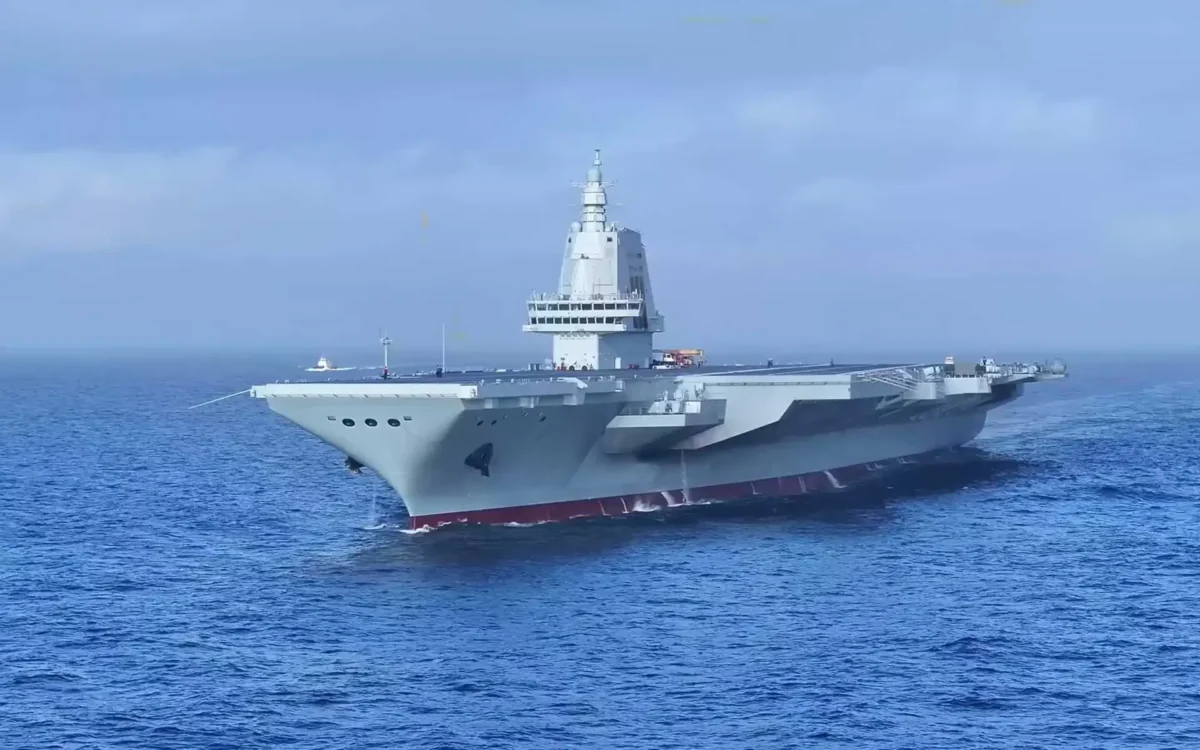
The Fujian will join Liaoning and Shandong—China’s two active carriers—once it completes its trials and formal commissioning.
The Liaoning, a refurbished Soviet-built vessel, entered service in 2012, while the Shandong, the first domestically produced carrier, joined the fleet in 2019.
Together, they have served as platforms for China to develop carrier warfare proficiency and conduct large-scale joint navy exercises.
Unlike its predecessors, the Fujian introduces a next-generation electromagnetic catapult launch system, similar to the technology used aboard the United States Navy’s Ford-class carriers.
This capability allows aircraft to launch with heavier payloads, more weapons, and increased fuel, greatly extending combat range and endurance.
Analysts at the Center for Strategic and International Studies (CSIS) assessed that the Fujian will enable the PLA Navy to field carrier strike groups with firepower approaching near-peer adversary levels.
China’s priority on naval expansion has been clear. A Pentagon report in December concluded that China now possesses the largest navy in the world by numbers, fielding more than 370 ships and submarines.
The drive to expand blue-water operations has allowed Beijing to deepen its presence in the western Pacific, challenge the US-led alliance system, and put regional rivals under growing pressure.
Both Liaoning and Shandong recently conducted combat exercises in the Pacific Ocean, maneuvers that unsettled nearby nations including Japan and Taiwan.
In May, Taiwan’s security services confirmed that Beijing had positioned both carrier groups around the island to demonstrate coordinated wartime readiness.
The appearance of Fujian alongside these actions signals the next phase in China’s maritime strategy.
While Beijing insists its buildup is defensive and aimed at safeguarding territorial claims, its refusal to rule out the use of force to unify Taiwan further stirs unease in the region.
China’s leadership under President Xi Jinping continues to pursue a long-term goal of transforming the PLA into a force capable of matching US military power in Asia, with a navy structured to operate globally.
Fujian’s debut in the Taiwan Strait is not only a milestone in Chinese shipbuilding but also a clear indicator of Beijing’s desire to reshape the strategic balance in the Indo-Pacific.