Follow Us:
Follow Us:


Defense Feeds – New Coyote Anti-Drone launchers have been installed aboard the Arleigh Burke-class destroyer USS Bainbridge (DDG 96), marking a breakthrough in maritime defense revealed by the US Navy on July 27, 2025.
The striking image, shared via the Navy’s DVIDS platform during NATO’s Neptune Strike exercise in the Ionian Sea, confirms the operational use of this advanced drone defense system on a US Navy destroyer for the first time.
This significant installation highlights a strategic shift in the Navy’s approach to countering unmanned aerial threats, focusing on cost efficiency and flexible protection of fleet assets amid evolving threats.
USS Bainbridge, part of the Gerald R. Ford Carrier Strike Group, is a Flight IIA Arleigh Burke-class guided-missile destroyer tasked with protecting critical naval forces in complex, multi-domain combat zones.
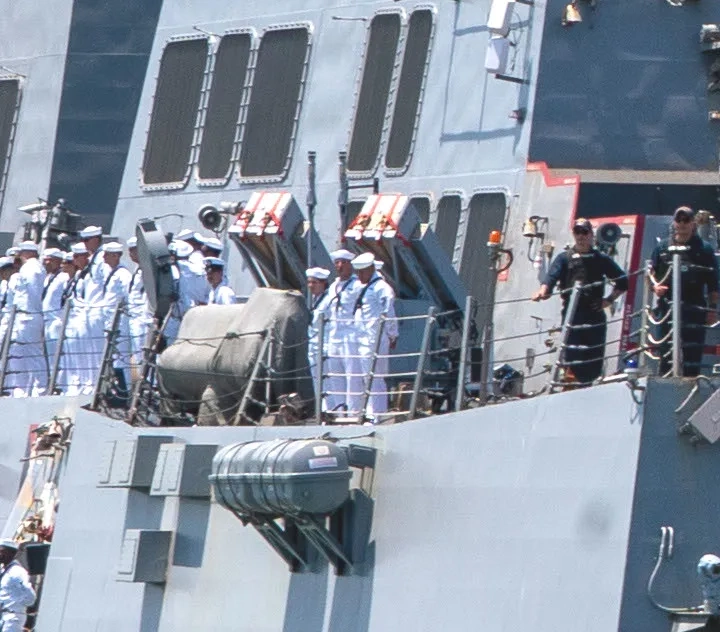
The recently installed Coyote interceptors, developed by Raytheon, are positioned near the aft Mk 41 Vertical Launch System cells, providing a dedicated shield against small, slow-moving, and low-flying drones that pose increasing threats.
These interceptors are notable for their loitering capability — meaning they can remain airborne, searching for and engaging multiple incoming drone targets with agility and persistence.
This represents a significant enhancement over traditional missile defenses, which are less economical against swarms of inexpensive drones.
Already proven in action with the US Army under the Low, Slow, Unmanned Aircraft Integrated Disposal System (LIDS) program, the Coyote Block 2 systems have demonstrated operational success across diverse theaters like the Middle East, Africa, and Europe.
Compared to high-cost interceptors such as the SM-2 Block IIIC and ESSM missiles, which can cost upwards of $1.65 to $2 million each, the Coyote’s estimated $100,000 price tag offers exceptional value.
This affordability allows the Navy to conserve expensive missile stocks while maintaining robust continuous defense against low-cost unmanned threats.
The deployment of Coyote launchers aboard USS Bainbridge reflects an evolving naval doctrine that acknowledges unmanned systems as a primary and rapidly growing maritime threat vector.
While conventional surface-to-air missiles will continue to defend against larger airborne dangers like cruise missiles and manned aircraft, they are impractical for countering large-scale drone swarms due to their steep cost and limited magazine capacity.
Coyote interceptors bridge this vital gap by providing a nimble, layered defense capable of persistent engagement without exhausting expensive resources.
Images of a similar setup on USS Winston S. Churchill suggest the US Navy is evaluating the integration of Coyote systems across several destroyers, potentially expanding the fleet’s anti-drone capabilities Navy-wide.
The system’s modularity and cost efficiency perfectly align with wider US military goals for scalable, adaptable force protection technologies.
Such measures also serve as an important model for allied navies facing similar UAV threats in contested maritime spaces.
As drone tactics increasingly blur the lines between reconnaissance, attack, and saturation assaults, the introduction of loitering interceptor technology reshapes naval defense paradigms.
USS Bainbridge stands as a prime example of how modern warships are evolving to meet these challenges head-on — combining affordability, advanced technology, and operational readiness in the protection of high-value naval assets.
This move likely signals the beginning of a broader shift in armament strategy for surface combatants in the US Navy and possibly its allies, addressing the future threat landscape with smarter, economically sound solutions.