Follow Us:
Follow Us:


Defense Feeds – Leonardo Debuts Lionfish 30 Turret, a next-generation 30mm remote weapon system designed for naval and land platforms, during the Sea Future 2025 defense exhibition in La Spezia, Italy.
The unveiling highlights the company’s latest step in providing compact, multi-role gun systems to counter modern threats such as drones, helicopters and fast-attack craft.
The announcement reflects rising demand among global navies for advanced close-in defense solutions that offer lightweight design, modular flexibility and low maintenance.
Leonardo confirmed the Italian Navy will be the first to receive the Lionfish 30 by the end of 2025, integrating the turret on new-generation warships including PPX patrol vessels, FREMM EVO frigates and DDX destroyers.
Several international customers have also selected the system, reinforcing its reputation as a modern anti-drone and counter-missile capability for maritime and littoral defense.
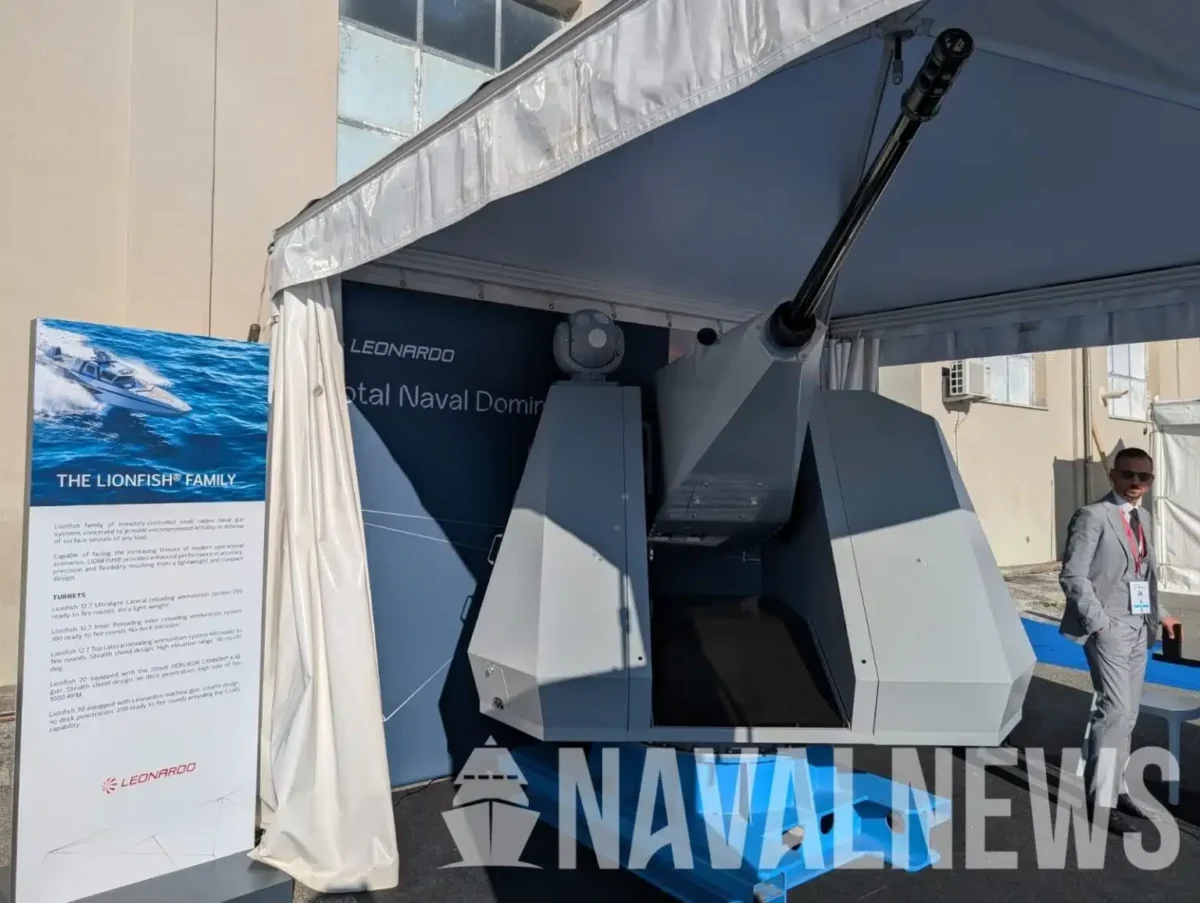
The Lionfish 30 turret belongs to the wider Lionfish family of small and medium-calibre systems that have become popular among coastal defense forces and maritime patrol operators.
Unlike heavier close-in weapon systems, the Lionfish 30 is engineered to have low platform impact, making it compatible not just with warships but also with smaller patrol boats under 25 meters in length.
Interestingly, Leonardo has stressed the weapon can also be mounted on land-based vehicles or coastal defense installations, broadening its operational use.
One of its main strengths lies in its wide elevation angle of -20° to +70°, giving the system the ability to engage threats approaching from sea level or from above, including helicopters, swarm drones, and low-flying aircraft.
This broad coverage area reflects the increasing importance of counter-unmanned aerial system (C-UAS) capabilities in modern naval defense, where small and fast-moving drones pose significant risks to both warships and land-based positions.
The turret is also characterized by ease of use. Leonardo designed the system with modularity and minimal maintenance in mind, while also ensuring simple training requirements reduce crew workload and long-term lifecycle costs.
This approach matches the trend among NATO and European navies to adopt advanced yet user-friendly weapon systems that reduce sustainment burdens.
At the heart of the Lionfish 30 is Leonardo’s new X-Gun 30mm cannon, developed fully in-house.
By keeping the design ITAR-free, the company ensures broader international export opportunities without restrictions tied to U.S. technology transfer controls.
The gun is able to fire the latest air-burst programmable ammunition, a decisive upgrade for engaging small, hard-to-hit targets such as mini drones, micro-UAVs, and fast-moving surface threats.
The turret combines a high rate of fire with a long operating range, features that make it effective for short- to medium-range defense.
Integrated advanced electro-optics allow the system to generate stabilized firing solutions independently.
An onboard ballistic computer calculates trajectories and provides real-time firing coordinates, which enhances accuracy even in rough sea states.
In addition, Leonardo has integrated artificial intelligence-supported software to allow the turret to track and engage multiple targets simultaneously.
This AI-assisted capability is particularly crucial when facing modern saturation or swarm tactics, where hostile drones or fast-attack boats attack in numbers.
Remote operation is carried out through a dedicated command and control console that offers low-latency digital video and intuitive controls, giving operators a clear tactical advantage.
According to Leonardo, the Italian Navy will receive its first Lionfish 30 turret sets before the end of 2025.
The system will be fitted onto upcoming PPX vessels, which are patrol platforms designed for coastal and international waters.
It will also be delivered for integration on the upgraded FREMM EVO frigates, a key backbone of Italy’s fleet modernization, as well as the future DDX destroyers, which are intended to replace older Durand de la Penne-class destroyers.
For Italy, the adoption of the Lionfish 30 reflects a broader strategy of reinforcing close-in defense and protecting naval task groups against new types of aerial and littoral threats.
The weapon’s compatibility with smaller vessels means it may also see further deployment across Italy’s secondary patrol fleets and possibly in joint projects with NATO partners.
International interest has already resulted in procurement by several unnamed navies, suggesting global recognition of the turret’s capability in addressing asymmetric threats.
Many coastal defense forces in Europe, the Middle East, and Asia are expected to monitor the progress of Italy’s integration as a potential model for their own modernization efforts.