Follow Us:
Follow Us:

Iran warns USS Fitzgerald near disputed Gulf of Oman waters; US downplays incident as professional amid rising Iran-US military tensions.
Tensions between Iran and the United States have reignited following a direct maritime encounter in the Gulf of Oman, where Iranian military forces issued a warning to the USS Fitzgerald, a US Navy guided-missile destroyer.
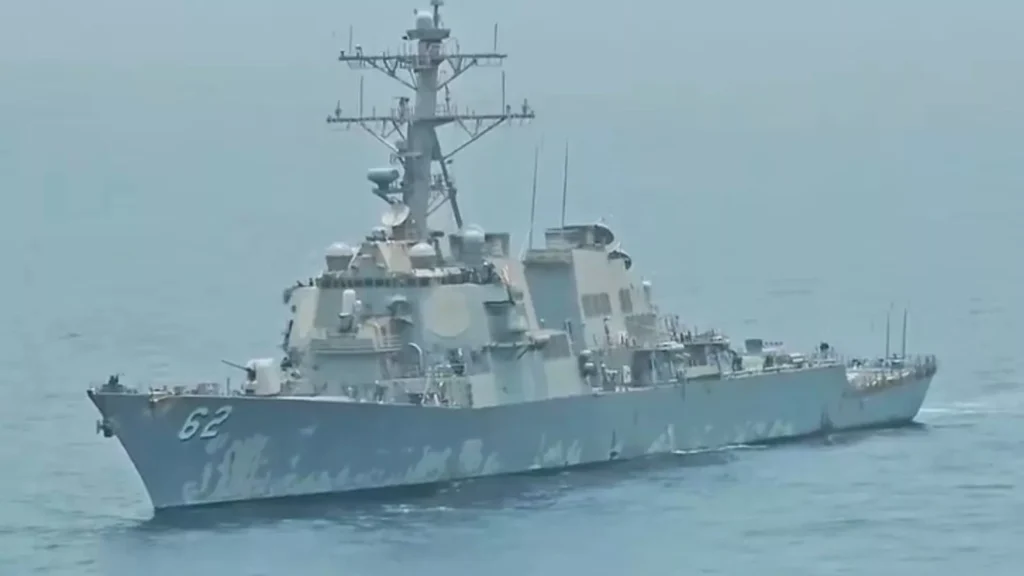
According to Iranian state media, the incident occurred around 10 a.m. local time on Wednesday when the US vessel reportedly approached waters claimed by Tehran. In response, Iran dispatched a military helicopter to intercept the ship and demanded it change course.
Footage aired by Iranian state television showed an SH-3 “Sea King” helicopter flying at low altitude near the Fitzgerald. A voice, reportedly from an Iranian crew member aboard the aircraft, issued a radio message in English instructing the warship to leave the area.
The Iranian broadcaster described the situation as a “provocative move” by the United States, characterizing the exchange as tense and confrontational.
Iranian media stated that the US destroyer responded by threatening to engage the helicopter if it did not disengage. However, after repeated warnings from the Iranian military, the warship reportedly exited the area. This event marks the first direct confrontation between US and Iranian forces since the 12-day war between Iran and Israel in June.
While Tehran portrayed the incident as a significant warning and show of sovereignty, the United States painted a far more restrained picture. US Central Command disputed Iran’s version of events, referring to the encounter as a “safe and professional interaction” with no impact on the destroyer’s mission.
A senior US defense official, speaking anonymously to Reuters, stated that the USS Fitzgerald remained in international waters throughout the exchange and that no hostile actions were taken by either side.
According to the official, the Iranian aircraft involved was correctly identified as a Sea King helicopter operated by the Iranian military, which monitored the US vessel for a short period before retreating.
“This interaction had no effect on USS Fitzgerald’s operations, and reports claiming otherwise are falsehoods and part of Iran’s broader misinformation campaign,” the defense official added.
The US Navy has routinely operated in the Gulf of Oman and the Strait of Hormuz as part of international efforts to ensure the free flow of maritime commerce. However, encounters between Iranian and US forces in these contested waters have become increasingly common, often sparking diplomatic and military concerns.
This latest naval exchange comes in the wake of heightened regional instability following a brief but intense war between Iran and Israel. The United States had previously escalated its involvement in the conflict, launching airstrikes on Iranian nuclear sites last month. President Donald Trump celebrated the campaign as a significant blow to Iran’s nuclear capabilities, claiming that it had “obliterated” Tehran’s infrastructure.
However, recent US intelligence reports suggest that only one of Iran’s three targeted nuclear facilities—the Fordow site—was effectively neutralized. The other two reportedly sustained only partial damage, raising doubts about the overall impact of the US strikes and leaving room for Iran’s nuclear ambitions to continue.
In a televised interview aired on Wednesday, Iranian President Masoud Pezeshkian addressed the broader geopolitical context. He reaffirmed that Iran’s nuclear program remains focused on peaceful development but warned that his government remains fully prepared to respond to any future military aggression, particularly from Israel.
When asked about the prospects for a lasting ceasefire with Israel, Pezeshkian expressed skepticism, stating, “We are not optimistic. History shows us the pattern of broken truces and repeated violence. We are prepared for whatever may come.”