Follow Us:
Follow Us:


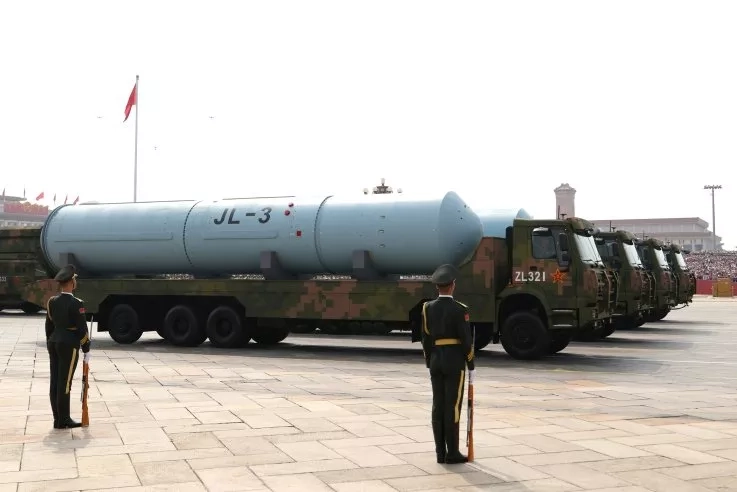
Defense Feeds – The Chinese JL-3 missile has been publicly revealed as a major advancement in China’s submarine-launched ballistic missile (SLBM) program, capable of striking the continental United States.
First unveiled during the Sept. 3, 2025 Victory Day military parade, the Chinese JL-3 missile represents a significant step forward in Beijing’s undersea nuclear deterrence and signals a stronger, more assertive strategic posture.
This missile upgrade enhances China’s global second-strike capability and poses new challenges to existing U.S. defense strategies.
The JL-3 SLBM is an evolution of the earlier JL-2, showing remarkable improvements in range, payload, and missile defense evasion.
The JL-3’s operational reach is thought to fall within the 9,000 to 12,000-kilometer range, experts say.
This extended range means Chinese ballistic missile submarines can target almost any location within the mainland U.S., without needing to approach heavily monitored areas near the first island chain in the Pacific.
China’s earlier SLBMs had limited regional strike capabilities, but the JL-3 now provides Beijing with genuine global nuclear reach.
Designed to be launched from the Type 094A submarine and the upcoming more advanced Type 096 class, this missile employs solid-fuel propulsion for rapid launching, along with improved guidance accuracy and multiple independently targetable reentry vehicles (MIRVs).
This MIRV capability allows a single missile to hit various targets with several warheads simultaneously, complicating missile defense interceptors like the U.S. Ground-based Midcourse Defense system.
Analysts believe each JL-3 may carry three to five warheads or a mix with decoys to defeat enemy interceptors.
This shift underscores China’s desire to move from strategic ambiguity to a more transparent and credible nuclear deterrent strategy.
Instead of merely possessing nuclear weapons, China is demonstrating a robust second-strike posture that assures retaliation.
Strengthening the naval part of its nuclear triad guarantees that, even if land missile silos are targeted initially, Chinese submarines can launch a retaliatory strike from beneath the surface.
This development aligns China with global powers such as the U.S. and Russia in strategic nuclear capability.
The integration of the JL-3 missile is directly connected to China’s expanding fleet of nuclear ballistic missile submarines.
The Type 094A, an upgrade over the original Type 094 Jin-class, is currently equipped to house the JL-3 missiles.
The 094A offers improved acoustic stealth, updated sonar systems, and enhanced reactor efficiency, though it remains noisier than leading U.S. Ohio-class or Russia’s Borei-class SSBNs.
There are around six of these Type 094/094A boats in active service, patrolling strategic waters like the South China Sea with increasing frequency.
Of particular importance is the Type 096 SSBN, currently being built at the Bohai Shipyard, marking a significant advancement.
This new class of submarine is expected to feature cutting-edge stealth technology, advanced air-independent propulsion for prolonged underwater endurance, and sophisticated acoustic sensors.
It is expected to be equipped with 16 to 24 powerful JL-3 missiles, greatly enhancing China’s underwater nuclear firepower.
Intelligence sources suggest the Type 096 will enable China to maintain more consistent deterrence patrols far from shore, raising the survivability and alertness of its second-strike capability.
This rapid modernization puts pressure on U.S. anti-submarine warfare (ASW) forces, which have depended on detecting and tracking Chinese SSBNs closer to coastal patrol zones.
With longer-range missiles launched from quieter subs further away, early warning becomes more difficult, increasing strategic uncertainty.
China’s unveiling of the JL-3 happens amid a broader expansion of its submarine fleet, which is now the largest globally in numbers, comprising approximately 76 to 80 vessels.
This fleet includes six Type 094/094A SSBNs, around seven to nine nuclear-powered attack submarines (such as the newer Type 093A Shang-class), and some 60 diesel-electric boats, notably the Yuan-class with air-independent propulsion (AIP).
These diesel submarines offer exceptional silence in shallow waters, posing a growing challenge in regional theaters.
Despite ongoing advancements, Chinese nuclear subs still lag behind U.S. counterparts in sonar evasion and underwater endurance.
Ongoing advancements in noise reduction, reactor technology, and pump-jet propulsion are steadily closing the gap.
The development of the Type 095 SSN and enhanced versions of existing design indicate a strategic focus on undersea warfare dominance.
The JL-3’s deployment requires the U.S. and its allies to rethink their maritime and missile defense strategies in the Indo-Pacific.
The missile’s longer range means China can threaten American mainland targets without risking submarines within heavily patrolled choke points.
MIRV technology complicates interception and increases the lethality of any strike. Countering this requires more sophisticated undersea surveillance, faster production of advanced U.S. nuclear submarines, and deeper allied coordination in anti-submarine efforts.
In sum, China’s JL-3 missile and its supporting submarine classes herald a new era of strategic competition beneath the waves.
The advancement represents significantly more than a symbolic display. It challenges the existing global balance of power and requires urgent strategic responses from NATO, U.S. Indo-Pacific partners, and defense planners worldwide.
The age of undersea nuclear deterrence is entering a transformative and highly contested phase driven by China’s rapid technological progress.