Follow Us:
Follow Us:


Defense Feeds – China Unveils YJ-19 Hypersonic Missile, showcasing its drive to equip submarines with a new class of cruise weapons and underscoring a key step in the People’s Liberation Army Navy’s modernization.
The scramjet-powered YJ-19, built for submarine launch, made its first public appearance at a major military parade in Beijing attended by Xi Jinping, Vladimir Putin and Kim Jong Un.
Military experts say the new system demonstrates a breakthrough in China’s undersea strike capabilities, combining the stealth of submarine launch with the speed and range of hypersonic flight.
If fully deployed, the YJ-19 would stand among the most advanced submarine-launched hypersonic missiles currently revealed in Asia.
The YJ-19 appeared in a smaller configuration compared to China’s bulkier YJ-17 and YJ-20 systems, with a noticeably shorter and slimmer design.
Defense analysts noted its diameter, including the booster section, was small enough to fit inside standard 533 mm torpedo tubes.
This feature is critical, as it allows China’s growing submarine fleet—both nuclear-powered and conventional diesel-electric vessels—to adopt the missile without requiring major structural modifications or vertical launch systems.
Chinese state media broadcast footage of the YJ-19 mockup unveiled during the parade. Interestingly, the missile carried a distinctive white paint scheme rather than the typical blue associated with PLAN anti-ship weapons.
Observers highlighted the absence of suspension lugs or fittings, reinforcing the belief that the YJ-19 is not designed for air or ship deck deployment but optimized for encapsulated storage and underwater launch.
According to defense analyst Shahryar Pasandideh, the missile’s proportions strongly support the view that it is tailored for submarine use.
By making it compatible with existing torpedo tubes, the PLAN gains flexibility to field the system across a wide spectrum of its attack and ballistic missile submarine classes.
The development of the YJ-19 fits into Beijing’s broader strategy of enhancing anti-access and area-denial capabilities in the Indo-Pacific.
By integrating a submarine-launched hypersonic cruise missile into its arsenal, China could strike naval targets at long range with far less warning than traditional missile systems.
The combination of underwater launch and high supersonic or hypersonic speed makes interception by missile defenses more difficult.
For regional navies, including those of Japan, Australia, and the United States, the operational fielding of the YJ-19 would create new challenges.
Submarines could engage warships or carrier strike groups from below the surface, reducing detection windows and compressing reaction times.
Naval strategists note that this dynamic would strengthen China’s deterrence posture and complicate any potential maritime operations near contested waters such as the South China Sea or Taiwan Strait.
Parades by the Chinese military are often meant as strategic signals, showcasing capabilities not only to a domestic audience but also to foreign powers.
The presence of Russia and North Korea’s top leadership at the event underscored the alignment of these states in military posture.
By displaying the YJ-19, China communicated both technological progress and geopolitical coordination.
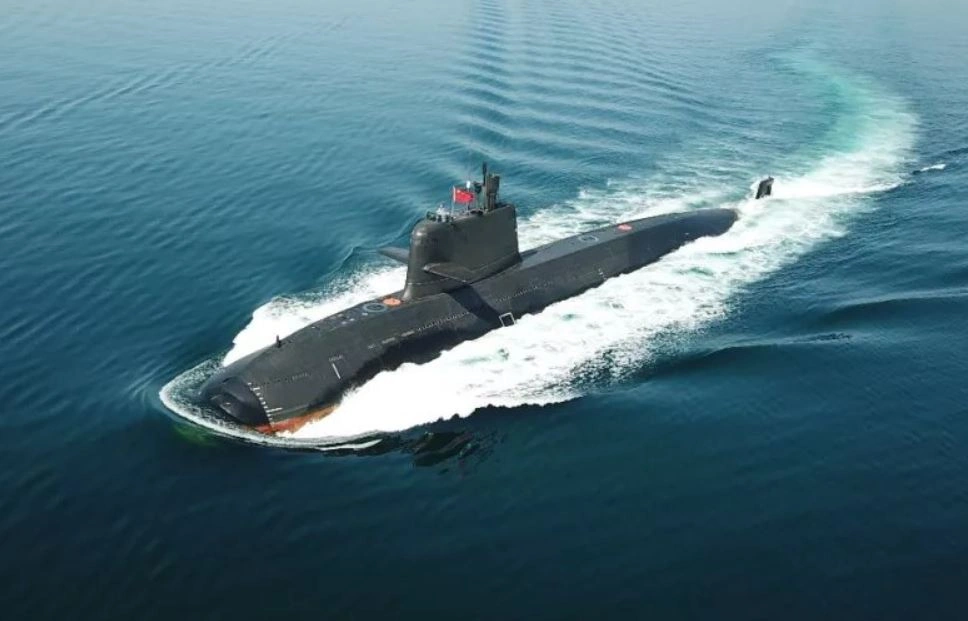
The People’s Liberation Army Navy has spent the past two decades rapidly expanding its undersea fleet both in quantity and sophistication.
China’s submarine fleet, once shaped by aging Soviet platforms, has transformed into a modern force operating some of the most capable non-nuclear submarines globally.
With air-independent propulsion, upgraded sonar, and advanced torpedo systems already in place, the addition of the YJ-19 hypersonic cruise missile ushers in a new era of strike power.
What sets the YJ-19 apart is its propulsion system. It is believed to be powered by a scramjet engine—a supersonic combustion ramjet—
enabling it to sustain hypersonic speed through the atmosphere. Analysts believe its high-altitude cruise profile, combined with a powerful booster for launch, would allow it to travel great distances at blistering speeds.
While exact range figures remain secret, regional military watchers speculate it may be capable of striking naval targets several thousand kilometers from launch.
Despite its unveiling, Beijing has not publicly confirmed when—or if—the missile will enter active service.
Military parades have often been used to display advanced prototypes or early-stage systems before full operational deployment.
However, the fact that the YJ-19 was displayed on national television strongly suggests the program is well advanced and nearing entry into the PLAN’s arsenal.
The move is consistent with China’s heavy investments in hypersonic missiles across land, air and sea domains.
Previous focus on surface-launched anti-ship systems now appears to be matched by undersea counterparts, extending strike coverage and survivability.
Fielding the YJ-19 would give Chinese submarines the ability to threaten high-value naval formations across contested waters almost immediately after surfacing for launch.