Follow Us:
Follow Us:


Defense Feeds – China Reveals GJ-11 Drone in what appears to be a new stealth variant designed for carrier operations, a development that could shift the balance of naval airpower in the Asia-Pacific.
The Sharp Sword unmanned combat aerial vehicle (UCAV), unveiled during Beijing’s Victory Day parade earlier this month, featured folding wing hinges, an unmistakable adaptation for deck storage and carrier launch missions.
During the September 3, 2025 military parade in Beijing, the GJ-11 led an unmanned aerial formation, making it the centerpiece of China’s rising drone fleet.
Military observers noted visible folding wing joints on the aircraft, a clear indication that the design has been modified to support deployment aboard carriers and amphibious assault ships.
Parade footage and state media coverage highlighted the stealth drone’s low-observable flying wing configuration, comparable to the U.S. Navy’s X-47B demonstrator.
Unlike earlier appearances of the GJ-11, which seemed optimized for land-based roles, this variant revealed carrier-specific adaptations.
According to defense analysts, folding wings not only save deck space but also suggest strengthened landing gear, corrosion-resistant coatings, and potentially upgraded avionics for maritime operations.
The timing of this public display is notable. Just months ago, reports linked the Sharp Sword to China’s newest warships, including the Type 076 amphibious assault ship Sichuan and the aircraft carrier Fujian.
If confirmed, the drone could give the People’s Liberation Army Navy (PLAN) a long-range strike and reconnaissance capability that rivals U.S. naval aviation.
The introduction of a carrier-capable GJ-11 could mark a turning point in Chinese naval strategy. Traditionally, the PLAN relied on manned aircraft such as the J-15 fighter and its future derivatives for power projection.
However, a combat-capable stealth drone would allow carriers to operate in high-threat environments with lower risk to pilots, while also extending surveillance, strike, and electronic warfare missions beyond the reach of current manned platforms.
Military experts suggest several scenarios where the Sharp Sword may prove decisive. First, its stealth design enables it to penetrate advanced air defense networks, carrying precision-guided munitions deep into contested zones.
Second, the drone could provide persistent intelligence, surveillance, and reconnaissance (ISR) over maritime chokepoints, complementing China’s expanding satellite coverage.
Third, UCAVs like the GJ-11 could conduct electronic attack and decoy missions, overwhelming adversary radars to clear the way for manned aircraft.
The folding-wing variant also strengthens China’s ability to scale drone operations across multiple warships.
Larger decks on carriers such as the Fujian allow launch and recovery of heavier UCAVs, while Type 076 assault ships may use electromagnetic catapults or advanced arresting systems to handle drone sorties.
This dual-platform approach mirrors U.S. Navy interest in integrating MQ-25 Stingray tankers and future carrier drones.
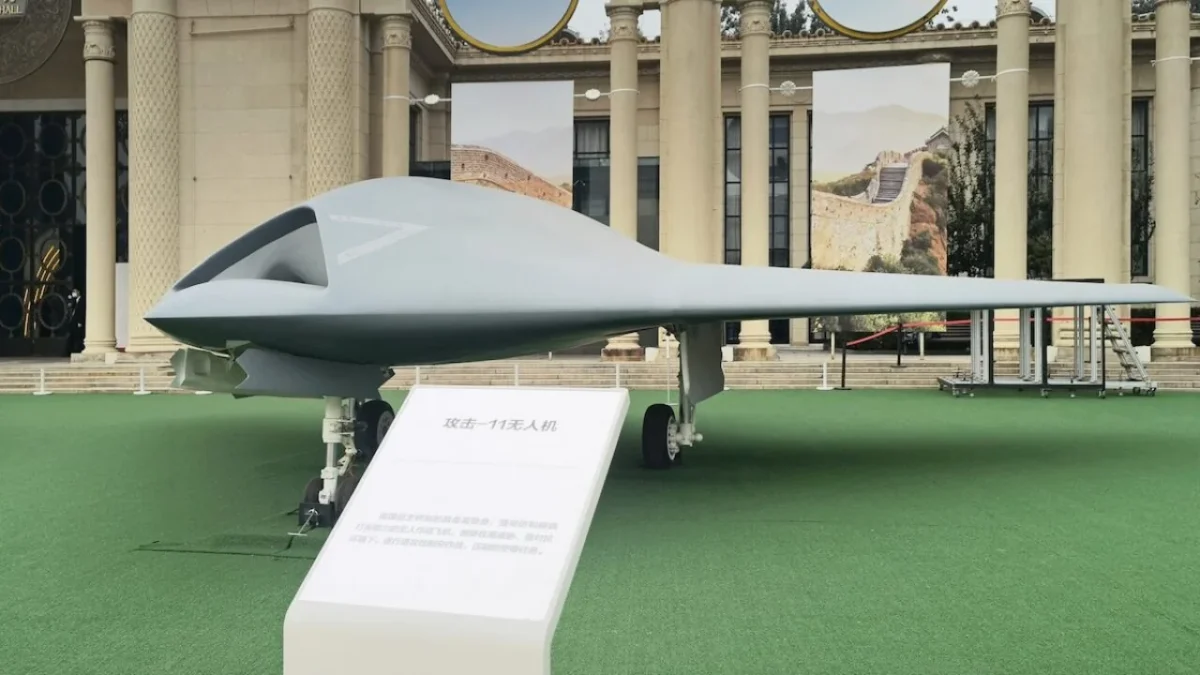
The parade demonstration of the Sharp Sword with folding wings is not a mere ceremonial gesture—it sends a strategic message to regional rivals and global military watchers.
By showcasing the drone in such a prominent national event, Beijing demonstrated confidence in its technology and signaled the seriousness of its naval modernization drive.
For the United States and its allies in the Indo-Pacific, a shipborne GJ-11 would complicate naval planning.
Carrier groups operating in contested zones like the South China Sea or near Taiwan would face a new layer of threats.
Unlike conventional fighters, stealth drones offer smaller radar cross-sections, longer endurance, and potentially networked swarm tactics, a combination that could overwhelm even advanced integrated air defense systems.
Furthermore, the appearance of such technology highlights how rapidly China is closing the gap with U.S. naval drone programs.
While the United States has been slower to operationalize shipborne UCAVs beyond refueling roles, China appears to be moving directly toward weaponized stealth drones on carriers.
If this trend continues, the balance of carrier aviation may shift toward unmanned dominance in the next decade. For now, much about the GJ-11 remains unclear.
Questions persist on its payload capacity, combat radius, datalink security, and carrier integration.
What is clear, however, is that its latest public appearance signals intent: China is preparing to make stealth drones an integral part of its naval strike doctrine.
At a time when maritime competition is intensifying in the western Pacific, the emergence of a carrier-ready GJ-11 Sharp Sword underscores Beijing’s ambition to reshape future naval warfare.
If carrier deployment becomes standard, this stealth drone could offer the PLAN a decisive edge in surveillance, electronic attack, and long-range strike missions, fundamentally altering the strategic landscape at sea.