Follow Us:
Follow Us:


Defense Feeds – On September 3, 2025, China showcased the AJX002 Chinese underwater drone during its major military parade in Beijing.
The event, marking the 80th anniversary of World War II’s end, involved senior leaders such as Russian President Vladimir Putin and North Korean leader Kim Jong Un.
The debut of the AJX002 Chinese underwater drone highlighted China’s expanding focus on underwater drone capabilities aimed at reinforcing naval pressure in the Taiwan Strait and surrounding areas.
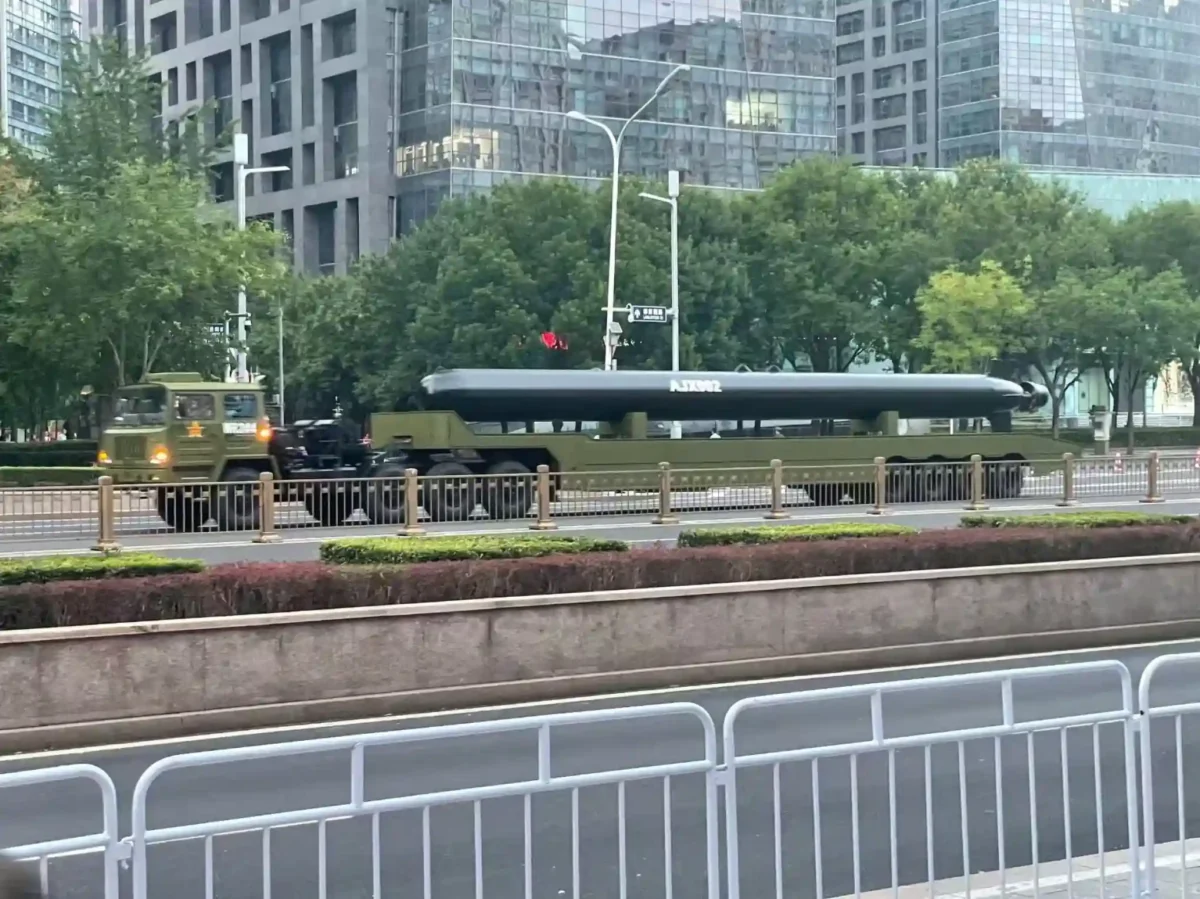
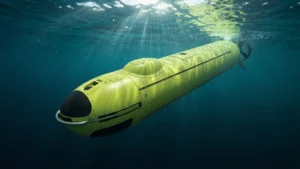
The AJX002 is a highly advanced extra-large uncrewed underwater vehicle, designed to operate without any human crew on board.
Unlike smaller underwater drones, the AJX002 is far too big to be deployed from traditional submarines, requiring ship-side cranes for launch and recovery.
This vehicle measures around 18 to 20 meters long and has a slim diameter between 1 and 1.5 meters, giving it a streamlined hull optimized for reduced acoustic signature.
The drone’s hull houses modular payload sections. The front contains space likely dedicated to payloads, while the rear holds propulsion systems.
It uses a pumpjet propulsion unit, a quieter system than traditional propellers, which helps minimize underwater noise and lowers the risk of detection.
The control surfaces are arranged in a classic cruciform rudder format, differing from other Chinese underwater drone designs that use X-shaped rudders. This shows a focus on conventional underwater control methods.
The AJX002 is chiefly built for mine deployment missions, reflecting the People’s Liberation Army Navy’s drive to develop autonomous undersea mine warfare capabilities.
This reflects a global trend where major navies invest in systems similar to the Boeing Orca and Australia’s Anduril Ghost Shark. However, the AJX002’s size and lack of visible sensor equipment suggest it may have broader uses.
Experts suspect it could carry offensive armaments like torpedoes or cruise missiles, though no evidence points to nuclear-powered propulsion or nuclear warhead deployment at this stage.
The introduction of the AJX002 signals China’s intent to strengthen its undersea military posture, particularly regarding the sensitive Taiwan Strait.
Its ability to covertly deploy mines can disrupt maritime traffic and create significant obstacles for enemy vessels. Reports suggest the drone could lay sea mines in deep waters off Taiwan or conduct patrols beyond the reach of land-based defenses.
The AJX002 may also be capable of covertly attacking key undersea assets, including communication cables and naval port facilities.
These capabilities add another layer of challenge for adversaries in anti-submarine warfare, forcing them to respond not only to crewed submarines but also to large autonomous systems operating independently.
The AJX002 is a piece of a larger program of XLUUV development initiated around 2022, with satellite data revealing China has tested several different models.
During parade rehearsals, observers spotted at least four AJX002 units plus two larger, unnamed variants.
The larger model features twin masts and X-form rudders, indicating a more multipurpose function compared to the AJX002’s specialized mine warfare role.
Today, China leads global efforts both in variety and pace of extra-large underwater drone production, outpacing competitors.
Chinese military experts highlight the AJX002’s potential to operate in coordinated groups or “swarms,” working alongside other unmanned underwater and surface vehicles.
Such operations could generate multi-layered blockade zones in strategically sensitive areas including the South China Sea and Western Pacific.
The drone’s sensor and recognition systems might also allow it to identify friendly and enemy vessels autonomously, reducing accidental engagements and increasing mission success.
When deployed en masse, the AJX002 could become a formidable tool for maritime area denial, capable of restricting enemy access and complicating naval operation planning significantly.
The AJX002 underwater drone’s public unveiling, displayed alongside nuclear missiles, hypersonic arms, and directed-energy weapons, highlights China’s wider modernization efforts targeting emerging battlefields.
Although details on its endurance, control mechanisms, and sensor technology are still unclear, the AJX002 demonstrates the increasing value the People’s Liberation Army Navy (PLAN) assigns to unmanned underwater systems.
This high-visibility debut also doubles as a political statement from Beijing, emphasizing China’s expanding military strength to both regional neighbors and the global community.
In summary, the AJX002 represents a major step forward in China’s pursuit of autonomous naval warfare platforms.
Its unique size, quiet propulsion, and modular design make it a versatile asset for the PLAN’s expanding underwater fleet and a strategic factor in escalating tensions around Taiwan.
As China continues to advance its XLUUV programs, rival navies will need to adapt their anti-submarine tactics to address the challenges posed by these large, covert underwater drones.