Follow Us:
Follow Us:

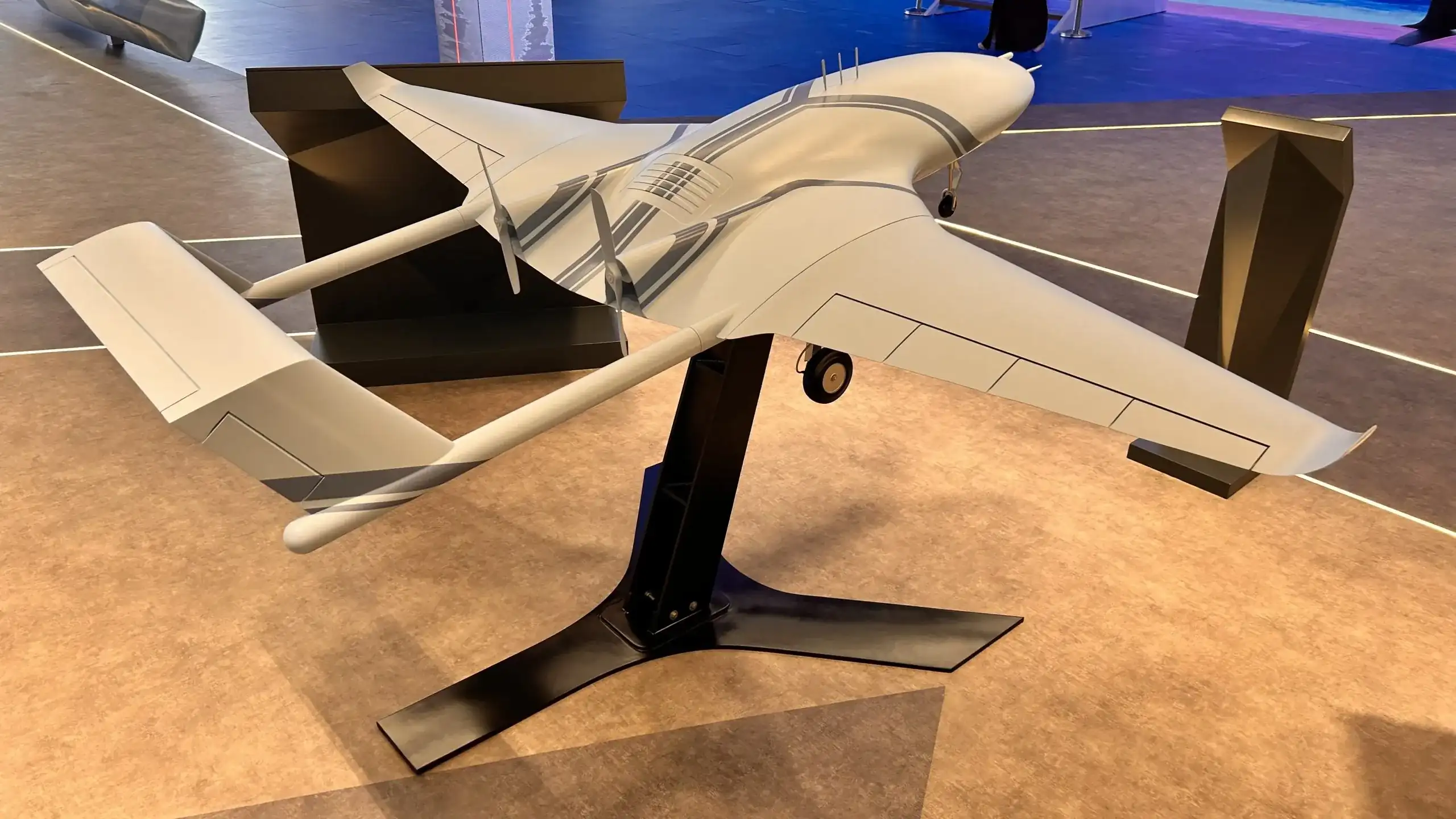
Defense Feeds – ST-5 Stingray drone developed by Cranfield Aerospace Solutions (CAeS), an innovative UK aerospace company, has officially been unveiled as a long-endurance unmanned aerial vehicle (UAV) that represents a major leap in sustainable drone technology.
Debuting at the Dubai Airshow 2025, the ST-5 Stingray drone introduces a new standard in multi-role UAV efficiency, aerodynamic performance, and environmentally friendly propulsion.
Its launch coincides with a newly signed Memorandum of Understanding (MoU) between CAeS and the National Oceanography Centre (NOC), a leading ocean research institution with more than six decades of expertise.
This collaboration sets the foundation for advancing UAV-supported ocean monitoring and expanding the adoption of sustainable aviation systems for scientific missions.
The ST-5 Stingray drone features a hybrid wing-body design with a 5.5-meter wingspan, delivering aerodynamic efficiency and strong operational agility.
Its innovative hydrogen-electric powertrain enables emission-free operation, cost-effective performance, and impressive long-endurance capability—making this drone particularly effective for extended marine research, atmospheric sampling, and remote surveillance missions.
Drawing on CAeS’s previous UAS design work with Boeing and NASA, the ST-5 Stingray drone also benefits from optimized payload integration, refined flight dynamics, and a modular architecture tailored for diverse mission profiles.

The ST-5 Stingray is built as a versatile, multi-role platform that can handle a broad range of missions, from cargo delivery and environmental studies to search and rescue, maritime surveillance, and atmospheric observation.
Its spacious airframe can accommodate a variety of payloads such as oceanographic sensors, high-resolution imaging systems, communications equipment, and surveillance packages.
A major innovation within the Stingray’s architecture is its distributed propulsion system, which boosts usable internal cargo volume by up to 60% compared to similar-weight aircraft.
This design allows the UAV to be configured for increased payload capacity or extended range, depending on operational requirements.
Since June 2025, the effort has rapidly advanced through design, manufacturing, and propulsion system assembly stages.
CAeS engineers are now installing the hydrogen-electric powertrain into the airframe, preparing the UAV for the next stage of testing.
Progress has been driven by rising global demand for sustainable aerospace systems that support long-endurance missions while minimizing environmental impact.
The Stingray’s low noise profile and zero-emission propulsion make it an optimal tool for environmental and marine research, allowing scientists to gather high-quality data without disturbing sensitive ecosystems.
Its ability to operate for extended periods over remote or difficult-to-access areas positions it as a valuable asset for ocean monitoring and environmental mapping.
The MoU between CAeS and NOC represents a strategic step forward in developing UAV-based ocean observation capabilities under the ARIA Forecasting Tipping Point program, which studies critical ocean convection processes in the North Atlantic Subpolar Gyre.
These processes have significant implications for global climate patterns, making improved monitoring an essential priority.
NOC Principal Scientist Christine Gommenginger emphasized the Stingray’s long endurance, payload capacity, and adaptability as ideal traits for airborne data collection in challenging marine environments.
Planned joint demonstration campaigns will evaluate the UAV’s performance in demanding oceanic and coastal conditions, helping refine its operational capabilities for scientific missions.
CAeS Chief Technology Officer Paul Clarke highlighted the ST-5 as the first UAV specifically designed for hydrogen fuel cell propulsion.
With a flexible fuel cell configuration that provides scalable power and an aerodynamic structure optimized for extended-range efficiency, the Stingray is well-suited for continuous environmental observation missions.
This design also ensures the UAV can conduct scientific missions without contributing to carbon emissions or disturbing marine ecosystems.
Supported by investment from the EDGE Group’s Strategic Development Fund, the collaboration between CAeS and NOC positions the UK as a leader in sustainable aerospace innovation.
With its combination of endurance, versatility, and eco-friendly propulsion, the ST-5 Stingray stands poised to become a key platform for future advancements in defense, environmental research, and scientific exploration.