Follow Us:
Follow Us:


Defense Feeds – US Expands Bradley M2A4 Production as the Army awards new contracts to BAE Systems, boosting upgrades of Bradley Fighting Vehicles to keep armored brigades combat-ready while transitioning toward the future XM30 program.
The move highlights the enduring importance of the Bradley M2A4 and M7A4 variants even as the next-generation infantry vehicle family approaches service entry.
In late September 2025, the Army confirmed two contract modifications with BAE Systems worth more than $22 million, covering additional production and modernization of Bradley Fighting Vehicles.
A $12.2 million award was issued on 22 September, followed by a $10.2 million modification two days later. Both adjustments raise the total contract value to over $668 million.
These modifications task BAE Systems with converting legacy Bradley hulls into modernized M2A4 and M7A4 configurations, keeping the platform aligned with current operational needs while reducing the pressure on strained inventories.
Deliveries under these contracts are scheduled to be completed between November 2027 and November 2027 at various production facilities working under the Army Contracting Command at Detroit Arsenal.
The Army has steadily issued successive orders to ensure armored brigades retain modernized mechanized vehicles.
By June 2025, the service had procured 985 of its planned 1,329 M2A4 and M7A4 units, representing equipment for nine armored brigades plus support and training fleets.
With the XM30 not expected to enter service until the early 2030s, the Bradley upgrades serve as a critical capability bridge.
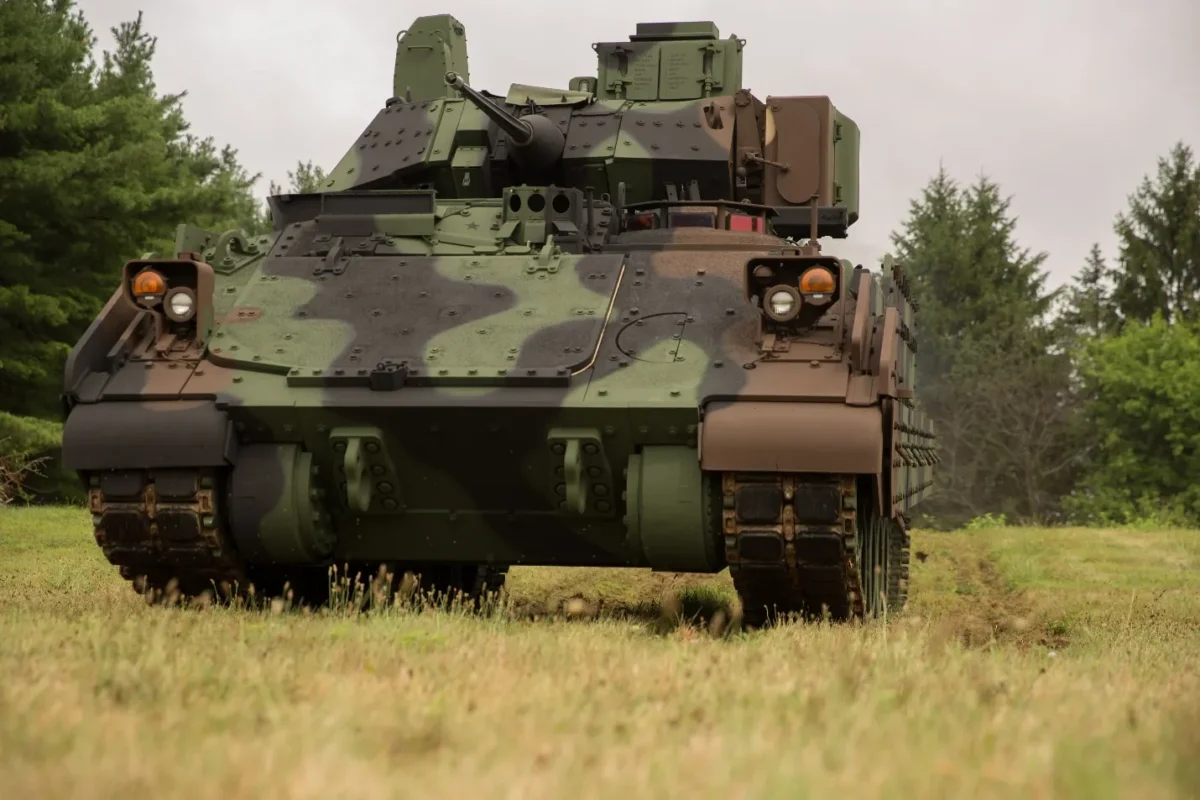
The Bradley Fighting Vehicle, first fielded during the Cold War, has undergone decades of incremental improvements to preserve its battlefield relevance.
Under the Army’s Engineering Change Proposal program, the M2A4 variant received a host of upgrades addressing performance shortfalls identified during wars in Iraq and Afghanistan.
Mobility was restored through lighter tracks, updated suspension, new torsion bars and shock absorbers.
Power improvements came via a 675-horsepower Cummins diesel engine paired with an HMPT-800 transmission, enabling the M2A4 to manage heavier armor and advanced onboard systems.
Combined with modern fire control software, the upgraded Bradley can effectively employ its 25 mm M242 Bushmaster chain gun, a coaxial 7.62 mm machine gun and a dual TOW missile launcher for anti-armor engagements.
The Army has also fielded the M2A4E1 subvariant, integrating the Israeli-developed Iron Fist Light active protection system.
Fitted with radar and infrared sensors and defensive interceptor rounds, the APS enhances survivability against rockets, anti-tank guided missiles and drone strikes.
Additional upgrades include improved sights, compartment cooling systems and jammers to defeat improvised explosive devices.
Parallel advances were applied to the M7A4, which is built on the same chassis but optimized as a fire support coordination vehicle.
It incorporates long-range targeting sensors providing digital Call-for-Fire messaging up to 20 km.
Retaining defensive armaments equivalent to the M2A4, it adds advanced communications, digital targeting and satellite-enabled situational awareness links for fire support leaders.
The M7A4 ensures tank and artillery coordination while keeping pace with mechanized formations in the field.
Recent exercises have underscored the operational effectiveness of the M2A4. During NATO’s Exercise Hedgehog 25 in Estonia, Bradleys from the 3rd Infantry Division demonstrated their ability to conduct mechanized assaults, urban combat and rapid deployment by C-17 Globemaster III transport aircraft.
The exercise highlighted the vehicle’s role in rapid reinforcement tasks and interoperability with allied forces amid growing security tensions with Russia.
The Army’s promotional strategy also reflects the balance between legacy requirements and future planning.
Around 186 older Bradley M2A2 vehicles have been transferred to Ukraine as part of U.S. military aid. By backfilling U.S. Army stocks with modernized A4 series vehicles, the service maintains its armored strength at home and abroad.
Testing and evaluation highlighted both strengths and limitations of the Bradley fleet. The A4 variants demonstrated superior mobility, targeting efficiency and crew situational awareness compared to older models.
However, challenges such as excessive heat in compartments and select cyber vulnerabilities remain ongoing issues. The Army has pledged continued refinements to address those deficiencies.
While the XM30 Mechanized Infantry Combat Vehicle is scheduled to replace the Bradley beginning in the early 2030s, the A4 generation will remain a mainstay in U.S. heavy formations for the rest of this decade.
With modern firepower, enhanced mobility and survivability improvements, the A4 ensures mechanized infantry brigades have a capable platform until the Army fields its AI-driven, 50 mm cannon-equipped XM30.
The latest contracts underline a pragmatic procurement approach: sustain proven systems long enough to meet today’s operational challenges while investing in the breakthrough capabilities of tomorrow.
The Bradley may have its origins in Cold War designs, but with current upgrades it continues to deliver armored mobility, firepower and networked command functions in line with NATO defense strategies.