Follow Us:
Follow Us:


Defense Feeds – UK Launches Project Nightfall in a bold move to design and produce a low-cost, homegrown tactical ballistic missile aimed at boosting British artillery firepower and cutting dependence on foreign suppliers.
Officially announced on 27 August 2025 by the Ministry of Defence (MoD), the program is considered a historic step toward reviving the UK’s independent missile development after decades of reliance on U.S. systems.
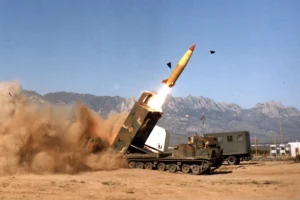
Unlike previous acquisitions, which leaned heavily on American missiles such as the ATACMS and the upcoming Precision Strike Missile (PrSM), Project Nightfall is positioned as both a cost-saving measure and a sovereignty-driven initiative.
With its planned range of over 600 kilometers, a 300-kilogram payload, and full integration into the British Army’s M270 Multiple Launch Rocket Systems (MLRS), Nightfall is intended to provide the UK with a cost-effective long-range strike capability.
At the heart of Project Nightfall lies the UK’s determination to secure a cost-effective strike capability without being tied to overseas export restrictions.
The MoD has limited the missile’s cost to £500,000 ($675,000) each, positioning it as a cheaper alternative to the U.S. PrSM while aiming to achieve both extended range and affordability in mass output.
According to the early notice, British industry has until 18 September 2025 to submit proposals for key components, with the expectation that at least five prototype missiles should be built for initial testing within 12 months.
This rapid timeline reflects the growing urgency across Europe to field long-range precision fires in the wake of Russia’s war in Ukraine.
Key operational requirements set by the MoD emphasize speed and survivability. Launch teams must demonstrate the ability to release multiple Nightfall missiles from a single M270 in 15 minutes, followed by a withdrawal in less than five.
The missile itself must feature a low multispectral signature to reduce detectability, electronic warfare resilience, and guidance systems capable of striking targets accurately even in GPS-degraded environments.
If met, these specifications would give the British Army a sustainable strike capability comparable to modern U.S. systems but at a fraction of the cost.
However, achieving this balance between affordability and performance will likely involve compromises, such as simplified guidance systems and innovative structural design choices like folding fins to maximize the number of missiles that can be carried.
Project Nightfall brings to mind the Cold War missile race, when tactical ballistic weapons such as the U.S. Pershing and Soviet Tochka shaped Europe’s strategic balance.
Those missiles provided rapid, mobile firepower capable of delivering devastating precision strikes deep behind enemy lines.
However, Nightfall aims to be different in one critical aspect: affordability within modern procurement constraints.
Unlike Cold War missile projects, which were resource-heavy and designed with fewer budgetary considerations, the UK’s latest program acknowledges the financial pressures confronting NATO allies.
By insisting on a price limit of £500,000 per missile, the MoD is sending a clear message that the future of warfighting depends not only on long range and accuracy but also on the ability to field large stockpiles quickly.
From a strategic perspective, the missile would fill a capability gap that has long left Britain dependent on U.S. systems.
While ATACMS and future PrSM variants offered London extended strike options, those systems remain under American control and subject to Washington’s export policies.
Nightfall would provide the UK with operational sovereignty, ensuring its forces could act independently if required.
In the NATO context, Britain’s contribution could also support alliance stockpiles at a time when European militaries are racing to replenish their arsenals.
With the war in Ukraine highlighting the importance of deep precision strike, Project Nightfall could become a cornerstone of NATO’s long-range fires structure by the 2030s.
Despite its promise, Project Nightfall carries significant risks. The combination of advanced performance requirements, such as a CEP under five meters without GPS, and budgetary restrictions may create the familiar defense dilemma of promising too much and delivering too little.
Analysts caution that unless British industry rapidly demonstrates viable prototypes, Nightfall could suffer the same fate as other ambitious indigenous defense efforts that collapsed under cost overruns or technological setbacks.
The MoD has also demanded a production rate of at least 10 missiles per month, scalable to higher volumes, which will test the capacity of domestic defense contractors already engaged in other procurement programs.
If it succeeds, Project Nightfall could significantly alter the trajectory of Britain’s defense capabilities and industrial base.
A homegrown, cost-competitive ballistic missile would provide not only a critical deterrent tool for the British Army but also open doors for the UK defense sector to export missiles to allied nations seeking affordable long-range strike options.
As the MoD evaluates feedback over the coming months, much will depend on whether British firms can deliver creative engineering solutions within the tight financial framework.
The next 12 to 18 months could therefore determine whether Nightfall becomes a landmark success in UK defense strategy or remains an aspirational concept overshadowed by proven foreign systems.
For now, Project Nightfall symbolizes an energetic push by London to reclaim technological independence, revive domestic missile expertise, and offer NATO a new tool in the evolving battlefield of long-range precision fires.