Follow Us:
Follow Us:


Defense Feeds – UAE Firm Debuts Anti-Drone Mesh as TAC Armored Vehicles LLC unveils an advanced modular protection system for its Jedi armored personnel carrier, responding to the rising prevalence of drones in modern warfare and enhancing battlefield survivability.
The innovative anti-drone solution directly addresses vulnerabilities exposed in recent conflicts, where remotely piloted explosive drones have wreaked havoc on frontline vehicles.
Taking lessons from the ongoing war in Ukraine, where both sides increasingly deploy first-person view (FPV) attack drones, TAC’s approach prioritizes lightweight yet highly effective protection.
The UAE Firm’s latest innovation, the “Active Anti-Drone Net,” builds upon its UAE Firm Debuts Anti-Drone Mesh concept, providing enhanced protection against explosive drones and RPGs while maintaining a lightweight design.
Departing from traditional protection systems, TAC’s “Active Anti-Drone Net” employs a durable cable mesh known as Q-NET, engineered to stop low-altitude threats before they impact the vehicle’s armor.
This mesh technology, claimed by TAC to have no direct analogs worldwide, works as a physical defense, minimizing the risk from explosive-laden drones and mobile-shoot RPGs, which increasingly threaten light armor and soft-skinned vehicles operating in drone-heavy zones.
Factory integration of this system on the Jedi armored personnel carrier represents an evolution beyond improvised field solutions.
Historically, soldiers in Ukraine and Russia have had to retrofit vehicles using makeshift cages or netting systems scavenged from local materials.
These homemade barriers offer protection, but they can add significant weight and reduce mobility.
TAC’s solution offers a modular package that balances protection with agility, enhancing both survivability and operational effectiveness for personnel carriers navigating contested terrain.
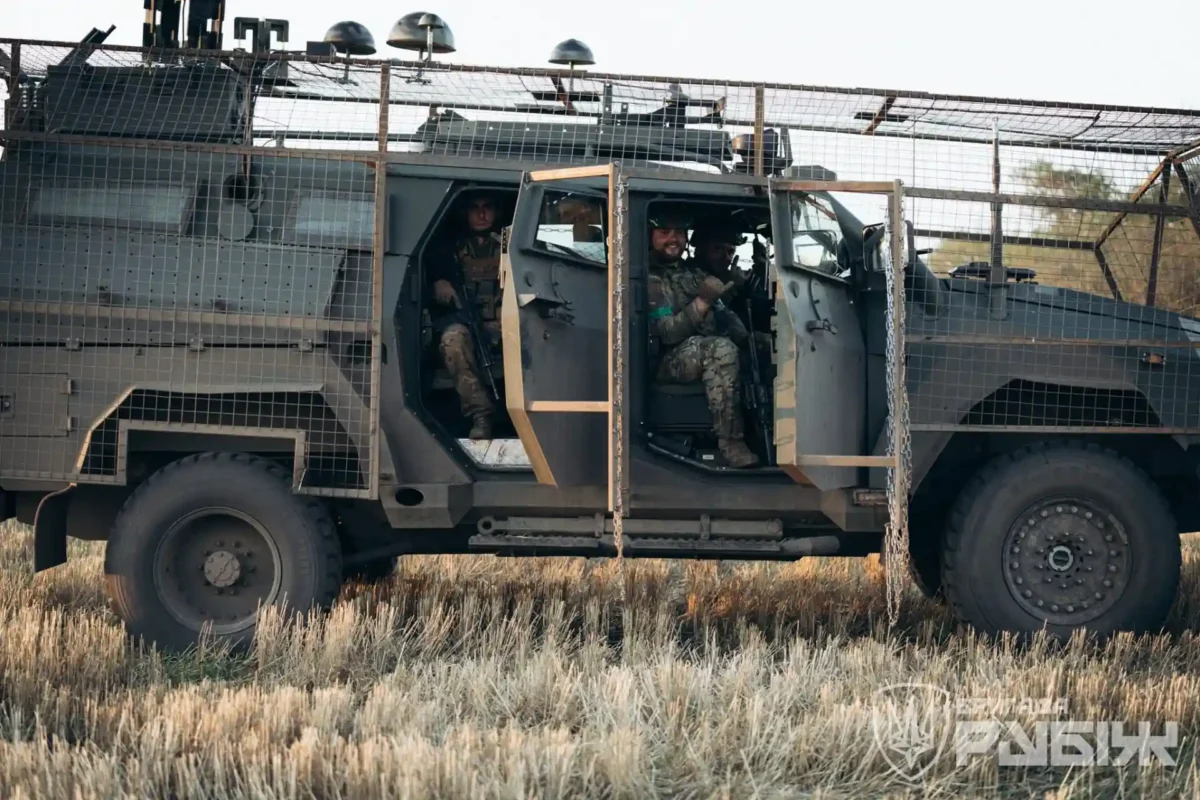
The Jedi armored personnel carrier, based on the rugged Toyota Land Cruiser 79 chassis, represents a major advancement in modular vehicle protection.
It is the first in its category to combine a V-shaped mine-resistant hull with a factory-installed anti-drone mesh, creating a comprehensive defensive package for modern battlefields.
Built to comply with STANAG Level II blast protection standards, the Jedi already offers improved survivability against mines and roadside explosives.
However, the integration of the lightweight anti-drone mesh highlights a broader industry shift toward countering aerial threats that now dominate front-line combat zones.
This factory-engineered system delivers reliable protection against shaped-charge FPV drones, which have proven especially destructive against lightly armored vehicles.
While main battle tanks can often endure repeated drone impacts, smaller 4×4 tactical vehicles remain vulnerable targets.
TAC’s mesh barrier intercepts drone strikes before impact, providing a practical and scalable solution for forces operating in high-threat environments.
The demand for anti-drone innovations continues to surge as unmanned aerial threats adapt and diversify. By deploying the modular Active Anti-Drone Net, TAC Armored Vehicles signals its commitment to addressing the realities of today’s battlefield.
The company has yet to confirm if the mesh barrier will become standard equipment for all Jedi production units or remain an optional upgrade for existing fleets, but its introduction reflects a proactive response to the demands of modern warfare.
The improvised barriers developed by Ukrainian and Russian troops to fend off drone strikes underscore the pressing demand for professionally engineered protective systems.
TAC’s solution, which integrates seamlessly and preserves vehicle agility, marks a notable advancement in the field of armored vehicle self-protection.
With drone warfare’s rapid evolution, armored personnel carriers like the Jedi are set to become increasingly dependent on efficient, lightweight anti-drone measures.
In a world where unmanned threats continue to proliferate, innovations like TAC’s mesh barrier are likely to shape the future of tactical vehicle design and battlefield resilience.