Follow Us:
Follow Us:


Defense Feeds – Sig M18 Sidearm restrictions have been imposed by multiple U.S. Air Force units following the tragic death of an airman at F.E. Warren Air Force Base in Wyoming.
This development follows an indefinite pause in the use of the M18 Sidearm across the Air Force Global Strike Command (AFGSC), reflecting heightened safety concerns surrounding the weapon.
Part of the Sig Sauer P320 family, the M18 Sidearm has faced ongoing allegations of unintentional discharges occurring without trigger pulls
While the Air Combat Command (ACC) headquarters has not mandated a total halt, several subordinate units under ACC have taken precautionary measures by limiting the M18’s deployment.
These decisions follow the lethal discharge involving Airman Brayden Lovan, a security forces member who died on duty on July 20, 2025.
Details remain under investigation, but early reports suggest the pistol discharged while still holstered after being removed and placed on a table.
An ACC spokesperson confirmed that some units are substituting alternative weapons temporarily and emphasized ongoing monitoring of the situation.
Additionally, refresher training on the safe handling and operation of the M18 is being conducted in affected units, with access to the pistol resuming after completion, typically within a two-week window.
This phased approach reflects a careful balance between operational readiness and personnel safety.
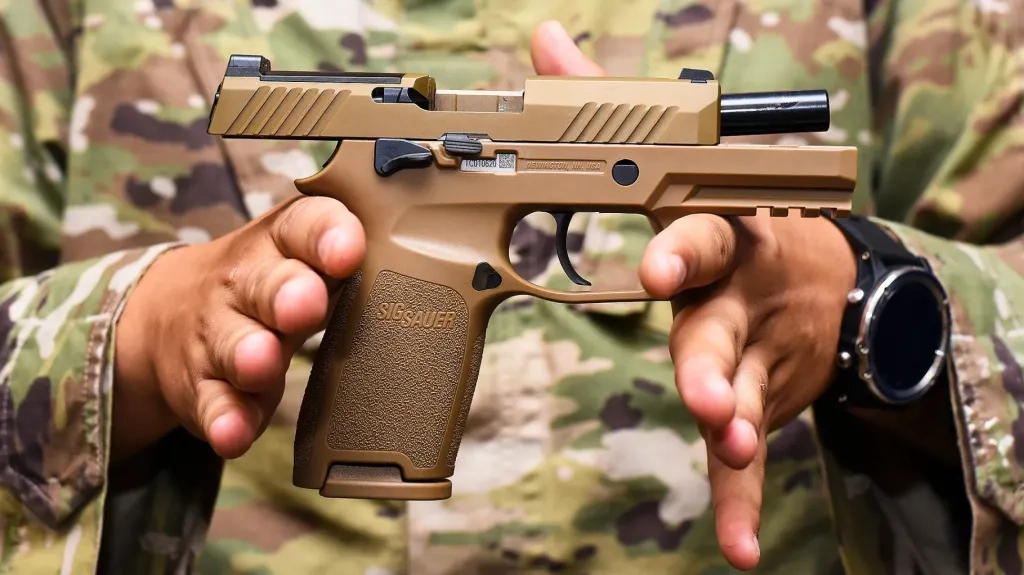
The M18 is the compact variant of the modular handgun system—the MHS—adopted by the U.S. military since 2017, managed primarily through the U.S. Army. Both the M18 and its full-size counterpart, the M17, are based on the Sig Sauer P320 platform.
Despite wide military adoption, the P320 series has been under scrutiny due to multiple reports, lawsuits, and leaks alleging the pistol’s ability to fire without an intentional trigger pull.
In 2024, an FBI report investigating a Michigan State Police (MSP) P320 variant detailed incidents of “uncommanded discharges.”
Sig Sauer countered the report’s findings by highlighting testing flaws, stating that manipulation in the report was unrealistic and that the pistol consistently met safety standards during extensive testing, including over 1,100 drops without failure.
Other federal agencies have taken actions reflecting these concerns.
U.S. Immigration and Customs Enforcement (ICE) abruptly banned the P320 pistols shortly after the FBI report, opting to replace approximately 19,000 pistols, though Sig Sauer has maintained ongoing contract negotiations with ICE to extend use during the transition period.
Alongside the Air Force’s moves, various law enforcement agencies and police academies nationwide have banned or suspended P320 usage.
The Florida-based Tampa Police Department is among those exploring alternative firearms due to safety doubts amplified by recent federal findings.
Additionally, Sig Sauer is contesting bans legally, such as the ongoing lawsuit against the Washington State Criminal Justice Training Commission for prohibiting the P320.
Military branches beyond the Air Force have generally not changed their M18 policies or training protocols.
Marine Corps program offices conducted their own evaluations of the pistol after isolated discharges in 2023, finding the weapon functional and performing as designed.
The Marine Corps and Army emphasize the rigorous DoD testing and lot acceptance procedures that all MHS pistols undergo.
Sig Sauer representatives stress that alleged malfunctions like uncommanded discharges only occur under manipulated test conditions, such as forcibly pushing sear components, which would equate to improper use.
The company reiterates that the M18 and other P320 variants will not fire unless the trigger is intentionally pulled and safety mechanisms are disengaged.
They cite extensive durability testing, including thousands of drop tests with no accidental discharges, in defense of the pistol’s safety record.
With the Air Force ordering a service-wide supplemental inspection of all M18 pistols to validate their serviceability, the results of the ongoing investigations—especially the official Air Force findings on the F.E. Warren incident—will be pivotal.
In the interim, increased restrictions and precautionary measures remain in place across Air Combat Command units and AFGSC, accompanied by mandatory refresher training.
The scrutiny on the Sig Sauer M18 is emblematic of broader challenges in ensuring firearm safety across military and law enforcement operations.
Though no definitive design flaws have been officially confirmed, the high-profile nature of these incidents and the growing list of bans and suspensions underscore the importance of continued oversight, transparency, and adherence to rigorous safety standards in sidearm selection and use.
Overall, these developments mark a critical moment for the Modular Handgun System within the Department of Defense and among federal law enforcement, with operational safety and personnel confidence at the forefront.