Follow Us:
Follow Us:


Defense Feeds – Saudi Arabia buys 300 new M1 Abrams tanks, officially confirming one of the largest milestones in its evolving defense partnership with the United States.
This Strategic Defense Agreement, finalized between President Donald J. Trump and Crown Prince Mohammed bin Salman, strengthens Riyadh’s reliance on U.S. military technology and reinforces strong political and strategic ties between the two nations.
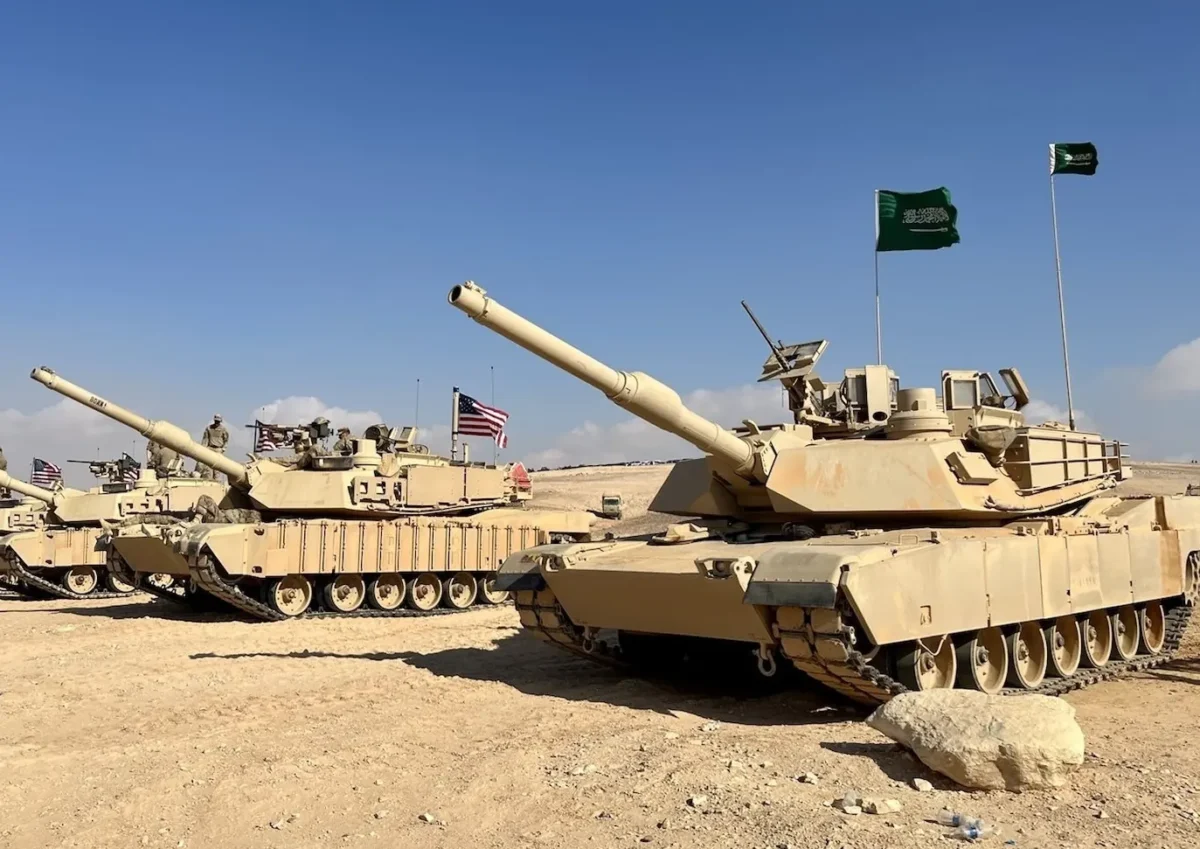
The Strategic Defense Agreement, announced on November 18, 2025, extends far beyond a single arms sale.
It establishes a long-term framework designed to streamline future U.S. arms approvals, accelerate defense industrial cooperation, and position Washington as Saudi Arabia’s core security guarantor.
Key elements of the package include expanded collaboration on defense production, increased U.S. industry participation in Saudi modernization programs, and mechanisms to align future weapons procurement with U.S. standards.
Complementing this security pact are several parallel agreements covering civilian nuclear cooperation, critical mineral development, and artificial intelligence collaboration.
These accords are designed to integrate Saudi Arabia’s broader technological and industrial growth more closely with U.S. ecosystems, ensuring compatibility in high-tech sectors critical to both nations’ strategic interests.
A major milestone within the agreement is Saudi Arabia’s elevation to major non-NATO ally (MNNA) status.
This designation underscores the political weight behind the partnership and opens the door to privileged defense trade, joint training opportunities, and advanced technology transfers that were previously more restrictive.
Although the documents describe the acquisition as “nearly 300 American tanks,” defense industry indicators suggest Riyadh will receive export variants modeled on the modern M1A2 SEPv3 Abrams architecture.
This version provides a major leap in lethality, survivability, and digital integration, featuring:
Saudi Arabia already fields around 575 upgraded M1A2s, equipped with second-generation thermal imaging and improved electronics.
Adding 300 more Abrams tanks will greatly expand the kingdom’s heavy armor capacity, enabling the formation of at least one additional fully-equipped heavy division.
This expansion boosts the Saudi Army’s ability to conduct sustained, high-intensity operations, including along the vulnerable Yemeni border and across key national infrastructure corridors.
The acquisition also accelerates the phased retirement of aging M60A3 Patton tanks, which will be replaced with a more modern, standardized fleet.
Unifying armored forces under a single advanced platform streamlines logistics, improves training efficiency, and enhances interoperability with U.S.-led coalition partners.
The timing of this tank purchase highlights rising regional tensions. Saudi Arabia faces increasing threats from Iranian-backed Houthi forces, who regularly deploy guided anti-tank missiles, drones, and loitering munitions.
Recent conflicts such as those in Ukraine and Gaza show that tank survivability now depends on a combination of reinforced armor, active protection measures, electronic warfare capabilities, and multi-layered air defense systems.
As a result, Riyadh is expected to pursue future upgrades focused on counter-drone capabilities and cutting-edge active protection technologies.
On the global stage, the expanded Abrams fleet positions Saudi Arabia alongside operators of Europe’s top-tier armored vehicles, including Germany’s Leopard 2A7 and France’s Leclerc.
The Abrams’ upgrade potential and crew protection features give Saudi forces a competitive edge in the rapidly evolving armored warfare domain.
Ultimately, this landmark tank deal reinforces the kingdom’s commitment to building advanced, networked ground forces capable of meeting emerging threats across the Middle East.
It clearly demonstrates Saudi Arabia’s resolve to sustain a strong deterrent capability while simultaneously strengthening its strategic alliance with the United States, its key defense partner in a region marked by rising instability.