Follow Us:
Follow Us:


Defense Feeds – Russia Launches Largest 2025 Iskander-M missile attack during an overnight assault on October 16, unleashing hundreds of aerial weapons in one of the most aggressive bombardments of the war.
Ukrainian authorities reported that the large-scale strike targeted the country’s energy facilities, defense infrastructure, and several urban centers, marking one of the most intense air raids of the year.
According to data released by Ukraine’s Air Force, this assault represents the heaviest use of the Iskander-M ballistic missile system in 2025.
It underscores Moscow’s continued effort to weaken Ukraine’s critical energy grid before the onset of winter, forcing Kyiv to divert resources to stabilize power supplies amid freezing conditions.
The attack also reveals Russia’s evolving strategy of combining precision-guided missiles with low-cost strike drones to sustain prolonged offensive pressure.
Ukrainian sources confirmed that 26 Iskander-M (KN-23) missiles were fired in a single attack, representing the most extensive launch since the beginning of the full-scale offensive.
For comparison, earlier record attacks on May 24 and October 10 each involved 14 Iskander-M launches.
The new record nearly doubles those figures, demonstrating Russia’s increasing missile stockpile readiness and production capacity.
Launch data indicated that missiles originated from several directions, including occupied Crimea and Russia’s Kursk and Voronezh regions.
This cross-regional launch coordination, experts say, aims to overwhelm Ukraine’s radar coverage by forcing its air defenses to track simultaneous threats from various trajectories.
In total, 357 aerial threats were recorded during the assault, comprising 320 attack drones and 37 missile launches.
Among them were 28 ballistic missiles, accompanied by two Kinzhal aeroballistic missiles, two Iskander-K cruise missiles, and seven Kh-59 guided air-launched weapons.
The heaviest strikes were concentrated in the Poltava and Kharkiv regions, where missile impacts caused fires at substations, temporary blackouts, and partial disruption of communication networks.
Several emergency crews worked overnight to restore power in affected zones, while local authorities urged civilians to remain in shelters amid fears of follow-up strikes.
Ukrainian air defense systems managed to intercept or neutralize 288 aerial targets, including 283 Shahed-type drones and five Kh-59 guided missiles.
However, some Iskander-M ballistic missiles managed to breach defense lines, striking infrastructure and residential zones.
Ukrainian commanders confirmed direct hits in at least 14 towns and cities, while falling debris caused secondary damage in two additional areas.
A total of 18 missiles vanished from radar tracking, raising concerns among defense analysts of enhanced Russian counter-detection capabilities or the use of radar-evading technology.
Ukrainian officials described the intensity of the assault as “unprecedented” and praised their air defense systems, particularly the mobile Buk-M1 launchers and Patriot batteries, for preventing further devastation.
“Our defensive units continue to repel sustained high-intensity attacks, but this kind of pressure is testing every layer of our air defense network,” a Ukrainian Air Force spokesperson told reporters during a morning briefing.
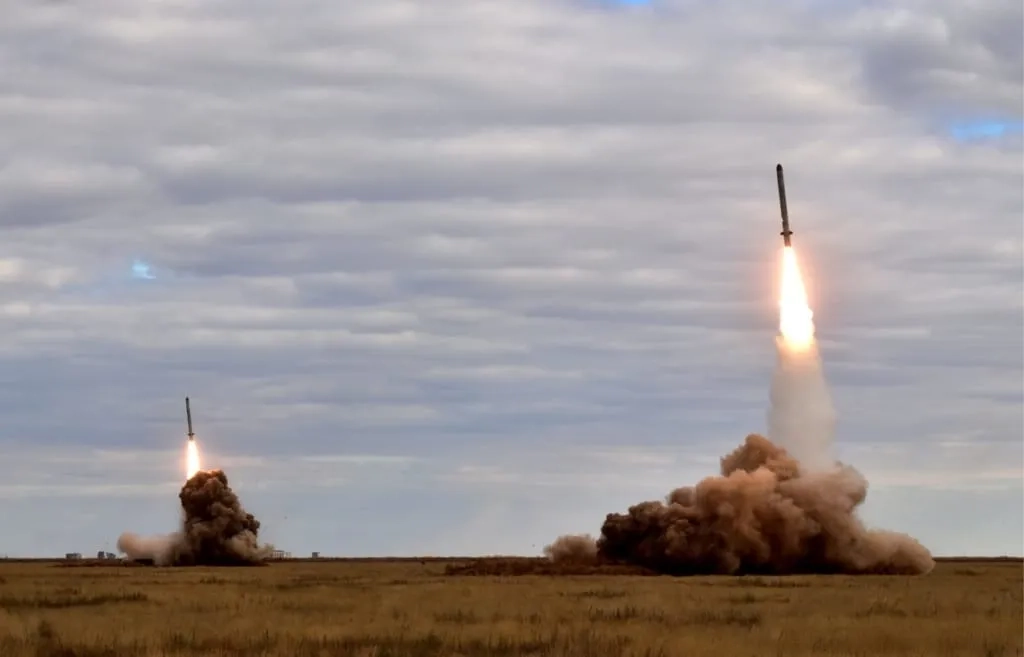
The Iskander-M missile, NATO reporting name SS-26 Stone, is one of Russia’s most advanced tactical systems, capable of carrying conventional, cluster, or bunker-busting warheads beyond 500 kilometers.
Its unpredictable flight path and high maneuverability make it a major challenge for Ukrainian air defenses.
Defense analysts say Russia Launches Largest 2025 Iskander-M strikes to drain Ukraine’s interceptor supply and disrupt energy recovery ahead of winter.
Using both Iskander-M ballistic and Iskander-K cruise missiles, Russia combines fast, high-altitude trajectories with low-flying precision attacks in a hybrid approach that complicates interception.
Together with drone swarms, these mixed strikes create a “saturation effect,” overwhelming detection systems and forcing split-second responses.
Experts also note that Iskander missiles may carry electronic countermeasures, explaining why several vanished from Ukrainian radar during the attack.
Ukraine continues to repel many incoming threats using Buk-M1, NASAMS, and IRIS-T systems, but sustained assaults strain defense resources.
The October 16 barrage marks a new stage of escalation as Russia intensifies long-range warfare to pressure Ukraine’s infrastructure and morale during the critical winter phase.