Follow Us:
Follow Us:


Defense Feeds – Russia has officially introduced the newest variant of its Pantsir air defense system, the Pantsir-SMD-E Drone, at the Dubai Airshow 2025.
This latest model represents Moscow’s most advanced step in counter-drone technology, designed specifically to neutralize small unmanned aerial vehicles (UAVs) that have increasingly threatened modern battlefields.
The debut marks the first public showcase of this variant in the Middle East, reflecting growing regional interest in scalable and modular drone defense solutions.
Russian defense representatives highlighted that the system is optimized for short-range interception of low-flying drones, loitering munitions, and other small aerial threats, including swarming attacks.
The Middle East has become a key market for such systems, as regional militaries face rising drone incursions targeting critical infrastructure, industrial sites, and urban centers.
The Pantsir-SMD-E’s design signals Russia’s intent to offer flexible, high-performance point-defense solutions capable of adapting to evolving aerial threats.
A major change in the Pantsir-SMD-E is its missile-only design. Unlike earlier versions, such as the Pantsir-S1, this variant removes the twin 30mm autocannons, focusing entirely on missile-based defense.
This allows for increased ammunition capacity and greater endurance during high-volume drone attacks.
Operators can configure the launcher to carry up to 48 small TKB-1055 missiles or 12 standard interceptors, providing operational flexibility depending on the threat environment.
The TKB-1055 missile is a compact surface-to-air weapon capable of engaging drones at ranges up to 7 kilometers and altitudes up to 5 kilometers.
Its ability to engage multiple UAV targets simultaneously enhances system efficiency against swarm attacks.
Alongside its updated armament, the Pantsir-SMD-E includes a redesigned radar and optical suite to improve detection and tracking of small, low-RCS (radar cross-section) targets like quadcopters and fixed-wing drones.
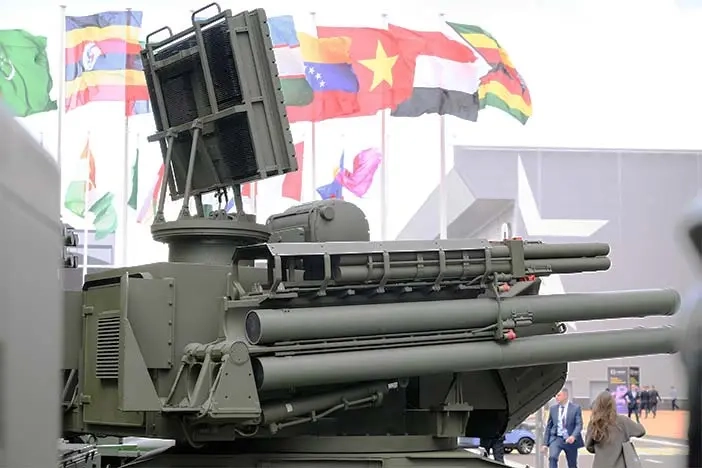
The Pantsir-SMD-E features a modular architecture that allows the radar, command post, and launcher units to be deployed separately while remaining networked via fiber-optic connections.
This distributed setup is particularly valuable for protecting large or irregular areas, including airbases, industrial zones, and urban facilities where drones operate at low altitudes.
The system can also be integrated with wider air defense networks, allowing coordinated responses and improved situational awareness.
This modularity makes the Pantsir-SMD-E adaptable for a variety of deployment scenarios, from rooftop installations to mobile carriers and standalone platforms, increasing its appeal for both military and civilian protection missions.
The development of the Pantsir-SMD-E underscores Russia’s response to the evolving nature of aerial threats.
Conflicts in Ukraine, Syria, and North Africa have demonstrated how inexpensive, mass-produced drones can overwhelm traditional air defenses.
By emphasizing missile-centric, modular systems, Russia aligns with a global trend prioritizing agile, cost-effective counter-UAV solutions.
Defense analysts suggest that the Dubai Airshow debut is also a strategic move to attract international buyers seeking layered drone defense capabilities.
While export pricing and integration vehicles have not yet been disclosed, the system’s compact footprint, scalable architecture, and rapid engagement capabilities make it a strong contender for global markets.
The Pantsir-SMD-E also reflects broader lessons learned from recent conflicts, emphasizing interoperability with existing defense networks and adaptability to emerging aerial threats.
Its modular design allows rapid relocation and deployment in diverse terrains, from urban centers to remote airbases.
Analysts note that, in addition to military applications, such systems may increasingly serve critical infrastructure protection roles.
The unveiling highlights how drone warfare is reshaping defense planning, requiring precision, flexibility, and rapid response—challenges that the Pantsir-SMD-E appears designed to meet.