Follow Us:
Follow Us:


Defense Feeds – The New Sarma 300mm rocket launcher was unveiled by Russian defense manufacturer Motovilikhinskiye Zavody, featuring an upgraded multiple-launch rocket system (MLRS) mounted on an 8×8 KamAZ-63501 chassis.
This new Sarma 300mm rocket launcher variant made its first public appearance during an exposition at the Motovilikhinskiye Zavody plant in Perm on September 20, 2025, highlighting Russia’s efforts to modernize its long-range rocket artillery capabilities.
The new Sarma 300mm rocket launcher comes equipped with six missile tubes on a KamAZ-63501 wheeled truck platform with an armored crew cabin, integrating advanced automated fire-control systems and the ability to fire both guided and legacy rockets.
This combination of mobility, precision, and crew protection enhances its battlefield effectiveness.
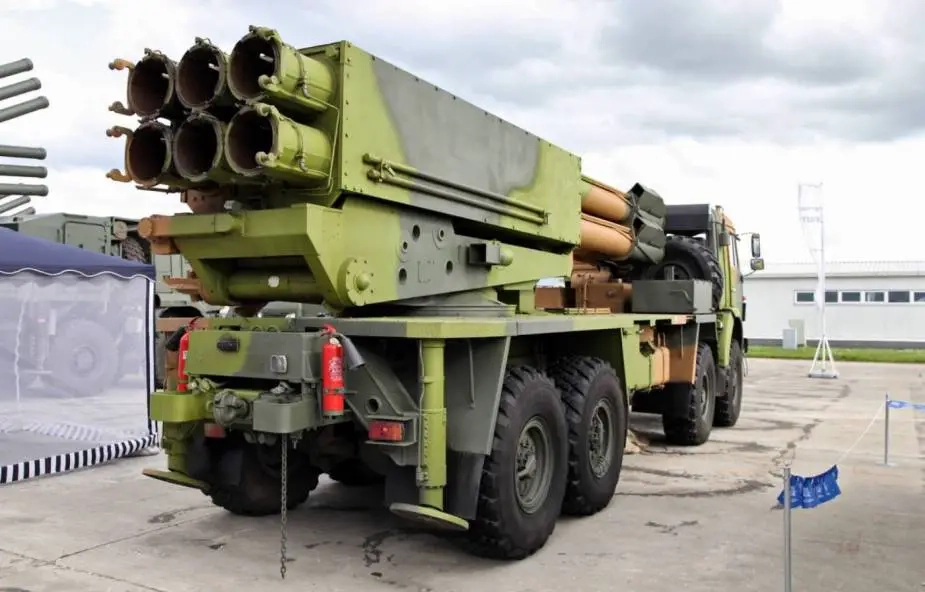
The Sarma MLRS concept derives from Russia’s earlier Kama project initiated in the 2000s. Originally aimed at developing a more agile and lighter 300mm rocket launcher, Kama used KamAZ truck chassis in place of heavier tracked carriers.
This approach prioritized rapid road mobility and operational flexibility over sheer salvo size. Prototypes were publicly shown during events like MAKS 2007, demonstrating containerized missile transport and launch systems with the potential for swift reloads via dedicated transport vehicles.
Though Kama remained experimental, it laid the groundwork for Sarma’s modular launch design.
Parallel modernization efforts—including the Tornado-S upgrade to the Smerch series, Uragan-1M’s bi-caliber rocket containers, and the Vozrozhdeniye dual-caliber system—helped define current Russian practices for unifying transport-launch containers, integrating satellite navigation in guidance, and automating fire-control processes.
These advances enable wheeled vehicles like Sarma to replace heavier tracked launchers by offering shorter firing and displacement times with improved logistical ease.
The Sarma system carries lessons learned: the use of uniform transport-launch containers simplifies logistics regardless of rocket calibre, reducing reload times and aligning better with truck-based maneuver units.
Unlike launchers with 12 tubes on tracked chassis, Sarma’s six-tube configuration favors tactical mobility and crew safety, balancing fewer rockets per salvo with faster shoot-and-move capability to reduce vulnerability to counter-battery fire.
The Sarma variant showcased in Perm rides on a KamAZ-63501 8×8 tactical truck, equipped with an armored cabin designed for enhanced ballistic and fragmentation protection.
Its overall dimensions measure roughly 11.2 meters long, 2.5 meters wide, and 3.15 meters tall, with a ground clearance of about 390 millimeters.
Combat weight falls near 24 tonnes, powered by a KamAZ V8 diesel engine producing around 360 horsepower.
This drivetrain allows the vehicle an on-road operational range close to 1,000 kilometers with a fuel consumption rate near 45 liters per 100 kilometers, ideal for strategic mobility within truck-based maneuver formations.
Sarma is engineered to launch a wide spectrum of Russian 300mm rockets. It remains compatible with legacy 9M55 series missiles offering a firing range near 70 kilometers and newer 9M528 and 9M531 rounds extending reach to about 90 kilometers.
Importantly, Sarma can also fire guided munitions from the Tornado-S family, such as the 9M542, 9M544, and 9M549, which reportedly reach up to 120-130 kilometers.
These precision-guided rockets employ inertial navigation with satellite updates, rotating stabilizers, deployable control surfaces, and programmable autopilot systems to drastically reduce dispersion.
This means Sarma’s smaller salvo volume is offset by striking targets with increased accuracy and range.
To maintain sustained fire missions, Sarma is meant to be supported by dedicated transport-reloader vehicles, which carry additional missile containers for quick reloads.
This setup supports flexible battery organization, where wheeled launchers operate alongside resupply trucks and organic reconnaissance assets to optimize fire distribution across operational theaters.
The design philosophy revolves around improving survivability by enabling rapid emplacement and displacement to lower risks from counter-battery fire.
Future development efforts have also considered expanding launcher tube counts to 10 or 12 rockets on wheeled chassis, if technological challenges related to weight and stability can be managed.
This would combine the mobility advantages of Sarma with higher missile salvo capability.
The unveiling of the Sarma MLRS on the KamAZ-63501 reflects Russia’s focused efforts to modernize its rocket artillery forces by combining precision-guided munitions, modular containerization, and truck mobility.
This system underlines a shift away from relying solely on large tracked launchers toward wheeled platforms that bring enhanced agility and better logistical integration with mechanized units.
By investing in automated fire control and satellite-guided rockets, the Sarma variant improves targeting accuracy and extends engagement range, making it highly relevant for contemporary warfare scenarios where precision and rapid deployment reduce collateral damage and friendly forces’ exposure.
Sarma’s versatile compatibility with legacy and advanced munitions also ensures continuity and flexibility within Russia’s artillery arsenal.
This strategic modernization aligns with ongoing Russian military doctrines emphasizing shoot-and-scoot tactics, precision fire support, and efficient logistics.
The Sarma MLRS fits within broader efforts to field modular rocket systems capable of defending against evolving threats and delivering timely counter-battery responses.
In summary, the new Sarma 300mm multiple launch rocket system mounted on the KamAZ-63501 chassis represents a significant modernization step for Russian artillery.
It highlights the balance between advanced rocket guidance, increased mobility, and operational flexibility that defines current trends in long-range rocket artillery development worldwide.