Follow Us:
Follow Us:


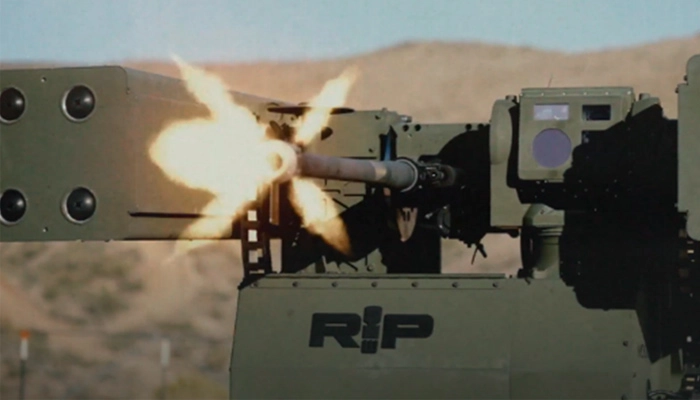
Defense Feeds – Moog Reveals New RIwP Turret at the 2025 AUSA Annual Meeting in Washington, D.C., introducing its lightweight LW RIwP model that expands the Reconfigurable Integrated-weapons Platform family with advanced capabilities.
This innovative turret is specifically designed to fulfill the U.S. Army’s M-SHORAD Increment 4 goals, delivering a combination of adaptability, enhanced firepower, and seamless integration to support modern light combat units effectively.
Manufactured at Moog’s East Aurora facility in New York, the Lightweight RIwP turret suits smaller vehicles such as the Infantry Squad Vehicle (ISV).
Despite its reduced weight, it maintains formidable offensive power with a 30mm cannon and multiple missile effectors.
Thanks to its modular and compact design, the LW RIwP turret offers critical airlift and sling-load transportability, ensuring rapid deployment forces can flexibly operate across diverse mission sets and challenging environments.
The M-SHORAD Increment 4 program is part of the Army’s broader push to modernize its short-range air defense (SHORAD) systems to counter drones, loitering munitions, and low-flying aerial threats.
Moog’s new platform aligns with this objective by providing scalable lethality and modular adaptability for evolving battlefield scenarios.
According to the company, the LW RIwP maintains full compatibility with Moog’s Standard RIwP turret, which is already fielded in M-SHORAD formations.
This design continuity means soldiers can transition seamlessly between variants using the same software, training procedures, and maintenance systems, significantly streamlining logistics while reducing the total cost of ownership.
By integrating these shared systems, the LW RIwP promises a smooth path for sustainment across fleets, ensuring that even the Army’s lightest vehicles gain access to advanced defensive power with fewer logistical bottlenecks.
Moog engineers have built the LW RIwP with priority on fire control precision, ammunition endurance, and mission flexibility.
The system provides an expanded ammunition load, allowing for extended firing periods without frequent reloads, which is crucial in dispersed combat or air defense missions.
The LW RIwP also features advanced targeting technology that enhances accuracy and response time, particularly useful for intercepting fast or low-altitude aerial targets.
Its modular design allows quick integration of alternative weapon systems, sensors, or electronics to match specific mission profiles.
This adaptability allows the same turret system to shift between air defense, ground engagement, or reconnaissance roles, providing commanders flexible tactical options in dynamic environments.
The RIwP family from Moog has proven its battlefield effectiveness through projects such as the SGT Stout and Mobile Low, Slow, Small UAS Integrated Defense System, which aim to safeguard forces from small drones.
The LW RIwP builds upon these combat-proven foundations while reducing overall system weight for faster, lighter applications.
The M-SHORAD Increment 4 effort represents a critical milestone in the Army’s vision of building a layered air defense architecture capable of defeating everything from drones to cruise missiles.
Increment 1 systems, developed by Leonardo DRS and General Dynamics Land Systems, currently deploy on Stryker vehicles armed with Stinger missiles and 30mm autocannons.
Meanwhile, Raytheon and Lockheed Martin continue work on directed-energy and missile-based interceptors for future M-SHORAD enhancements, including laser systems such as DE M-SHORAD and the Lockheed DEIMOS prototype.
These innovations complement Moog’s RIwP turret family by extending protection across multiple threat tiers.
Fielding for the Increment 4 systems is expected around 2030, forming part of a wider network spanning vehicle-mounted interceptors to fixed-base systems like the National Advanced Surface-to-Air Missile System (NASAMS).
Within this layered structure, the Lightweight RIwP is set to strengthen the Army’s lower-tier defense layer by giving lighter, faster vehicles the capability to counter emerging aerial and ground threats effectively.
More than a lightweight upgrade, Moog’s new turret represents a strategic move to integrate modular firepower, system compatibility, and agile maneuverability in next-generation battlefield scenarios.