Follow Us:
Follow Us:


Defense Feeds – The JLTV ZEUS 4 Laser System took center stage at the 2025 Association of the United States Army (AUSA) Annual Meeting when Parsons Corporation introduced this cutting-edge directed-energy weapon.
This system marks a major breakthrough in explosive ordnance disposal (EOD) by offering a faster, safer, and more precise method to neutralize landmines, improvised explosive devices (IEDs), and unexploded ordnance (UXO).
Created through a cooperative research effort with the U.S. Air Force, the JLTV ZEUS 4 Laser System offers a replacement for standard mine clearance methods that depend on explosives or mechanical means by using concentrated fiber laser energy to eliminate threats instantly.
Thanks to this advanced technology, the JLTV ZEUS 4 Laser System greatly enhances route clearance and airfield recovery missions, enabling military forces to quickly restore access in dangerous environments while minimizing risks to personnel.
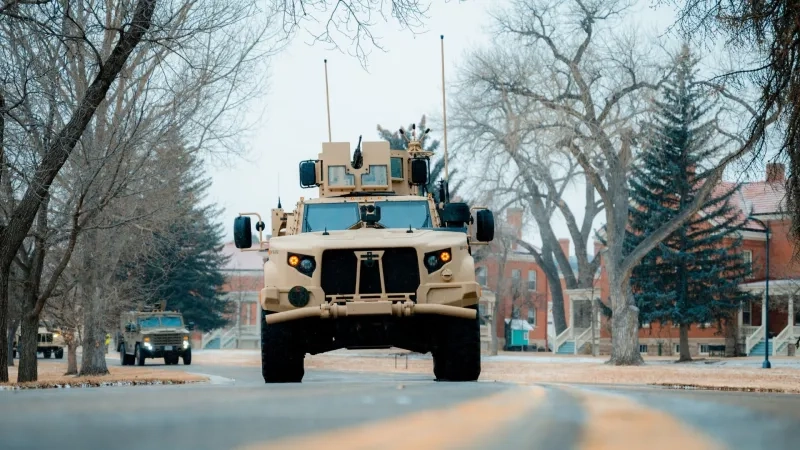
Building on the success of the earlier ZEUS 3, which was mounted on heavier Mine-Resistant Ambush Protected (MRAP) vehicles under the Recovery of Airbase Denied by Ordnance (RADBO) program, the ZEUS 4 introduces transformative improvements in size, weight, and power efficiency.
Developed in collaboration with the U.S. Air Force, the JLTV ZEUS 4 Laser System provides a new approach to mine clearance by using focused fiber laser energy instead of traditional explosives or mechanical tools to swiftly neutralize threats.
The JLTV’s advanced power management architecture sustains the high-energy demands of the laser system without compromising mobility or vehicle performance.
A major enhancement comes from ZEUS 4’s AI-enabled targeting sensor, which autonomously detects, classifies, and prioritizes explosive threats with high precision.
This automation shortens setup times, reduces operator workload, and allows EOD teams to act faster and more safely from stand-off ranges of 25 to 300 meters.
The bolt-on modular design ensures rapid installation and straightforward maintenance, while its compact profile allows the system to operate in confined or contested environments that larger platforms cannot reach.
The ZEUS 4’s architecture also supports future integration onto robotic or unmanned platforms, offering even greater flexibility and safety in future missions.
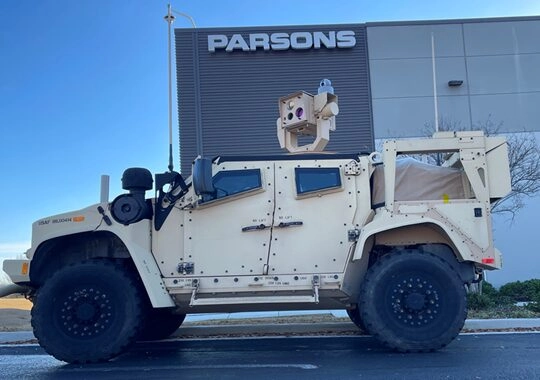
At the core of ZEUS 4 is a high-power fiber laser that directs concentrated energy onto explosive devices, heating their casings until the filler combusts harmlessly rather than detonating violently.
This controlled deflagration method virtually eliminates fragmentation and collateral damage, making it ideal for operations in both combat zones and civilian areas requiring humanitarian demining.
The system has undergone thorough testing in challenging conditions such as extreme temperatures, electromagnetic interference, heavy dust, fog, and rain, demonstrating reliable performance over more than 3,200 kilometers of rough terrain.
The fiber laser’s energy consistency and minimal power loss ensure long mission duration and sustained performance under battlefield conditions.
Parsons’ ZEUS laser systems have already demonstrated a flawless record in the field.
Since their initial deployment under the RADBO initiative, ZEUS units have neutralized more than 5,000 explosive threats, including landmines, artillery shells, rockets, and aerial bombs, without a single safety incident.
Under expanding U.S. Air Force contracts, the company has now deployed 29 operational units, strengthening military readiness and global ordnance-clearance capacity.
Mounted on the JLTV, the ZEUS 4 greatly enhances mission versatility by enabling route clearance, airfield recovery, post-strike area cleanup, and humanitarian efforts in post-conflict zones.
Because the system uses no consumable materials, it greatly reduces logistics complexity and operational costs.
Its intuitive control interface streamlines training and ensures efficient, repeatable performance in high-pressure scenarios.
With ZEUS 4, Parsons Corporation is redefining the future of explosive ordnance disposal.
By combining AI-driven targeting, fiber laser precision, and tactical mobility, the system delivers unmatched speed, safety, and sustainability.
Conflicts evolve and operational demands intensify, advanced directed-energy technologies like ZEUS 4 will be essential in protecting lives, restoring access, and enhancing mission readiness for both military and peacekeeping forces worldwide.