Follow Us:
Follow Us:


Defense Feeds – Israel boosts armored vehicle production through a $1.5 billion defense initiative designed to accelerate manufacturing of its newest tanks and armored personnel carriers.
This program aims to strengthen the capabilities of the Israel Defense Forces by expanding output of key platforms such as the Merkava Mk. 4 Barak tank, Namer APC, and Eitan wheeled armored vehicle.
The Ministry of Defense confirmed the program on August 21, 2025, which comes after months of intense fighting in Gaza during the Swords of Iron campaign, highlighting the urgent need to replenish Israel Defense Forces (IDF) equipment.
At the center of this program are three armored platforms that form the backbone of Israel’s ground forces: The main battle tank Merkava Mk. 4 Barak, the tracked Namer APC, and the 8×8 wheeled Eitan armored vehicle.
Together, these armored systems are designed to reinforce Israel’s ground maneuver capabilities, which have been heavily utilized in recent combat operations.
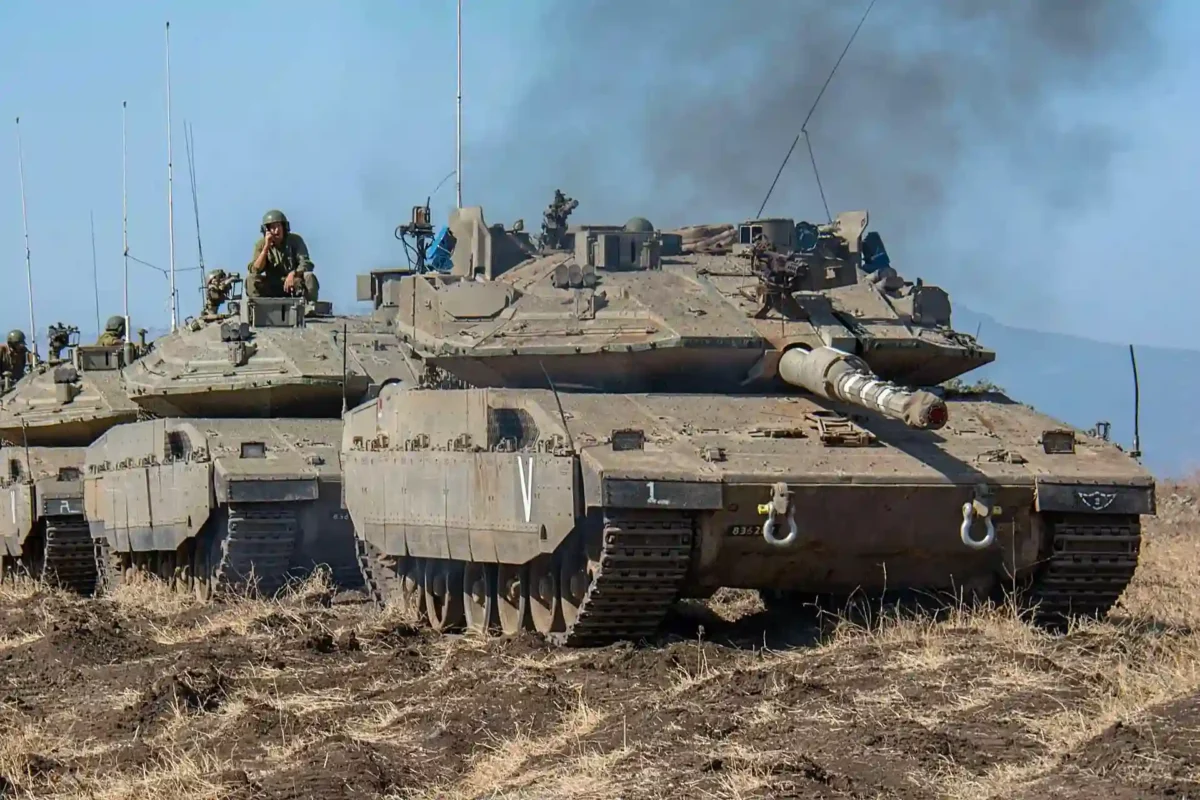
The most recent addition to Israel’s armored forces is the Merkava Mk. 4 Barak main battle tank.
Equipped with advanced situational awareness systems, next-generation optics, and the combat-proven Trophy active protection system, the Barak is engineered to face modern threats ranging from precision-guided missiles to urban ambushes.
Unlike many foreign tanks, the Merkava integrates combat experience directly into its design, creating a platform uniquely adapted to Israel’s operational environment.
The Namer APC, which is based on the Merkava platform, has shown itself to be vital in city combat alongside the tank. Its heavy armor, combined with troop-carrying capacity, enables infantry deployment under fire with minimal risk. T
The vehicle has been a consistent asset in Gaza’s dense and hostile terrain where protecting soldiers during rapid assaults is critical.
The third pillar of the program is the Eitan wheeled APC, Israel’s first modern 8×8 armored vehicle.
Highly agile and lighter in weight, the Eitan enables rapid movement across different types of terrain.
New models feature a remote-controlled turret with a 30mm cannon, allowing forces to conduct reconnaissance and fire support missions with improved flexibility.
Israeli defense sources note that these platforms combined have covered over one million kilometers in combat operations during the last year alone — a figure underscoring the sheer scale of deployment.
By fielding both heavy tracked systems like the Merkava and Namer alongside the lighter Eitan, the IDF aims to balance firepower, survivability, and mobility, creating a versatile force capable of fighting in open desert environments as well as dense urban centers.
The $1.5 billion defense package does more than replenish vehicle numbers. Analysts see it as a broader statement about Israel’s defense doctrine.
The IDF has long relied on maintaining a qualitative military edge over neighboring states and non-state adversaries.
With threats along the Gaza border, simmering tensions in the West Bank, and increasing concerns over Hezbollah’s arsenal in Lebanon, bolstering ground maneuver forces has taken on new urgency.
Since the 2006 Lebanon War, when Israeli armor was challenged by advanced anti-tank missiles, Israel has prioritized active protection technologies and fast integration of battlefield lessons into new vehicle designs.
This iterative philosophy contrasts with the slower procurement cycles common in countries fielding the U.S. Abrams or Germany’s Puma infantry fighting vehicle.
By accelerating Merkava and APC production, Israel ensures its forces are not just replenished, but equipped with state-of-the-art upgrades based on recent operational data. Equally important is the domestic nature of this manufacturing drive.
With global defense supply chains under strain and geopolitical uncertainty heightening, Israel’s choice to rely on its own industry minimizes vulnerability to external restrictions.
Production is spread between the Ministry of Defense’s MANTAK facility and local defense contractors, strengthening the entire Israeli military-industrial ecosystem.
Economists believe the program will provide broad benefits for local suppliers, sustaining thousands of skilled jobs and encouraging technological innovation across the sector.
For now, the plan has government backing but still requires final approval from the Knesset’s Joint Committee for the Defense Budget before contracts are signed.
Once funds are allocated, manufacturing is expected to scale up significantly, enabling the IDF to replace vehicles lost or worn out during the Swords of Iron War while building additional capacity for future conflicts.
Military experts suggest that this investment signals Israel’s intention to maintain heavy armored warfare as a central pillar of its defense strategy, at a time when other nations are shifting resources toward drones, sensors, and long-range precision strike.
While those technologies remain critical for Israel as well, the past year has demonstrated that enduring ground operations still rely heavily on armored firepower and protected mobility.
The ramp-up in Merkava, Namer, and Eitan vehicle production shows Israel’s focus on preparing for protracted and intense ground fighting.
Beyond the battlefield, the move sends an unmistakable signal to adversaries: despite the cost of recent operations, the IDF will not only recover but emerge with greater capacity than before.zed in recent combat operations.